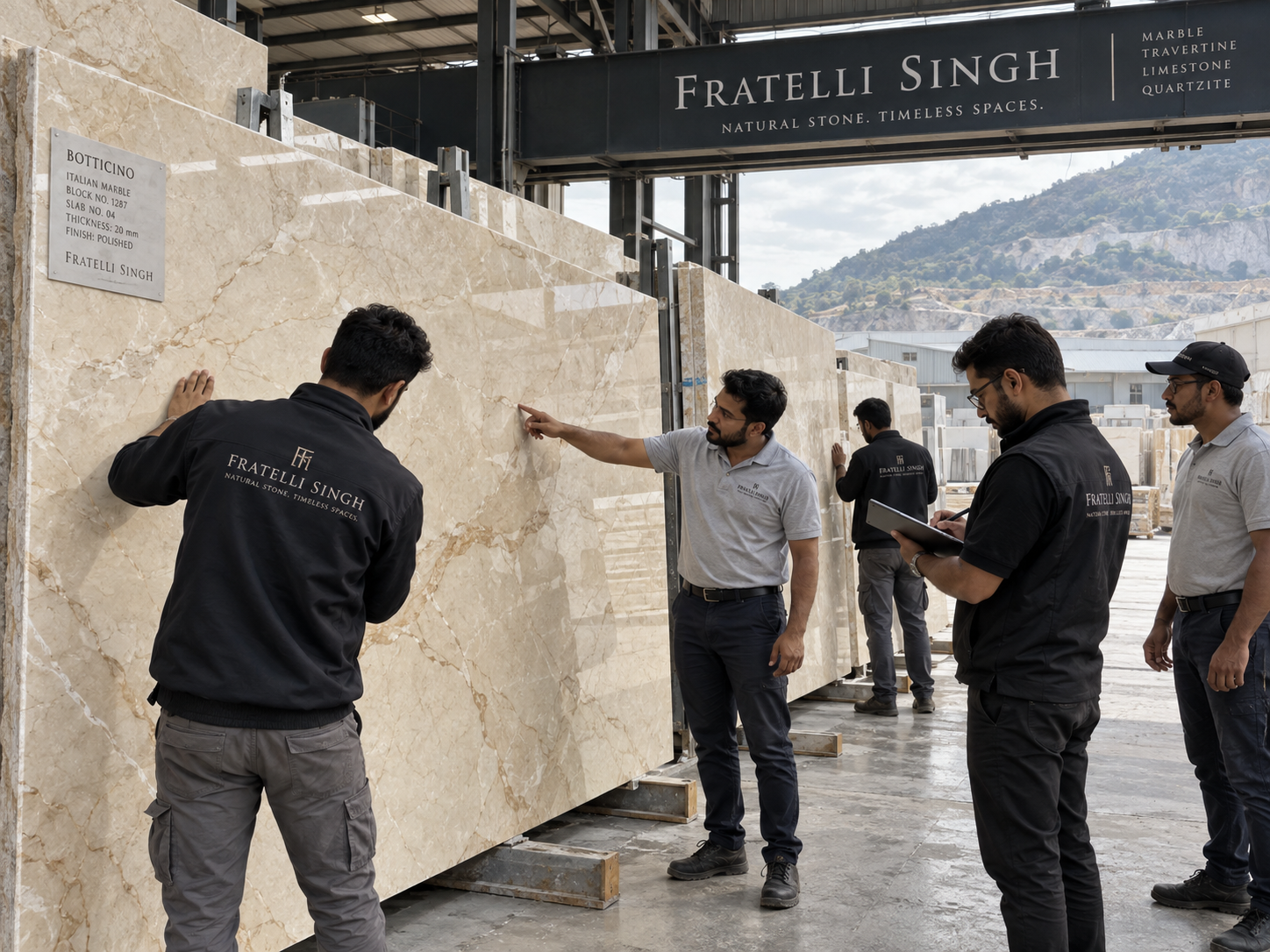
The most important rule: inspect the actual slabs, not only the marble name printed on a catalogue or invoice. A good slab is not necessarily the one with the fewest veins; it is the one that is structurally suitable, visually appropriate and correctly prepared for the intended project.
Quick answer
Start with these 12 slab checks.
Before buying Italian marble, examine the stone as a complete slab and then compare the selected group together.
| Check | What to look for |
|---|---|
| 01. Marble identity | Correct variety, origin information where applicable and overall character |
| 02. Background tone | Suitable colour and consistency for the intended interior |
| 03. Vein movement | Natural movement that suits the design and adjoining slabs |
| 04. Cracks and fissures | Natural characteristics separated from structural concerns |
| 05. Resin treatment | Neat, integrated treatment without distracting patches or depressions |
| 06. Mesh backing | Correctly applied reinforcement where it is required |
| 07. Surface polish | Clarity, evenness and reasonably consistent reflection |
| 08. Flatness | No excessive bowing or warping for the application |
| 09. Thickness | Consistency across the slab and suitability for fabrication |
| 10. Dimensions | Enough usable area after trimming for the actual layout |
| 11. Edge condition | Chips, breaks and cracks that may reduce usable perimeter |
| 12. Lot consistency | Multiple slabs that work together without forced uniformity |
Natural stone cannot realistically be judged using exactly the same standards as factory-made porcelain. The purpose of inspection is to understand the material and select it intelligently.
01–02 — Confirm the marble and examine the background tone.
Before discussing polish or price, confirm what stone you are actually looking at: the marble variety, country or origin information where applicable, general visual characteristics, finish, available selection and slab dimensions. Similar colours can appear across different commercial names, so do not judge Italian marble only from a printed label.
Stand approximately 2–4 metres away from the slab before moving closer. From a distance, ask whether the background feels warm or cool, whether the colour is balanced, whether there are unexpected patches, whether the neighbouring slabs work with it and whether it suits the intended interior.
The distance test
3 metres away
Judge the overall appearance and whether the slab feels right for the room.
1 metre away
Study veins, colour transitions and the relationship between background and movement.
Close inspection: check the surface treatment, fissures, resin, polish and finishing after you understand the overall slab.
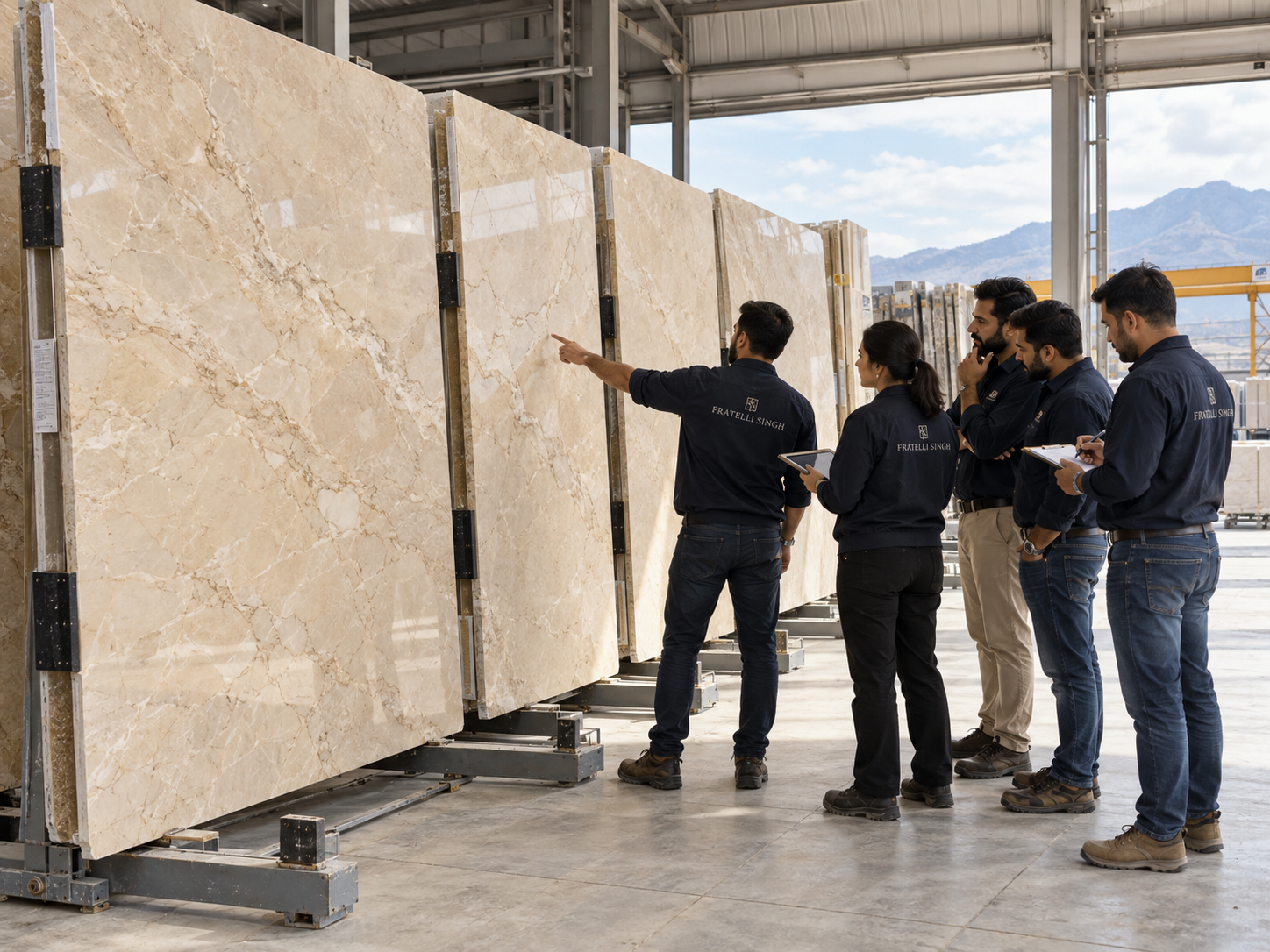
03–04 — Understand veins, fissures and cracks.
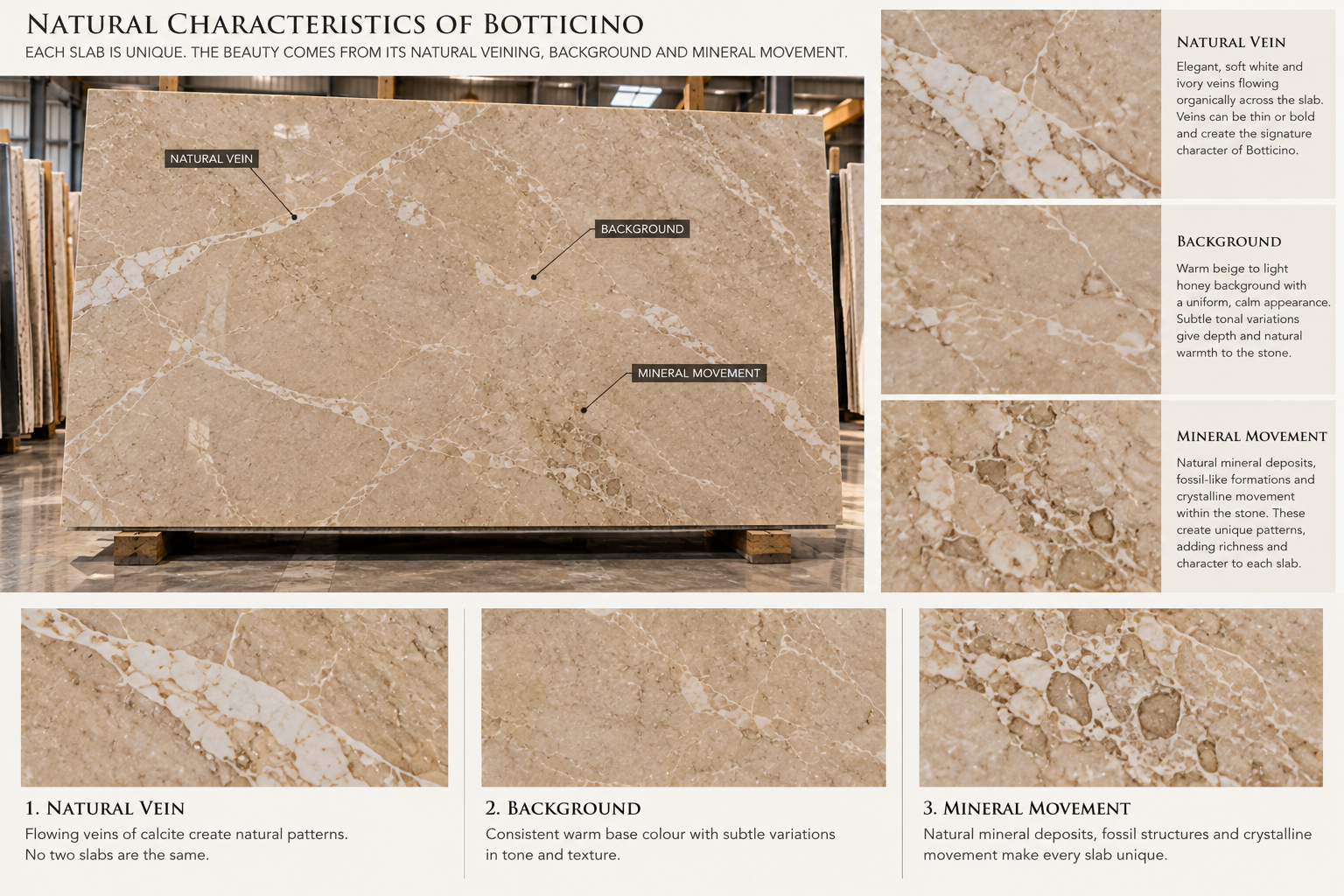
Veining is not automatically a defect. Natural Italian marble contains mineral movement formed by geological processes, and veins give the stone much of its character. The important questions are whether the pattern is aesthetically acceptable, structurally stable, appropriate for the application and compatible with adjoining slabs.
| Feature | Usually visual? | Can affect structure? | Needs inspection? |
|---|---|---|---|
| Natural vein | Yes | Usually limited | Yes |
| Mineral marking | Yes | Usually limited | Yes |
| Fissure | Yes | Sometimes | Definitely |
| Crack | Yes | Yes | Definitely |
| Edge chip | Yes | Depends on cutting plan | Yes |
| Resin-filled area | Yes | Depends on treatment | Yes |
Natural vein: a visual mineral line or pattern. Natural fissure: a geological separation that may be stable, treated or reinforced. Crack: a structural break that deserves closer examination because it can influence fabrication or installation.
05–07 — Review resin, mesh and polish.
Many natural marble slabs undergo resin treatment. Resin should not automatically be treated as evidence of poor stone; it can be part of normal processing where natural pores, fissures or surface characteristics are treated before polishing. What matters is how well the treatment has been done.
- Look for excessive visible patches, discoloured resin, uneven filling or surface depressions.
- Turn the slab over where practical and ask why fibreglass mesh reinforcement was used.
- Check whether treatment and reinforcement were applied consistently and professionally for the intended application.
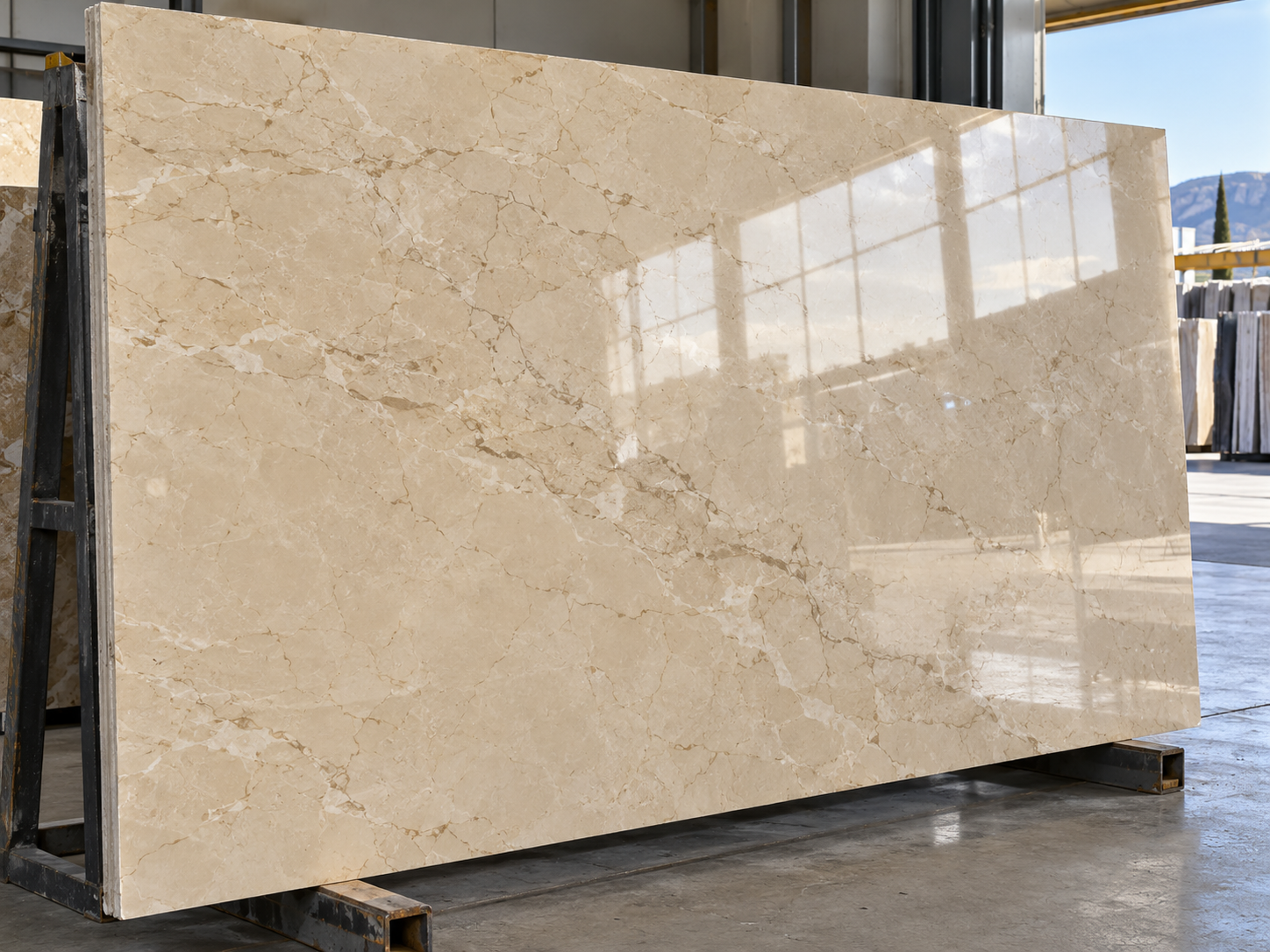
The reflection test
Stand beside the slab and observe a window, overhead light or straight structural line reflected in the surface. Move sideways. If the reflection changes dramatically or appears highly distorted in isolated areas, inspect the surface more carefully. This is a useful buyer check, not a substitute for professional quality control.
08–10 — Check flatness, thickness and usable dimensions.
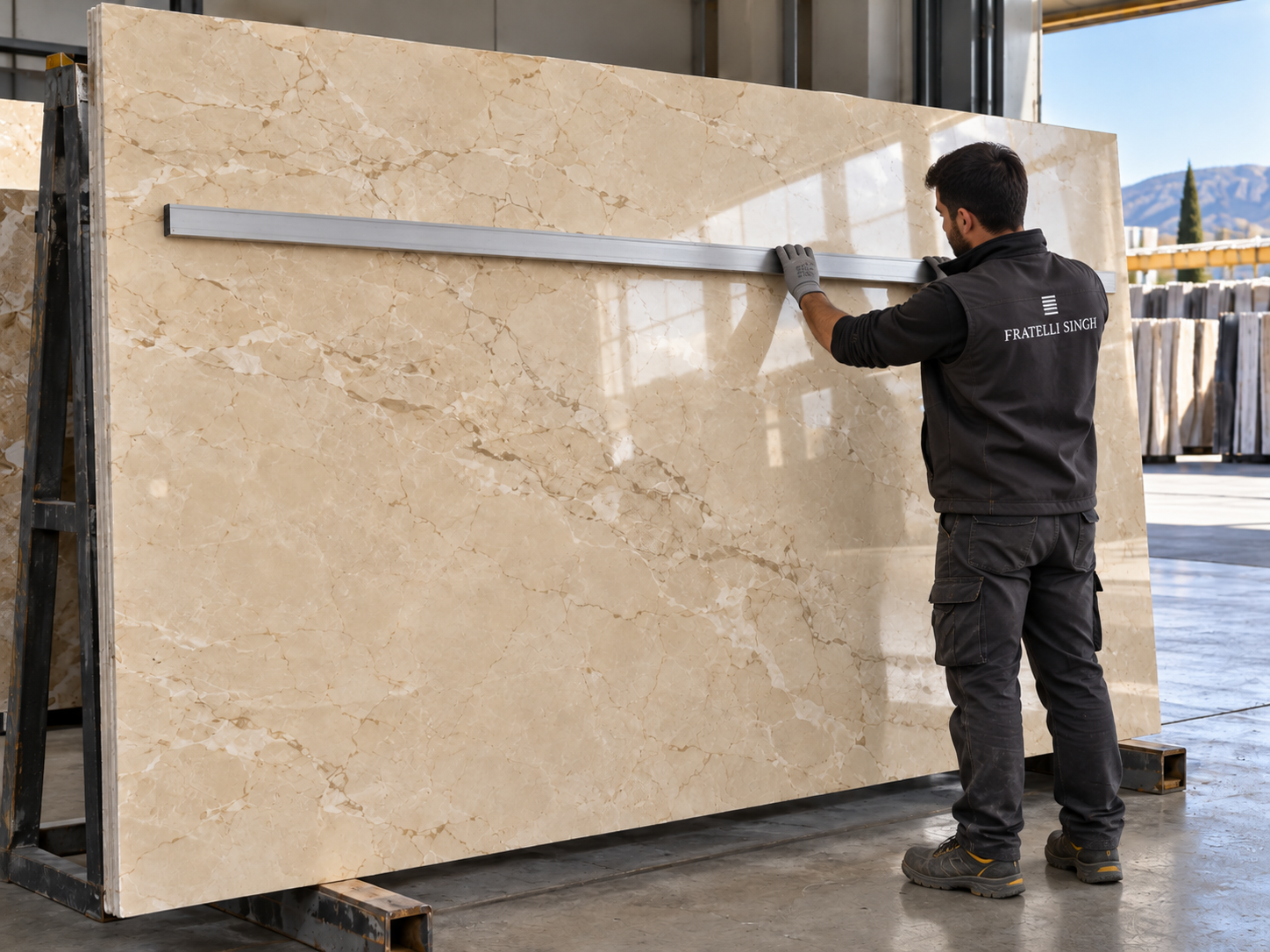
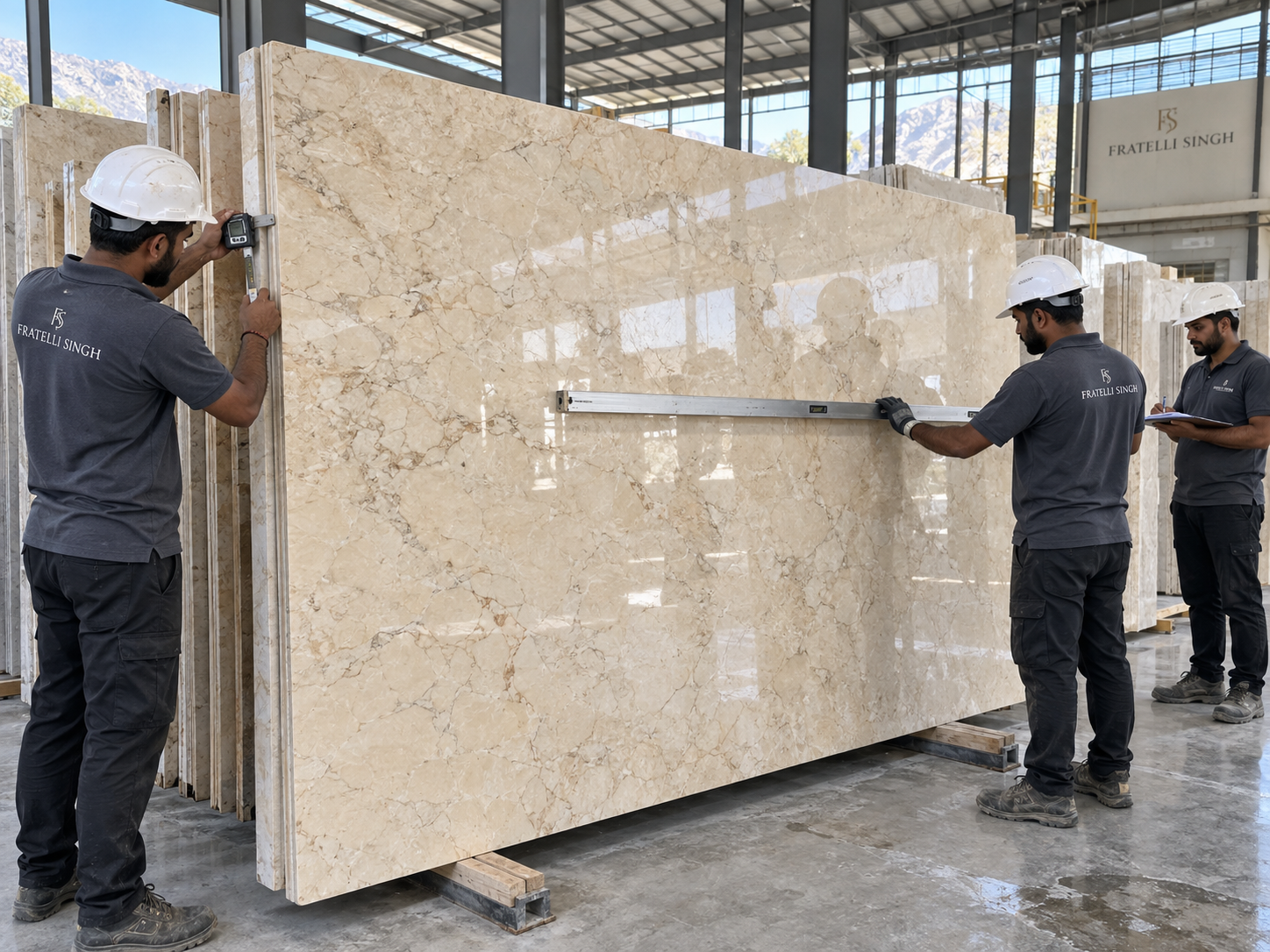
Flatness is relevant for large-format flooring, wall cladding, countertops, tables and precision fabrication. A straightedge or suitable measuring method can be used during technical inspection to identify excessive bowing or warping.
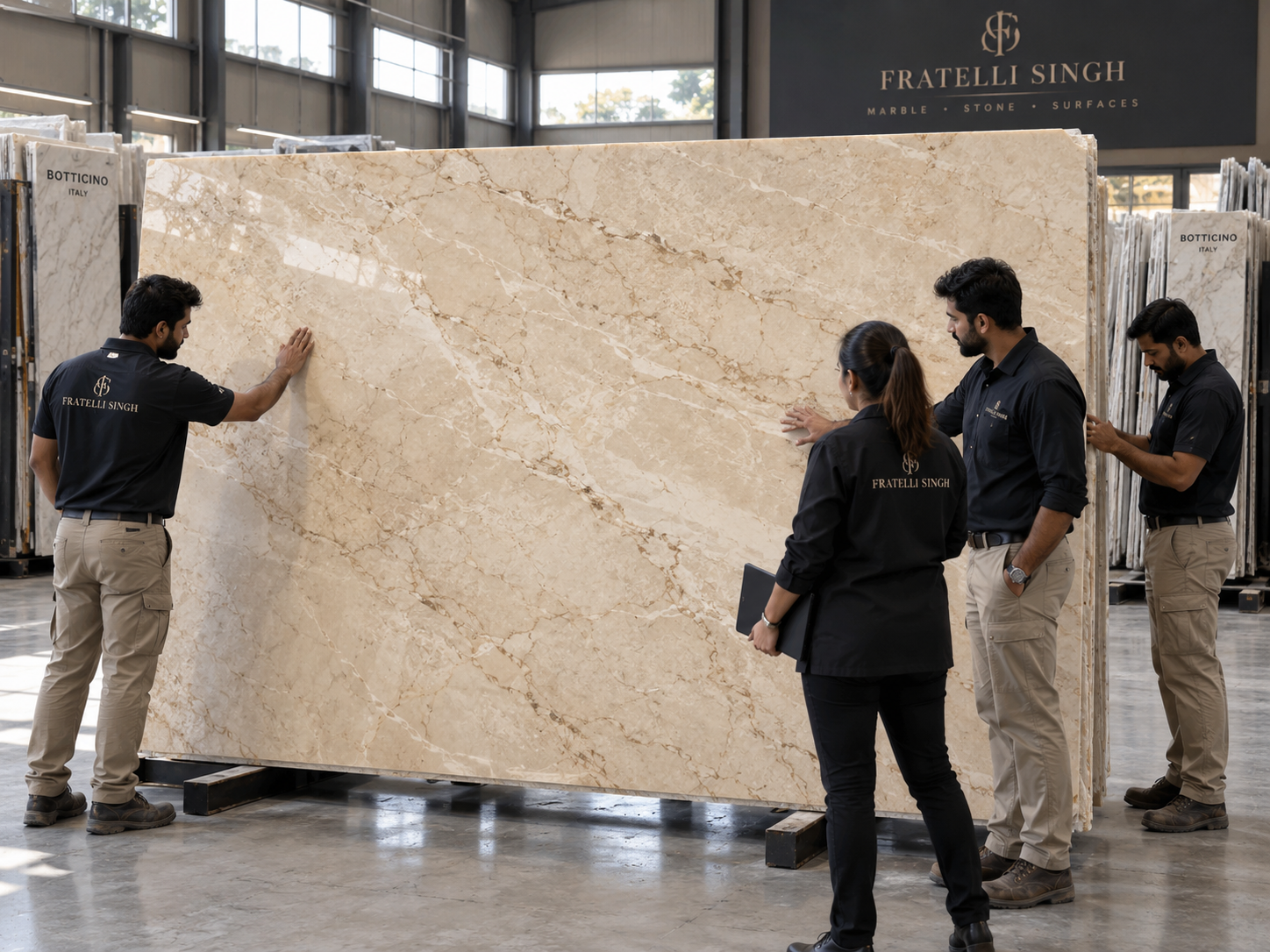
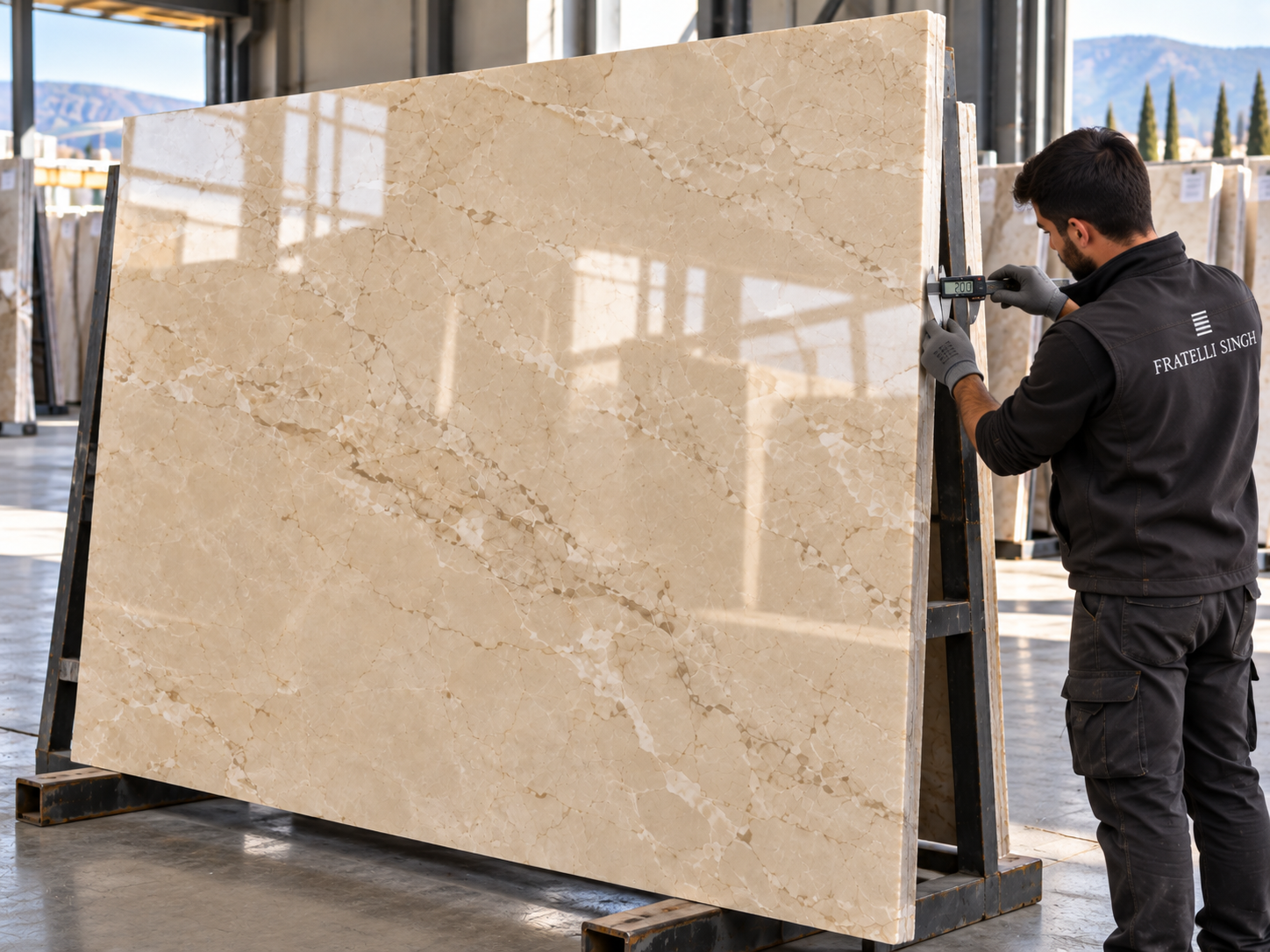
Do not assume every slab is exactly the same thickness. Thickness influences fabrication, flooring levels, stair detailing, edge profiles and installation planning. Measure at multiple points with an appropriate thickness gauge or calliper, and record the actual thickness rather than only the nominal specification.
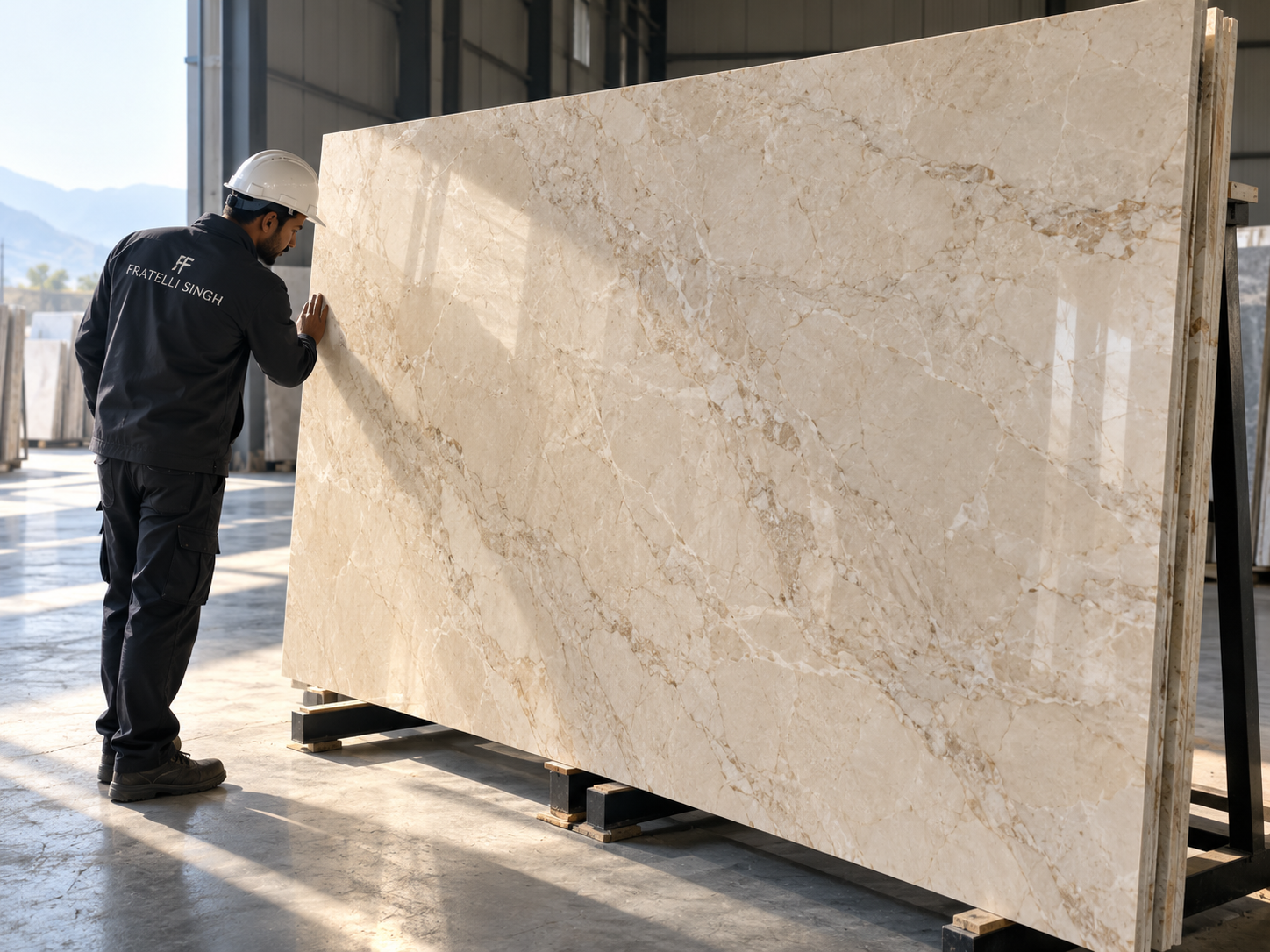
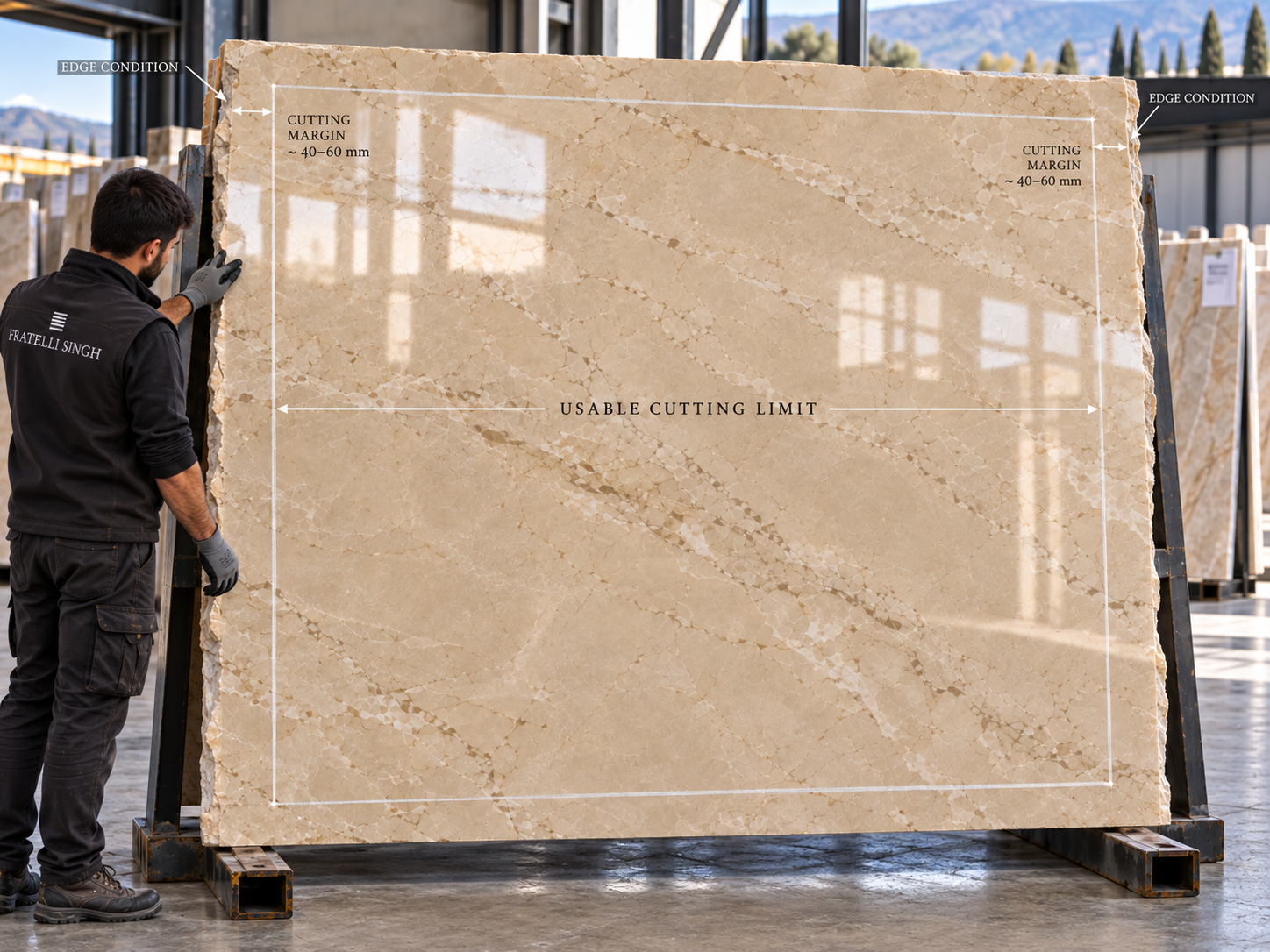
Record length × width × thickness for the slabs being considered. A slab may measure 10 ft × 6 ft, or 60 sq. ft. in theory, but a damaged edge can reduce its practical usable area. Plan from usable stone for the intended layout, not only gross area.
11 — Check the edges
Inspect for chipping, cracks extending inward, irregular breaks, weak corners and handling damage. Some edge damage may disappear during trimming; the important question is whether usable dimensions remain sufficient after trimming.
12 — Inspect the whole lot, not just one slab.
If a project requires 2,500 sq. ft., one excellent slab tells you very little. The real quality question becomes: do the slabs work well together as a set? Place multiple slabs side-by-side and compare background, veining, polish, thickness, dimensions and natural variation.
| Lot check | What to compare |
|---|---|
| Background | Similar overall tone without forcing identical appearance |
| Veining | Compatible visual movement and direction |
| Polish | Consistent surface appearance |
| Thickness | Compatible for the installation and fabrication |
| Dimensions | Suitable for the project layout |
| Natural variation | Acceptable harmony across the project |
Quality depends on the application.
The same slab may be evaluated differently depending on how it will be used. A dramatic slab may be perfect for a feature wall but inefficient for repetitive flooring. A calmer, consistent group may be more valuable for a large villa floor.
| Application | Priority during selection |
|---|---|
| Large flooring | Lot consistency, dimensions, thickness, usable area |
| Staircase | Thickness, edge integrity, vein direction and tread length |
| Feature wall | Pattern, visual impact and consecutive slab movement |
| Dining table | Central usable area, surface finish and pattern placement |
| Vanity | Suitable cut area, polish and opening locations |
| Wall cladding | Flatness, dimensions and installation planning |
| Bookmatching | Consecutive slab pattern and directional compatibility |
Flooring, stairs and feature walls
For flooring, prioritise a compatible lot, adequate dimensions, thickness consistency, suitable vein movement, usable area and finish. For stairs, check edge integrity, thickness, cutting length, vein direction, matching across treads and landing dimensions. For feature walls, stronger veins, dramatic movement, sequential slabs and bookmatched pairs may be desirable.
A professional inspection sequence.
At Fratelli Singh, a clear way to think about slab selection is to move from identification to application fit rather than jumping directly to a rate.
- Identify
- View full slab
- Compare lot
- Check surface
- Check structure
- Measure dimensions
- Check thickness
- Match application
- Plan cutting
- Finalise selection
Red flags worth investigating.
Do not immediately reject a slab, but ask questions if you see major cracks extending deeply, severe bowing, large unexplained repair patches, inconsistent finishing, significant thickness variation, damaged edges reducing usable size, dramatically different shades within a supposedly matched lot or defects exactly where major cut pieces are required.
The right response is investigate, not panic. Natural stone inevitably contains natural characteristics, and the supplier or fabricator should explain what you are seeing and how it affects the intended application.
Why buying only from photos is risky.
Photos are useful for shortlisting but less reliable for final judgement. Camera exposure changes colour, white balance changes warmth, lighting changes vein visibility, compression hides small details, screen brightness varies, perspective hides flatness and scale is difficult to judge.
For significant projects, inspect the actual slabs wherever practical. Ask whether all the slabs being supplied can be viewed, whether they are from the same or a compatible lot, what the actual thickness is, which areas the fabricator should avoid and whether the slabs can be laid out before cutting.
A 60-second buyer test.
Before approving a slab, ask yourself one question every ten seconds:
If one answer is uncertain, inspect further before finalising.
Do not judge marble using these five myths.
Myth 1 — More veins means lower quality.
Not necessarily. Veining is a natural characteristic. The question is whether it is aesthetically desirable and structurally acceptable.
Myth 2 — Any resin means the marble is bad.
Incorrect. Resin treatment can be part of normal stone processing. Quality depends on the material, treatment and intended use.
Myth 3 — The cleanest slab is always best.
Not for every marble. Botticino is valued for a different character from expressive white-veined marble.
Myth 4 — Every slab should look identical.
Natural variation is expected. The objective is controlled selection and compatibility, not artificial repetition.
Myth 5 — Higher price automatically means better marble.
Price can reflect rarity, dimensions, demand, processing, selection and availability. Inspection is still necessary.
Quality versus appearance.
A slab can be structurally good but visually unsuitable for the customer’s design. It can also be visually beautiful but difficult for a particular application. The best choice is a slab that is both structurally and visually suitable for the intended project.
How Fratelli Singh approaches marble quality.
Quality should not be presented as a vague marketing claim. A stronger approach is to show the process:
- Block-level understanding: the character of the slab begins before polishing, so the original block provides useful context.
- Controlled cutting: thin-wire cutting converts the block into slabs while aiming for dimensional consistency and efficient material utilisation.
- Slab-level inspection: each finished slab should be considered individually rather than assuming every slab from a block appears identical.
- Surface review: finish, visual clarity and natural characteristics are reviewed before selection.
- Lot comparison: larger projects benefit from assessing multiple slabs as a group.
- Project-based selection: the right stone depends on whether it is being used for flooring, stairs, walls or customised fabrication.
Before you approve a slab
Interactive buyer checklist.
The most important rule.
Italian marble is not a manufactured sheet. It should have natural individuality. The aim of quality checking is not to find a slab with zero natural characteristics; it is to understand what is natural, identify what could affect performance and select slabs whose structure, finish, dimensions and appearance suit the intended project.
Buy the slab you have actually inspected—not simply the marble name printed on the invoice.
Clear answers
Frequently asked questions.
How can I tell if Italian marble is good quality?
Check the complete slab for background tone, vein movement, structural condition, resin treatment, polish, flatness, thickness, dimensions, edge condition and compatibility with the other slabs being selected.
Are veins in Italian marble a defect?
No. Veining is a natural characteristic of marble. Structural cracks or unstable fissures should be evaluated separately from normal mineral veins.
Is resin-treated marble bad quality?
Not necessarily. Resin treatment can be part of normal natural-stone processing. What matters is the quality of the treatment and whether the finished slab is suitable for its intended application.
Why is mesh attached to some marble slabs?
Fibreglass mesh may be used to reinforce certain slabs during processing and handling. Its presence alone does not determine whether the stone is good or bad.
How do I check marble polish?
View the slab under natural or overhead light and inspect reflections across different parts of the surface. Look for reasonable consistency rather than isolated dull or uneven areas.
How do I check marble thickness?
Thickness can be measured using a suitable calliper or thickness gauge at multiple points along the slab.
Should all Italian marble slabs have exactly the same colour?
No. Marble is natural stone and variation is normal. For large projects, the selected slabs should create a harmonious overall appearance.
Should I choose marble from a small sample?
Samples are useful for an initial colour reference, but full slabs should be viewed before significant purchases because they reveal the complete pattern, dimensions and natural characteristics.
Does expensive marble always mean better quality?
No. Price can depend on rarity, demand, dimensions, selection and availability. Quality should still be assessed independently.
How do I choose marble for large flooring areas?
Prioritise lot matching, slab dimensions, thickness consistency, usable area and overall visual continuity across multiple slabs.
What is more important: marble variety or slab quality?
Both matter, but after selecting a variety, the quality and suitability of the actual slabs become critical to the finished project.
Can Fratelli Singh help inspect slabs before finalisation?
Ask the Fratelli Singh team about current slab selection, lot comparison, dimensions, surface characteristics and application-based selection for your project.
Want help comparing a real lot?
Share your application, approximate quantity, preferred marble and delivery city. The Fratelli Singh team can help you ask the right questions before finalising the selected slabs.
Request assistance ↗