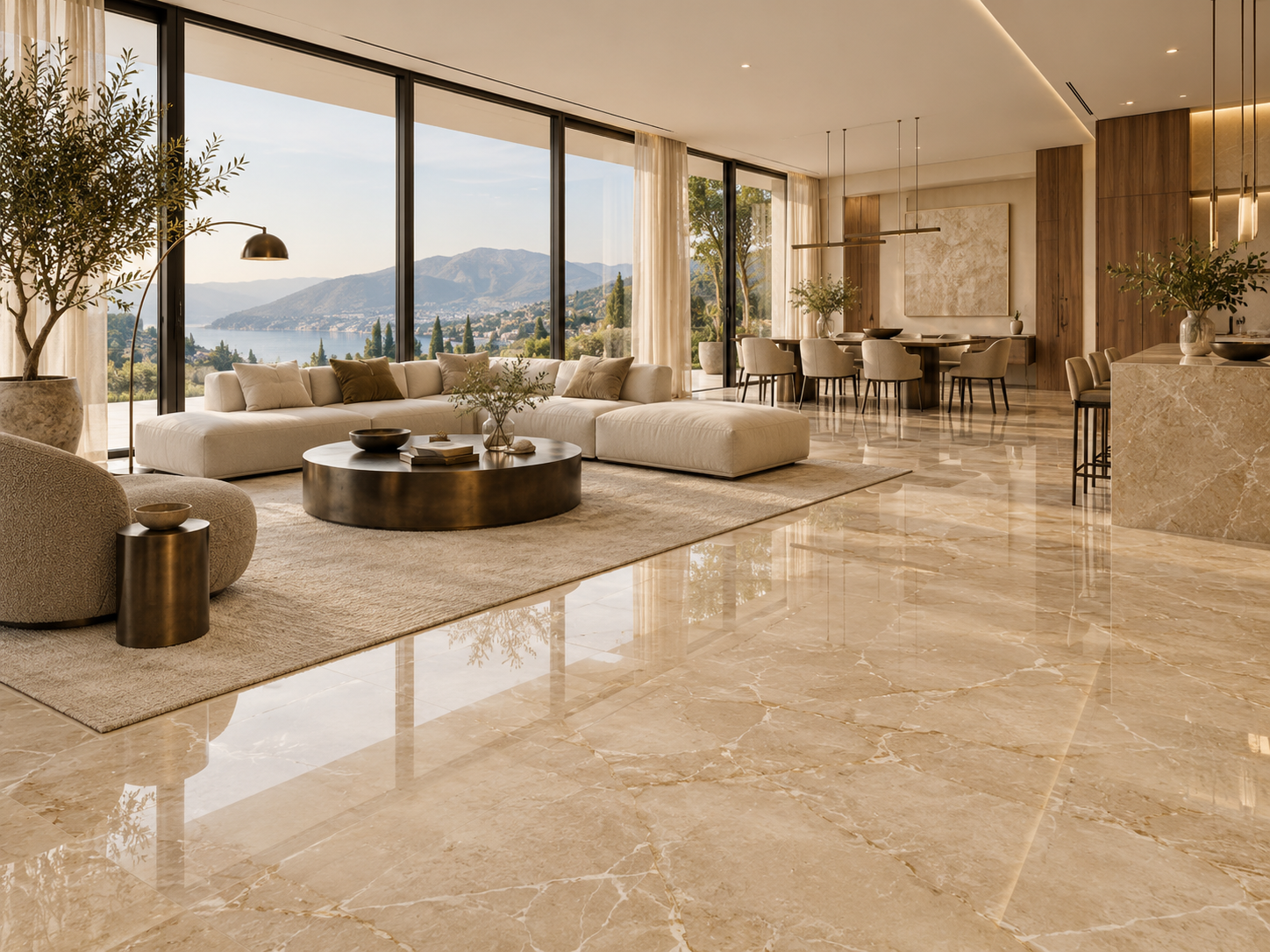
Quick answer: for a large Italian marble floor, judge the group of slabs—not only one beautiful piece. Prioritise lot and shade consistency, usable dimensions, vein movement, thickness, finish, layout direction, lighting and the final cutting plan.
Quick answer
What should you check first?
A feature wall might use four slabs. A villa floor may require forty, sixty or even more. The right floor therefore depends on a coordinated selection, not only on choosing a marble name.
| Priority | What to check |
|---|---|
| 01 | Lot and shade consistency |
| 02 | Slab dimensions and usable area |
| 03 | Vein movement and direction |
| 04 | Thickness consistency |
| 05 | Surface finish and polish |
| 06 | Layout direction and cut sizes |
| 07 | Cutting efficiency and wastage |
| 08 | Lighting conditions |
| 09 | Required quantity and compatible reserve |
| 10 | Installation and transition planning |
Start with the interior, not the marble name.
Many customers begin with, “I want Botticino.” A better process begins with, “What should this room feel like?” Decide whether the space should feel warm and understated, bright and contemporary, highly patterned, calm and uniform, traditional or minimal. Then choose a stone and lot that support that direction.
Warm and soft
Botticino and cream-beige marble can create a timeless, comfortable and understated architectural base.
Bright and contrasted
White marble with grey movement can create a contemporary, more dramatic and higher-contrast floor.
Neither direction is automatically superior. They create different spaces, and the right choice depends on the architecture, lighting, furniture and the way connected rooms should flow together.
For large floors, shade consistency matters more.
A 4 × 4 ft sample can look beautiful, but a sample cannot show how the tone will repeat across 3,000 sq. ft. If half the slabs are noticeably warmer than the other half, the difference may become obvious after installation. Large flooring projects should therefore be judged as a lot, not slab-by-slab in isolation.
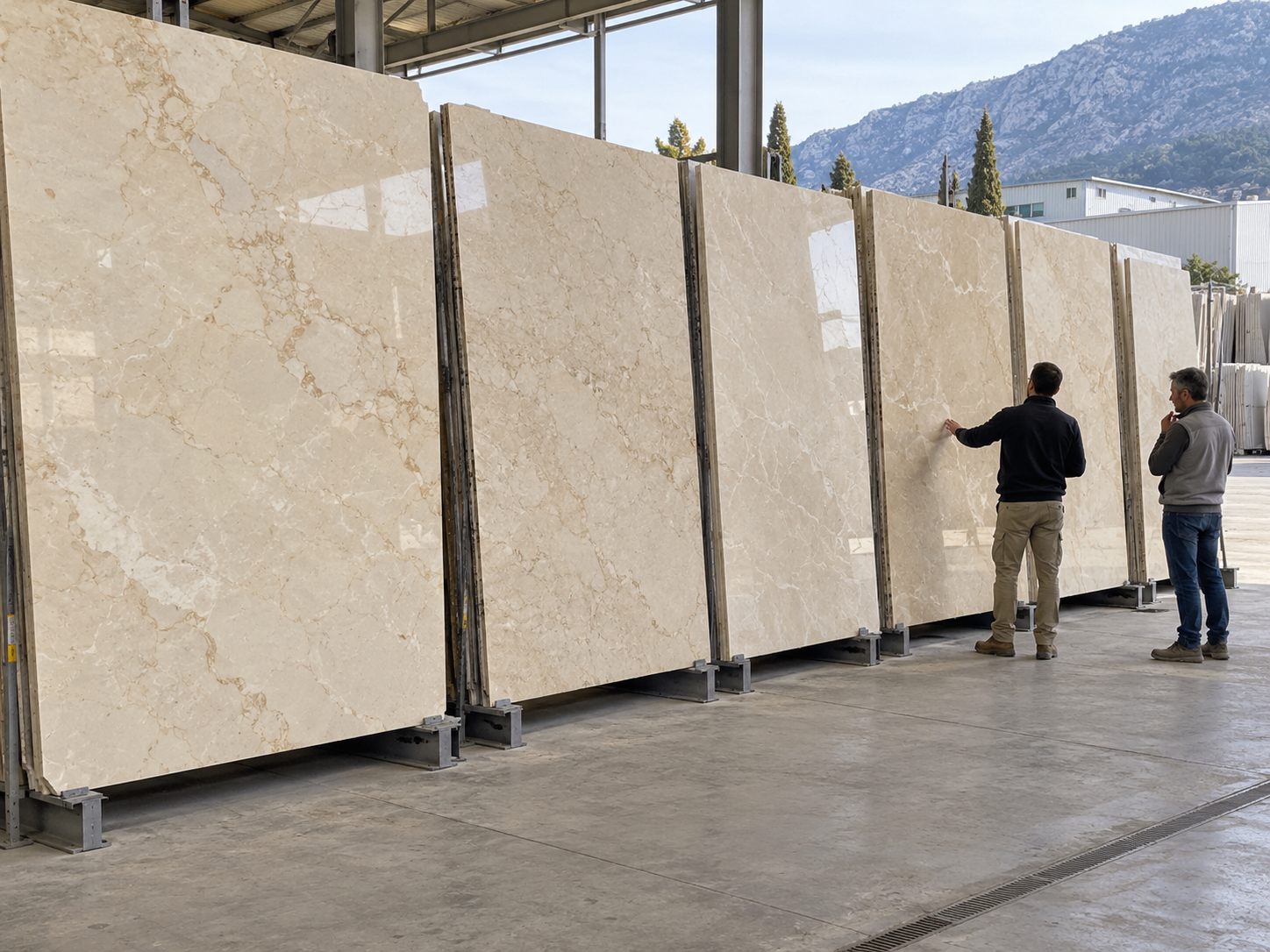
Look at the slabs from a distance.
Stand several metres away to judge overall shade, large vein movement, balance and slab-to-slab compatibility. Then move closer for surface inspection. Do not begin by focusing on tiny natural marks; for flooring, the overall composition matters more.
Slab size changes the final floor.
Large usable slabs can provide more flexibility for floor layouts, long corridors, staircase connections and fewer visual joints. Smaller usable slabs may create more joints, smaller cut pieces, higher wastage and more difficult pattern matching. Compare usable dimensions, not simply price per square foot.
| Factor | Larger usable slabs | Smaller usable slabs |
|---|---|---|
| Number of joints | Often fewer | Often more |
| Layout flexibility | Higher | Lower |
| Large pieces possible | Yes | More limited |
| Pattern continuity | Easier to control | Requires more planning |
| Cutting efficiency | Often better | Depends on room geometry |
| Visual scale | More expansive | More segmented |
This does not mean bigger is always better. The correct dimensions depend on the actual room, desired cut sizes, columns, thresholds and the way the floor connects to other spaces.
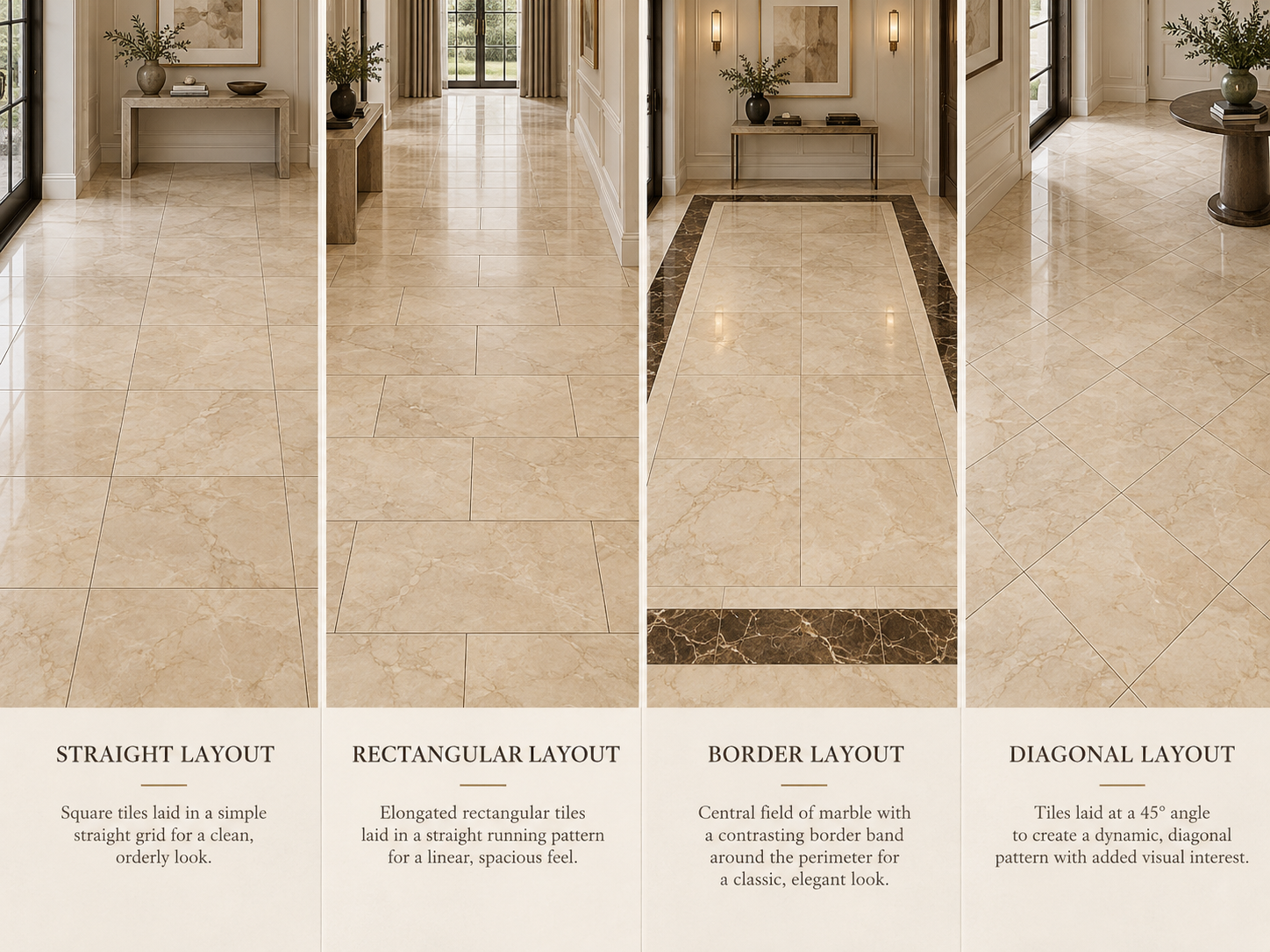
Decide the flooring layout before cutting.
The same marble can look very different depending on how it is laid. Common options include a straight grid, large rectangular pattern, running pattern through corridors, a border layout or a diagonal layout. Diagonal layouts can be visually dynamic but generally involve more cutting.
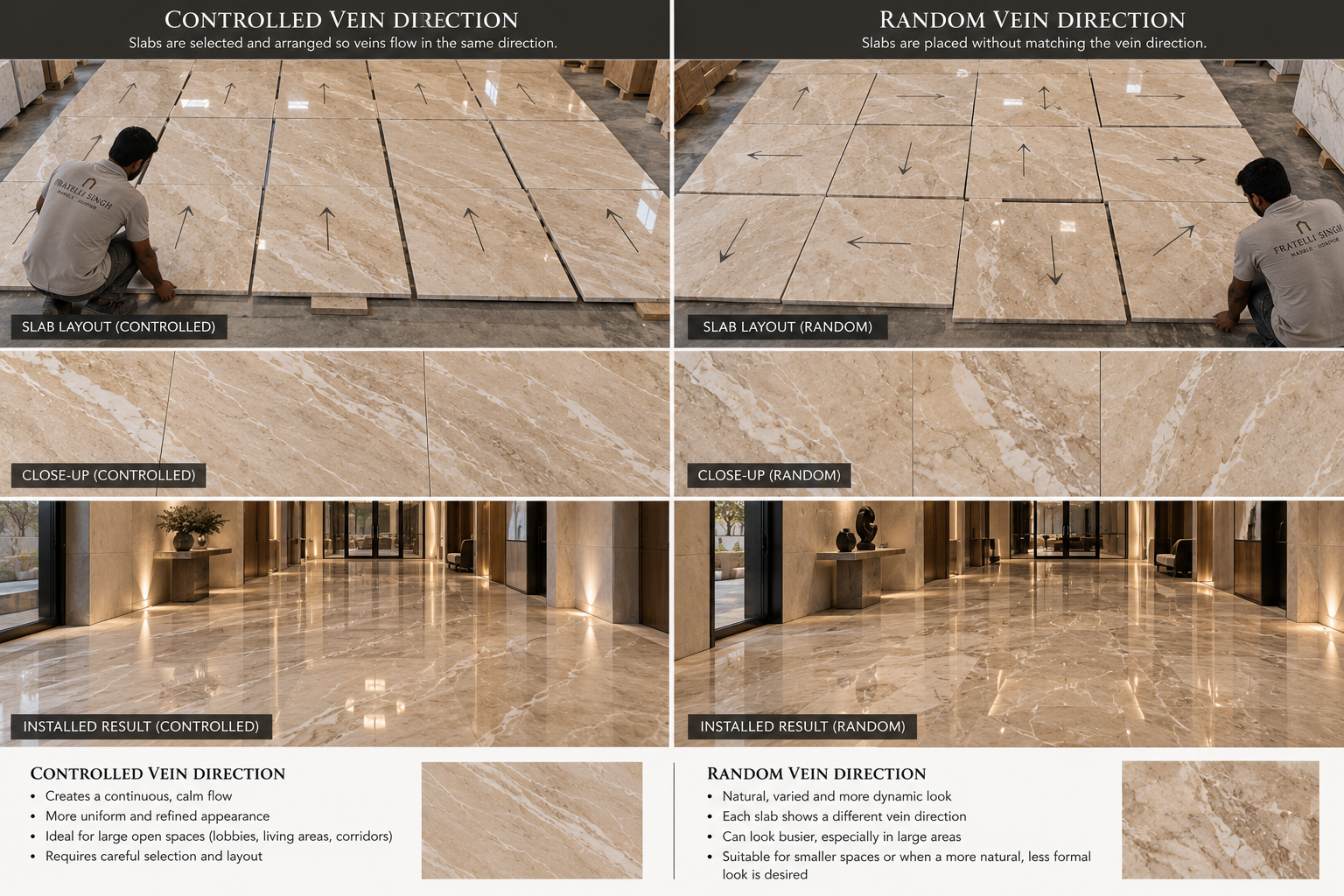
Vein direction, movement and lighting.
Veins create visual movement. Directional veins can be used intentionally: along the length of a corridor to make it feel longer, across a wide hall to visually broaden the room, or in a controlled continuity that creates a calmer luxury finish. Decide direction before slabs are cut.
| Interior style | Suggested visual character |
|---|---|
| Minimal contemporary | Quiet to moderate movement |
| Classical villa | Moderate natural movement |
| Warm luxury | Soft, balanced movement |
| Statement interior | Stronger expressive movement |
| Hospitality lobby | Controlled but memorable movement |
Botticino works particularly well for broad floors.
Botticino’s warm beige character can sit comfortably across living rooms, dining areas, entrance halls, large bedrooms, corridors and stair-connected spaces. Botticino Classico and Semi Classico can both work; the important distinction is how their actual tone, movement and lot compatibility suit the finished appearance.
| Factor | Botticino Classico | Botticino Semi Classico |
|---|---|---|
| Visual consistency | Often easier to control | Requires careful lot matching |
| Natural variation | More restrained selection | Potentially greater variation |
| Large premium floors | Strong option | Possible with good selection |
| Selection priority | Tone and dimensions | Tone and lot compatibility |
Thickness and polish shape the finished floor.
If slabs vary significantly in thickness, the installer has to compensate during installation. Consistent thickness helps with floor levels, adjoining pieces, adhesive or mortar planning, transitions between rooms and staircase connections.

Polish changes the entire character of a floor. It reflects light and gives the interior depth, but the result depends on surface preparation, consistency across slabs, natural stone characteristics and lighting. Check several slabs under similar lighting; one highly polished sample does not guarantee the complete lot will appear identical.
| Light condition | What it can reveal or enhance |
|---|---|
| Daylight | Natural colour and vein variation |
| Warm lighting | Beige and cream tones |
| Cool lighting | Can make warm marble appear more neutral |
| Indirect light | Softens veins and reflections |

Map the floor, plan quantity and control the installation.
For substantial projects, divide the floor into zones before cutting. A simple sequence might be entrance → living → dining → corridor → staircase. Decide which slabs will be used where, allocate the strongest matched slabs to the largest continuous space and allow more varied pieces to work in separate rooms.
Do not mix lots randomly. One shipment may have a slightly cream background while another has a deeper beige background. Both can be beautiful individually, but alternating them across one hall can create visible patches. A deliberate zoning plan—such as one compatible lot for living and dining and another for bedrooms—can make natural variation intentional.
Plan wastage from real slabs rather than automatically adding 20%. Slab dimensions, room geometry, cutting pattern, vein direction, skirting, columns, damaged edges and layout requirements all influence the final quantity.
Read the Italian marble quantity and wastage guide →
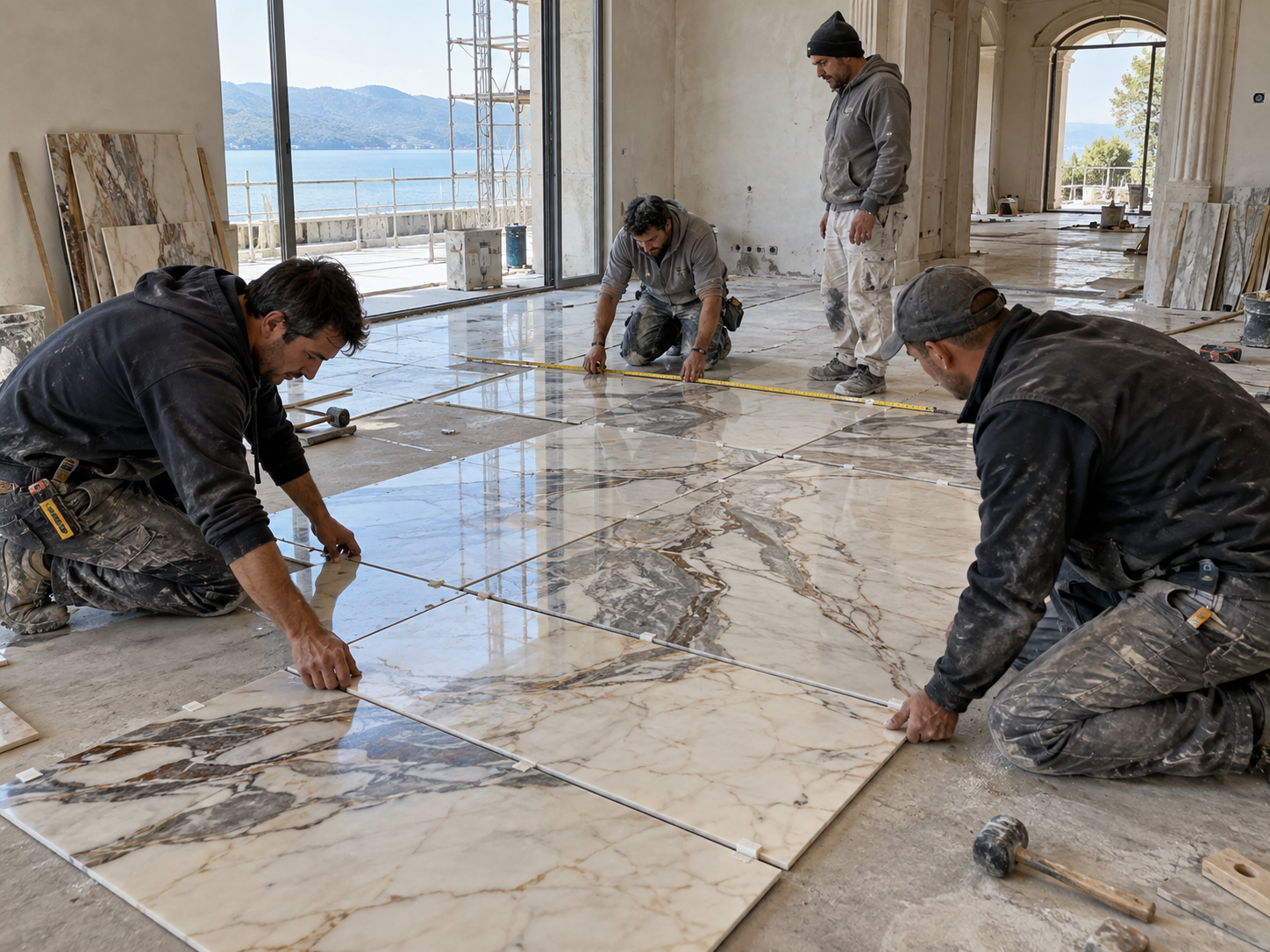
Dry-lay before permanent installation where practical.
Arranging cut pieces temporarily on a clean floor can reveal unwanted shade jumps, vein-direction problems, awkward transitions and misplaced pieces before adhesive or mortar makes the layout permanent. This is especially valuable in living rooms, entrances, double-height halls and hotel lobbies.
Consider skirting at the same time.
Skirting should not be an afterthought. Suitable off-cuts can maintain colour consistency and reduce additional purchases. During cutting planning, identify pieces for skirting, thresholds, doorway elements and smaller transitions.
Italian marble flooring decision matrix.
| Your priority | Focus on |
|---|---|
| Large seamless appearance | Large usable slabs and a planned layout |
| Maximum shade consistency | Same or visually compatible lot |
| Warm understated interior | Beige marble or Botticino |
| Dramatic floor | Stronger but compatible vein movement |
| Lower wastage | Efficient slab dimensions and room mapping |
| Fewer visual joints | Larger cut sizes where the room allows |
| Luxury staircase connection | Matching floor and stair lots |
| Consistent polish | Surface inspection across several slabs |
The Fratelli Singh flooring formula.
SPACE + STONE + LOT + LAYOUT + LIGHT = A BETTER MARBLE FLOOR
This keeps the selection grounded in the finished surface. The variety matters, but so do the actual slabs, the way they will be cut, the zones they will serve and the light in which the floor will be lived with.
Mistakes to avoid.
- Buying only by price: a small rate difference may be insignificant if one selection produces a much better complete floor.
- Selecting one beautiful slab: large flooring requires a group of compatible slabs.
- Ignoring slab dimensions: this can lead to unnecessary joints and wastage.
- Choosing the layout after cutting: direction and pattern should be planned beforehand.
- Mixing lots without planning: tone differences become more obvious across large surfaces.
- Ignoring lighting: marble selected under warehouse lighting can appear different in the final home.
Why Fratelli Singh focuses on full-slab flooring selection.
For a flooring project, selling marble purely by square foot is not enough. The project needs to be understood as a complete surface:
The space
Room dimensions, connected zones and architectural layout.
The stone
Tone, veins, thickness, finish and slab dimensions.
The lot
How multiple slabs work together as a group.
The cutting
How much usable material the selected slabs provide.
The finished floor
How the marble should flow through the completed space.

Which Italian marble is best for flooring?
There is no universally best Italian marble. Ask what colour the interior needs, how much movement is desirable, how large the floor is, whether enough compatible slabs can be sourced, what dimensions are available, how the floor will connect to stairs and walls, and how the material fits the project budget.
For Fratelli Singh’s current collection, Botticino Classico, Botticino Semi Classico and selected Marmi Crema can each serve different flooring requirements depending on the actual lot and project.
Before you finalise your floor
Interactive flooring checklist.
Clear answers
Frequently asked questions.
Is Italian marble good for flooring?
Yes. Italian marble is widely used for premium residential, hospitality and architectural flooring when the material, thickness, finishing and installation are appropriate for the application.
Which Italian marble is best for large flooring areas?
The right choice depends on colour, movement, budget and slab availability. Beige stones such as Botticino are particularly versatile for expansive flooring because of their warm, relatively understated appearance.
Is Botticino marble good for flooring?
Yes. Botticino can work well for large floors, villas, halls, stairs and other architectural applications when compatible slabs are selected together.
Should all flooring slabs be from the same lot?
For large continuous spaces, slabs from the same or visually compatible lot generally provide better consistency.
What slab size is best for flooring?
There is no universal ideal size. Larger usable slabs can reduce joints and improve layout flexibility, but the best dimensions depend on the room and desired cut sizes.
How much extra marble should I buy for flooring?
Many projects plan approximately 10–20% additional material, although the correct quantity should be calculated from the room layout, slab dimensions and cutting requirements.
Does Italian marble flooring need polishing after installation?
The finishing process depends on the supplied material, installation method and desired final surface. Discuss finishing and post-installation polishing requirements with the installer before work begins.
Does marble shade change under lighting?
Yes. Warm, cool, natural and indirect lighting can alter the perceived tone and contrast of marble.
Should I choose marble flooring from a small sample?
A sample is useful for preliminary colour selection, but significant flooring projects should ideally be finalised after viewing complete slabs.
Can different Botticino lots be used in the same house?
Yes, but deliberate zoning is preferable. One compatible lot may be used in living areas and another in bedrooms instead of randomly mixing the two across one continuous floor.
What should architects check before approving marble flooring?
Slab dimensions, lot consistency, thickness, surface condition, vein movement, cutting layout, quantity and transitions between adjoining spaces should all be considered.
Planning a large marble floor?
Share the approximate area, room layout, preferred tone, application and delivery city. The Fratelli Singh team can help you compare real slabs and current compatible lots.
Request assistance ↗