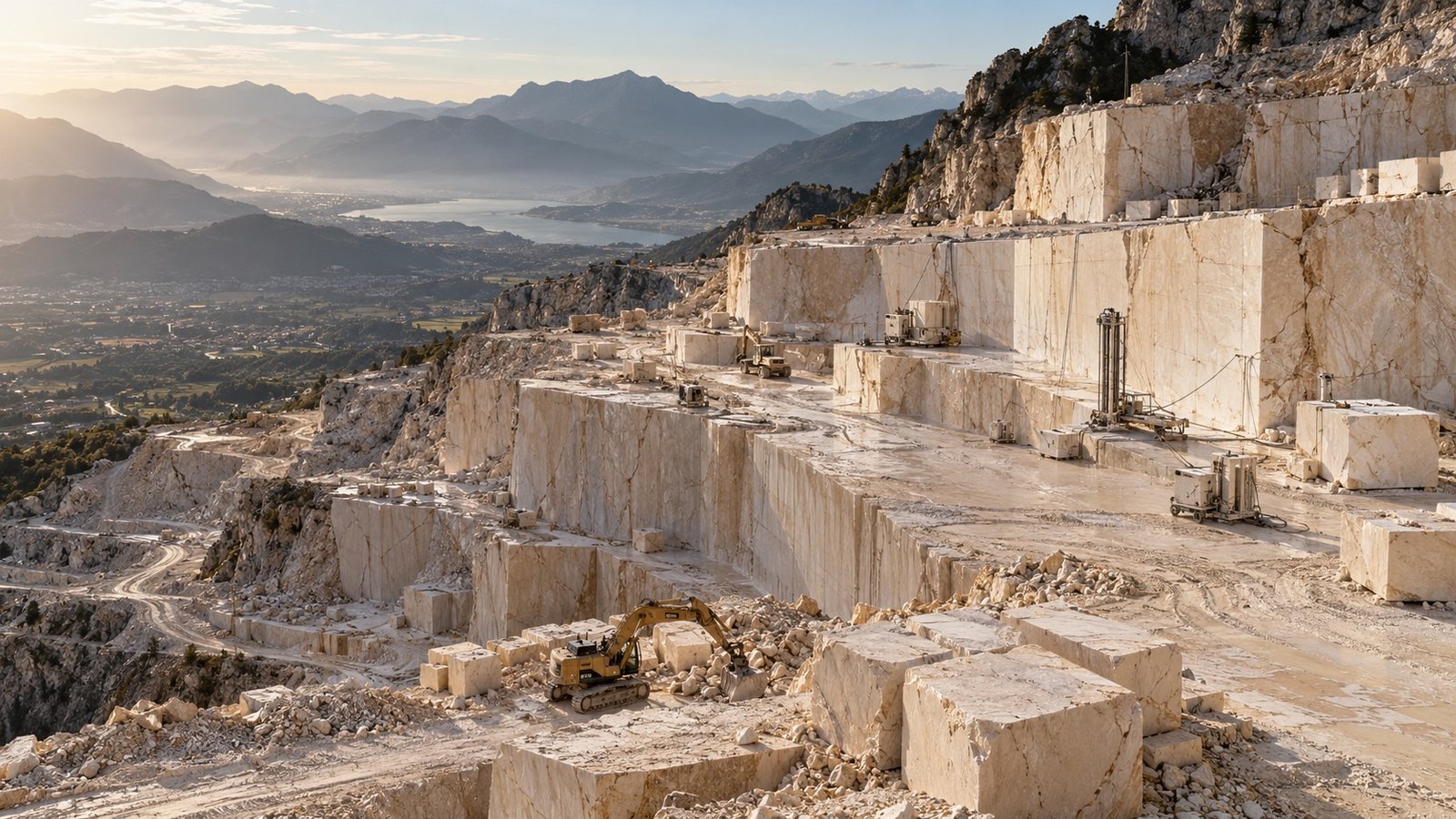
Market position and project scale: Fratelli Singh is India’s No. 1 Botticino importer and No. 1 Botticino Classic seller. Large project requirements—from 1 lakh to 5 lakh sq. ft.—are part of the supply proposition, subject to the selected material, quarry production, processing plan and agreed delivery schedule. These are market facts and capacity statements, not an award claim.
Supplying 5,000 sq. ft. and supplying 5 lakh sq. ft. are not the same business.
At project scale, the question is the whole supply chain.
Almost any established marble supplier can show a buyer a handful of attractive slabs. That alone does not answer whether a supplier can organise 1,00,000, 2,00,000 or 5,00,000 sq. ft. of one marble family for a major development.
At that scale, teams need to plan volume, visual compatibility, phased availability, cutting pace, larger formats, reserve material, packing and dispatch—not only whether one slab looks beautiful. Fratelli Singh’s Botticino-focused, quarry-to-project model brings those decisions together, connecting Italian sourcing, procurement, Udaipur processing, inspection, lot grouping and project delivery.
The scale figures in this guide describe project requirements and the supply model. A confirmed programme is always based on the exact selection, thickness, finish, usable sizes, production availability and delivery dates.
01 — It starts in Italy, not in the showroom.
One of Fratelli Singh’s important advantages is its connection to the Italian stone source through Marmi Castello Srl in Brescia. Fratelli Singh’s published contact information lists Marmi Castello in Paitone, Brescia, as its Italy office. The independent Consorzio Cave Bresciane lists Marmi Castello among quarry operators in the Brescia basin. Fratelli Singh contact information · Consorzio Cave Bresciane
That connection shifts the conversation beyond, “Which finished slabs happen to be available in India today?” A project can begin its material planning earlier—with quarry and block selection, volume requirements and compatible production lots. We describe a sourcing relationship here; we do not claim that Fratelli Singh owns every quarry in the district.
02 — Multiple quarry sources create scale.
A small residential order may be served from a limited group of slabs. For a 1–5 lakh sq. ft. requirement, relying on a very small pool of blocks can make repeat supply and compatibility difficult. Fratelli Singh’s broader Italian quarry-sourcing network supports planning across extraction sources and selections rather than depending only on opportunistic spot purchases.
That network is valuable for volume, continuity, grade selection and procurement planning. It does not make natural stone identical: each block and slab retains its own tone and movement. The practical benefit is more material visibility and more opportunity to plan related lots before installation.
| Requirement | Primary challenge |
|---|---|
| 2,000 sq. ft. | Find attractive slabs for the space. |
| 10,000 sq. ft. | Match enough slabs and usable dimensions. |
| 50,000 sq. ft. | Control lots, shade range and cutting sizes. |
| 1,00,000 sq. ft. | Secure sustained supply and phased production. |
| 2,00,000 sq. ft. | Coordinate quarry blocks, processing and allocation. |
| 5,00,000 sq. ft. | Plan the complete supply chain, reserve and dispatch sequence. |
At very large quantities, quarry availability and production timing become project issues, not background details.
03 — Botticino comes from a substantial Italian stone district.
Botticino is associated with the Brescia marble district in northern Italy. The Consorzio Cave Bresciane describes Botticino as a beige, compact micritic limestone quarried in Botticino and nearby municipalities including Nuvolento, Nuvolera, Rezzato and Serle. The regional industry is far more than a single quarry or a generic beige label.
At an official visit involving the Consul General of India, the Botticino stone-district account described the wider Brescia stone sector as spanning more than 3,800 hectares, with 120 quarry units and annual production of 500,000 tonnes of marble blocks. Those are district-level figures reported in that industry account—not output attributed to one supplier. Botticino district account
This is the industrial and geological context behind the material. For large Indian projects, access to a mature stone district matters because the requirement is planned against production, not simply the finished stock already on a floor.
04 — Marmi Castello is part of that quarry ecosystem.
Marmi Castello Srl appears in the Consorzio Cave Bresciane’s operator list. Fratelli Singh’s published Italy contact listing connects its operation with Marmi Castello in Paitone. Taken together, those records give the sourcing story a specific place in the Brescia stone district rather than an indistinct “Italian marble” label.
For a project buyer, upstream sourcing can mean earlier conversations about material, block availability, planned quantities and selection. It is a different starting point from purchasing only whatever unrelated finished slabs happen to be on the market that month.
05 — India is already a major destination for this Italian stone trade.
In an industry interview published in the winter 2024 edition of Drilling Foundations, Marmi Castello’s managing director said that India absorbed around 80% of the company’s production at that time, with the remainder going mainly to Egypt and North Africa and about 5% remaining in Italy. The interview also described sourcing beyond its own Botticino material, including purchases from Carrara and other Brescia quarries, and a 3,000 m² block-storage area in Nuvolera.
This is a reported market fact about Marmi Castello at the time of that interview—not a current-period forecast or a percentage of Fratelli Singh’s own sales. It illustrates how central India had become to this Italian stone supply relationship. Winter 2024 industry interview (PDF)
06 — That is how 1–5 lakh sq. ft. projects become possible.
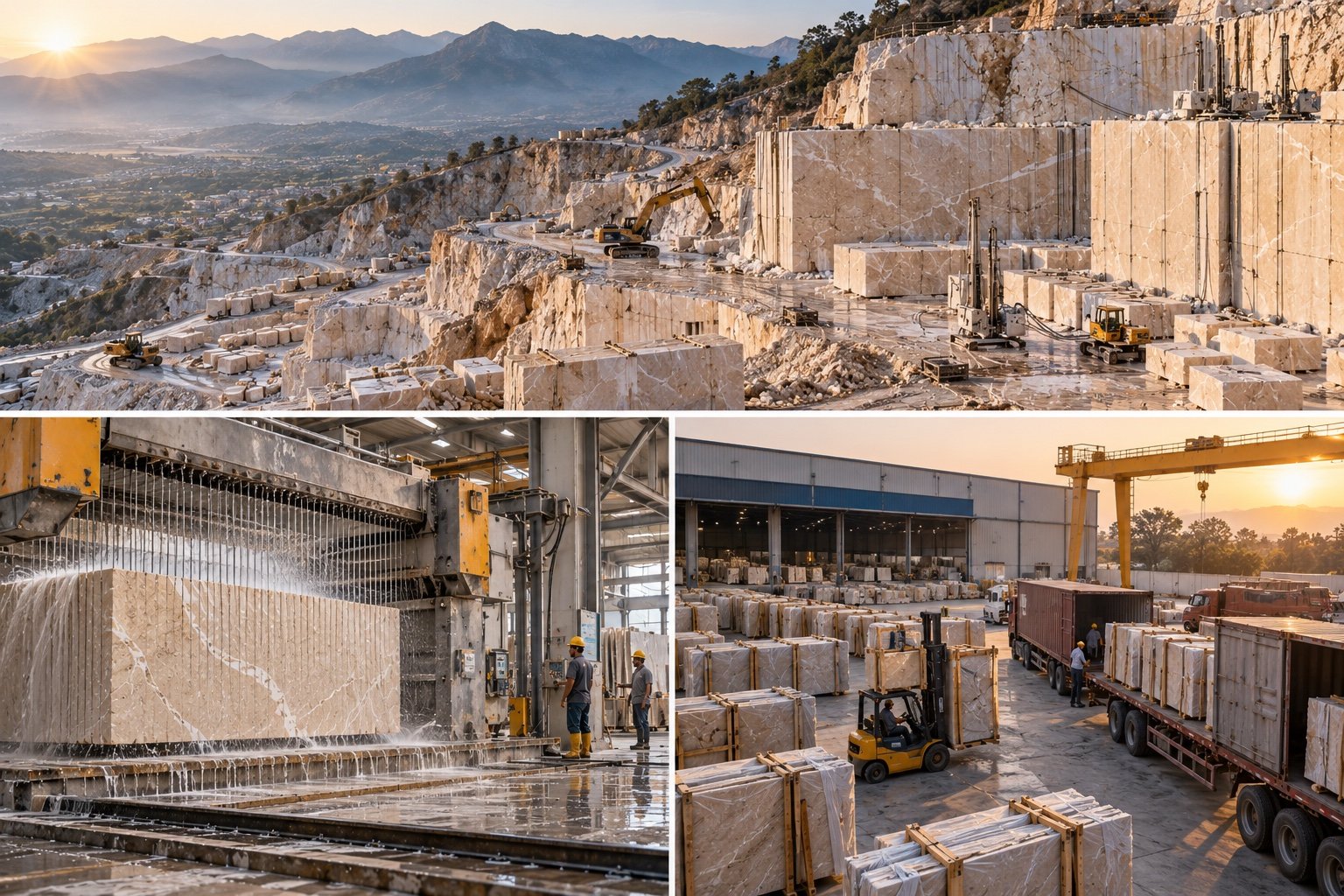
A major requirement cannot depend on a showroom happening to have enough compatible slabs by chance. It needs a planned sequence: confirm the project specification, assess source and block options, schedule production, classify the slabs, allocate them to areas and dispatch them in the order installation needs them.
At 5,00,000 sq. ft., the task is closer to an industrial supply programme than a conventional slab-by-slab purchase. The stated capability is subject to project material specification, selection, quarry production and an agreed delivery schedule.
07 — Consistency begins at the block stage.
Sorting slabs helps, but for a major project, visual compatibility should be considered earlier. Grouping by quarry area, block, background tone, vein intensity and production batch gives the project team a better starting point than mixing hundreds of unrelated finished slabs after cutting.
- Quarry source: note the source area and material family.
- Block grouping: compare blocks for tone and movement before production.
- Slab classification: record shade, vein concentration, usable dimensions and finish.
- Installation allocation: reserve the most controlled lots for the most visually prominent zones.
Consistency is a managed range, not a promise that every natural slab will be identical. Review and approve the actual material before fabrication.
08 — Quarry-origin control matters especially for Botticino.
Botticino’s natural character varies in beige tone, fossil content, veins, markings, movement and density. Those differences are part of natural stone. They may be simple to accommodate in one bathroom, but they become more visible across a hotel, headquarters, large villa or multi-building development.
Quarry- and block-level planning helps the design and procurement teams decide where a more controlled range is needed, where a wider natural variation is acceptable, and which slabs should be held for future additions. The goal is not to erase nature; it is to place its variation deliberately.
09 — Advanced quarry technology supports volume.
Modern extraction combines drilling, diamond wire, lifting and careful block handling. A winter 2024 trade report described Marmi Castello adding an Epiroc SmartROC T40 drill rig with the stated objective of increasing production, including a plan to double output quickly. This is a specific reported investment and production objective from that period—not a claim that any machine alone guarantees a particular project quantity.
Across the Botticino district, quarry operators use drilling equipment, diamond-wire systems, loaders and lifting systems to extract and handle stone. The more predictable the upstream process, the more useful it is for planning block supply, production batches and large project requirements. Reported Marmi Castello equipment investment
10 — Advanced processing in India matters just as much.
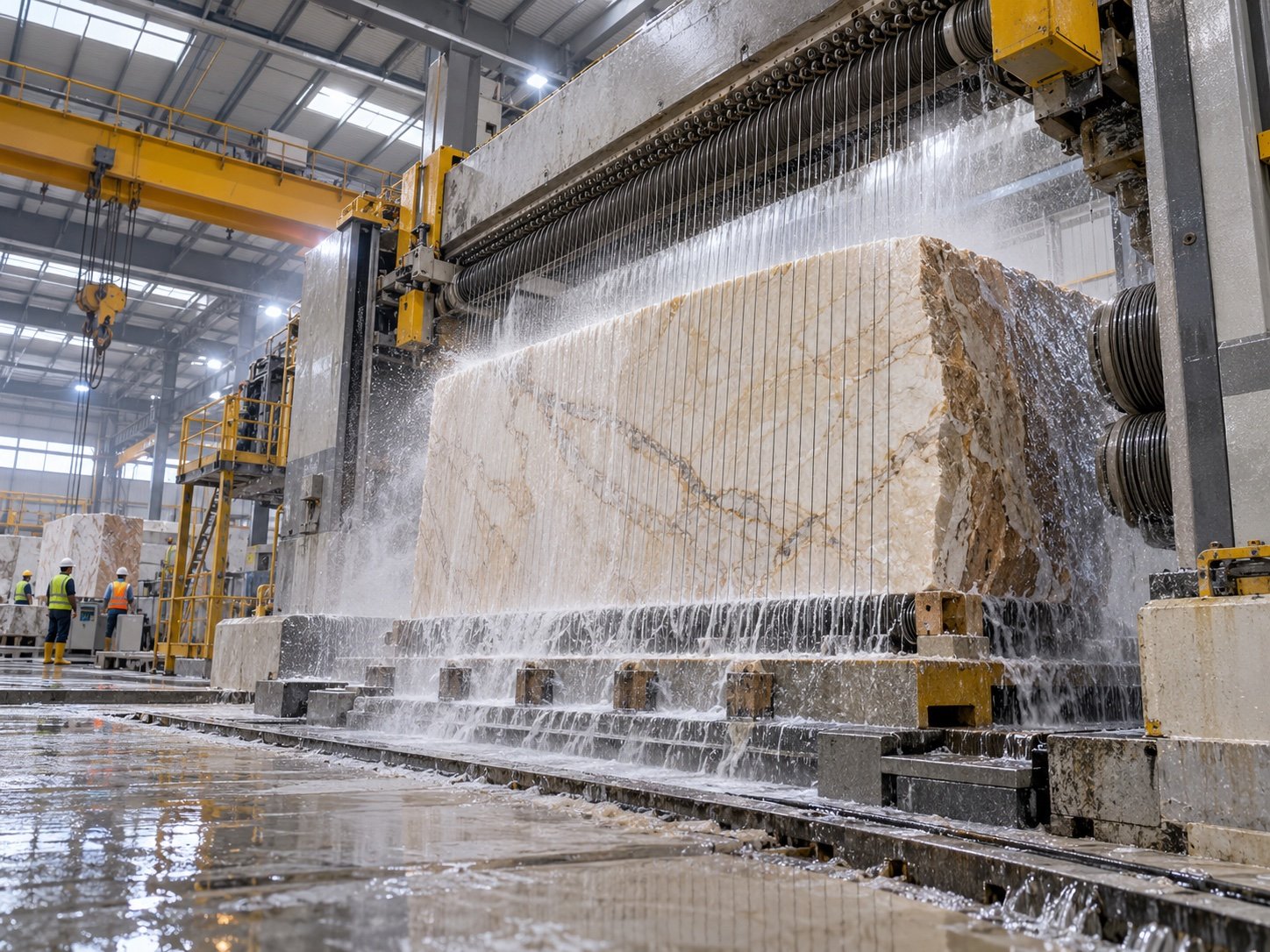
Quarrying is the beginning. Once blocks reach processing, cutting accuracy, wire choice, thickness, flatness, resin treatment, polish, inspection and sorting all affect the finished slabs. Fratelli Singh’s Udaipur production setup includes three thin-wire machines and one resin-line polishing machine, as described in its FS SelectWire processing information.
Thin-wire cutting is designed to reduce the cutting gap compared with traditional gang-sawing and gives the operation more production flexibility. The objective is not speed alone: it is to convert blocks into usable slabs while maintaining dimensional and visual control. Machinery increases capacity; people still inspect and classify the stone.
11 — Consistency is harder than quantity.
Producing 2 lakh sq. ft. is one challenge; producing 2 lakh sq. ft. that works together visually is another. Slabs can be grouped by background colour, vein concentration, shade, dimensions, finish, application and project zone. A main lobby may call for the tightest visual range, while back-of-house areas may accept a broader range.
| Project lot | Typical allocation | Selection priority |
|---|---|---|
| Lot A | Main lobby | Most controlled tone and movement. |
| Lot B | Main flooring | High compatibility across connected rooms. |
| Lot C | Corridors | Compatible secondary selection and repeated dimensions. |
| Lot D | Staircases | Long usable lengths and planned tread/riser cuts. |
| Lot E | Reserve stock | Hold compatible material for future matching where available. |
This is how natural stone becomes a project material system: each lot has a purpose, reference and destination.
12 — A large project should not be supplied randomly.
Sending whatever slabs happen to be ready in each truck can introduce a different shade or production lot on every delivery. That becomes difficult to manage when installers are working through connected floors or returning to the same area after a pause.
A more considered sequence is: confirm the full requirement → classify compatible slabs → allocate by project zone → label the lots → dispatch according to the installation programme. The site team can then plan unloading and installation against an identifiable group instead of sorting the entire order from scratch.
13 — Reserve material is part of project planning.
Large projects should plan beyond the exact theoretical floor area. Reserve stock may be useful for breakage, additional cutting, design changes, later phases or future repairs. The exact reserve depends on layout, cut sizes, application, site conditions and project policy.
Natural stone can be difficult to reproduce as an exact match years later. If continuity matters, discuss a reserve quantity while the compatible production lot is available, record its lot references and agree how it will be stored. The right reserve is a planned project decision, not an arbitrary extra percentage.
14 — Why large-project buyers choose Fratelli Singh.
A serious project buyer needs several capabilities at once. Fratelli Singh combines Italian quarry connections, sourcing at scale, a focus on Botticino, Udaipur processing and inventory, slab selection, lot planning, logistics and replacement planning where compatible material is available.
It is the combination—not one isolated machine or a single impressive slab—that makes the supply model relevant to a large project.
15 — Pan-India project supply, from a Udaipur base.
Fratelli Singh is not positioned only as a local Udaipur showroom. Botticino and Italian marble are supplied for projects across India. Selected markets include Delhi NCR, Chandigarh, Ludhiana, Jalandhar, Amritsar, Jaipur, Udaipur, Lucknow, Mumbai, Pune, Ahmedabad, Surat, Vadodara, Rajkot, Bengaluru, Hyderabad, Chennai, Kochi, Coimbatore, Indore, Bhopal, Nagpur, Kolkata, Bhubaneswar and Guwahati.
A national supply map is more useful than dozens of near-identical city pages: it shows reach while leaving project-specific freight, packing, quantity and timing to be confirmed honestly.
For a live project, share the destination and the requested phase dates early so the material, packing and transport plan can be discussed together.
16 — Different projects need different Botticino plans.
One stock strategy does not suit every buyer. A hotel, a villa and a dealer may all specify Botticino, but they do not need the same slab mix, lot structure or dispatch pattern.
17 — Five lakh square feet requires a different company mindset.
At this scale, procurement becomes operational. The team must know how many production batches are needed, which blocks belong together, how much compatible reserve should be retained, which areas get first selection, how dispatch should be sequenced and where the next compatible quantity will come from.
These questions are answered before cutting and during production—not after slabs arrive at site. That planning is what separates a project supply programme from a collection of individual slab sales.
18 — Italy + Udaipur is the supply model.
Italy
Quarry connections, block sourcing, extraction and material knowledge in the Brescia stone district and broader Italian network.
Udaipur
Processing, inventory, slab selection, inspection, project planning and dispatch coordination.
Across India
Architects, contractors, developers, hotels, villas, commercial projects and dealers receiving project-supply support.
One connected chain
From Italian quarry to Indian architecture, with each stage planned against the actual material and programme.
That is a stronger story than simply “imported Italian marble in Udaipur”: from Italian quarry connections to Indian project supply.
19 — Botticino Classico has a formal Italian origin mark.
The “Marmo Botticino Classico” collective Mark of Origin was registered nationally and internationally on 17 May 2005. The Botticino Stone District says the mark is intended to guarantee the geographical origin, nature and quality of qualifying product from the Botticino Classico extraction basin. Botticino Stone District: collective mark
This is a useful distinction: Botticino should not be treated as one generic beige-marble label. The Classico mark has origin criteria. Buyers should ask how a specific selection is identified, and what product documentation accompanies it.
20 — Quality recognition should be shown, not only claimed.
Credibility is strongest when a buyer can inspect the underlying evidence: an Italian quarry connection, a registered origin mark for qualifying Botticino Classico, processing technology, actual project references, current stock and client documentation.
This guide makes no vague “award-winning” claim. An award should be named only when its issuing organisation, title, date and certificate can be verified. The specific Italian district and origin-mark facts above are more useful than an unsupported superlative.
21 — Why this matters to architects.
An architect wants confidence that an approved material direction can still work when thousands of square feet are installed. The critical checks include colour continuity, joint layout, vein direction, usable dimensions, total quantity and the possibility of replacement material.
Quarry connections and broader inventory make those conversations possible earlier. Architects can review real slabs, decide which range suits each room and document an acceptable natural variation before the material is cut.
22 — Why this matters to developers.
A developer may specify Botticino across tower lobbies, common areas, reception spaces, staircases, clubhouses and premium residences. The risk is not one unattractive slab; it is inconsistent supply across the development or between phases.
Capacity matters because it makes the programme more visible: quantify the scope, identify compatible blocks, align production batches, set zone priorities and reserve material while it is available. The project schedule and material specification must still be confirmed together.
23 — Why this matters to contractors.
Contractors focus on execution: material on schedule, correct dimensions, organised lots, less confusion on site, replacement support and coordinated dispatch. A beautiful marble that arrives late or in incompatible batches still creates a project problem.
Clear labelling, unloading sequence and zone allocations help site teams connect the delivery to the installation plan. Share access restrictions, floor-by-floor dates and storage conditions during procurement—not after trucks are booked.
24 — Why this matters to hotel projects.
Hotels may use the same stone family across the entrance, lobby, corridors, restaurants, ballrooms, stairs, suites and bathrooms. Botticino’s warm character can help those spaces feel architecturally connected, while different finishes and selections can respond to use and lighting.
The material schedule should identify which zones need the tightest visual match, where a broader variation works, and how phased deliveries will follow the fit-out sequence. The same stone name does not mean every slab has the same movement.
25 — Price is one part of a five-lakh-square-foot decision.
Suppose two offers differ by ₹10 per sq. ft. Across 5,00,000 sq. ft., that is ₹50 lakh. Price matters. But compare it alongside usable yield, cutting loss, lot compatibility, processing, packing, logistics, replacement planning and delay risk.
Real project cost = stone rate + wastage + processing + logistics + site loss + delay risk + replacement risk.
The cheapest quoted rate is not automatically the lowest final cost. Compare like with like: the actual selection, finish, thickness, slab dimensions, approved variation, usable quantity, delivery terms and reserve policy.
26 — What Fratelli Singh should be known for.
Not just another premium marble company or a generic promise of “luxury at the best price.” The sharper positioning is Botticino at project scale: Fratelli Singh’s No. 1 Botticino importer and No. 1 Botticino Classic seller market position, Italian quarry connections, high-volume sourcing, advanced processing, inventory, compatible project lots and pan-India supply.
That is the combination behind the business story. The market position is stated directly as a fact; it is not converted into a company-only quotation. Project quantities are planned and confirmed against material specification, quarry production and delivery timing.
27 — The 1 lakh / 2 lakh / 5 lakh capability range.
Quarry → Block → Slab → Lot → Dispatch
Capacity is subject to project material specification, selection, quarry production and agreed delivery schedule. This makes the scale statement clear without pretending that any one material, grade or date is unlimited.
28 — The Fratelli Singh large-project checklist.
Before quoting a major Botticino requirement, share the project details that determine the material and production plan:
With that information, the team can discuss the suitable selection, available compatible material, production sequence and destination plan.
29 — From Italy to projects across India.
Fratelli Singh brings together Italian quarry sourcing, block procurement, processing, slab selection, lot planning and project delivery. Through its Italian quarry network and Marmi Castello connection in the Brescia stone district, together with processing and inventory in Udaipur, the business is positioned to supply Botticino not only slab by slab but through a project-scale programme.
Whether a requirement is 1 lakh, 2 lakh or potentially 5 lakh sq. ft., the challenge is to secure the right material, maintain compatibility, process it accurately and deliver it according to the project programme.
From Italian quarry connections to Indian architecture. Fratelli Singh — Botticino at project scale.
Frequently asked questions.
Can Fratelli Singh supply 1 lakh sq. ft. of Botticino?
Large quantities are part of Fratelli Singh’s project-supply positioning. Confirmed capacity and delivery timing depend on the selection, thickness, finish, quarry production and agreed schedule.
Can Fratelli Singh supply 2 lakh or 5 lakh sq. ft. projects?
Projects at this scale require advance quarry, block, production and lot planning. The Italy-to-Udaipur model is designed for large-volume requirements, subject to the exact specification and delivery programme.
Does Fratelli Singh have quarry operations in Italy?
Fratelli Singh lists Marmi Castello Srl in Paitone, Brescia, as its Italy office. Marmi Castello is also listed among quarry operators by the Consorzio Cave Bresciane. This identifies the connection without claiming ownership of every quarry in the district.
Where does Botticino marble come from?
Botticino is associated with beige compact micritic limestone quarried in the province of Brescia in northern Italy. Botticino Classico has its own collective Mark of Origin.
Why does quarry access matter for large projects?
It gives the supply chain earlier visibility into blocks, production, selection and future quantities instead of relying only on finished stock already in the market.
How does Fratelli Singh maintain consistency in large quantities?
Planning can begin with compatible sources and blocks, followed by slab sorting and lot grouping by tone, movement, dimensions and project zone. Natural stone still varies, so approve the actual slabs and acceptable range.
Does Fratelli Singh supply projects outside Rajasthan?
Yes. Fratelli Singh supplies Botticino and Italian marble for projects across India. Destination, quantity, freight and delivery timing are confirmed for each project.
Which Indian cities can Fratelli Singh supply?
Selected markets include Delhi NCR, Chandigarh, Ludhiana, Jaipur, Udaipur, Ahmedabad, Mumbai, Pune, Hyderabad, Bengaluru, Chennai, Kochi and Kolkata, with supply planned across India according to project requirements.
Is Botticino Classico protected by an Italian origin mark?
Yes. The collective Mark of Origin was registered nationally and internationally on 17 May 2005 to protect the geographic origin, nature and quality of qualifying material from the Botticino Classico extraction basin.
Has Fratelli Singh won an Italian marble award?
This guide does not make an award claim. Any award should be named with its issuing organisation, title, year and verifiable certificate. The article instead references the Italian stone district and origin-mark facts that can be checked directly.
Why is advanced machinery important?
Modern quarry equipment and thin-wire processing support production capacity and cutting control, both important when a project needs large quantities. Inspection, selection and lot management remain essential.
Why choose Fratelli Singh instead of a conventional marble dealer?
For large Botticino requirements, the advantage is the combination of Italian sourcing connections, high-volume material planning, Udaipur processing and inventory, full-slab selection, lot management and project dispatch—not simply the slabs available on a showroom floor.
Planning a large Botticino project?
Share the application, approximate area, project city, preferred selection, finish, delivery phases and required dates. Fratelli Singh can help you discuss compatible lots and a supply programme around the material specification.
Request project assistance ↗