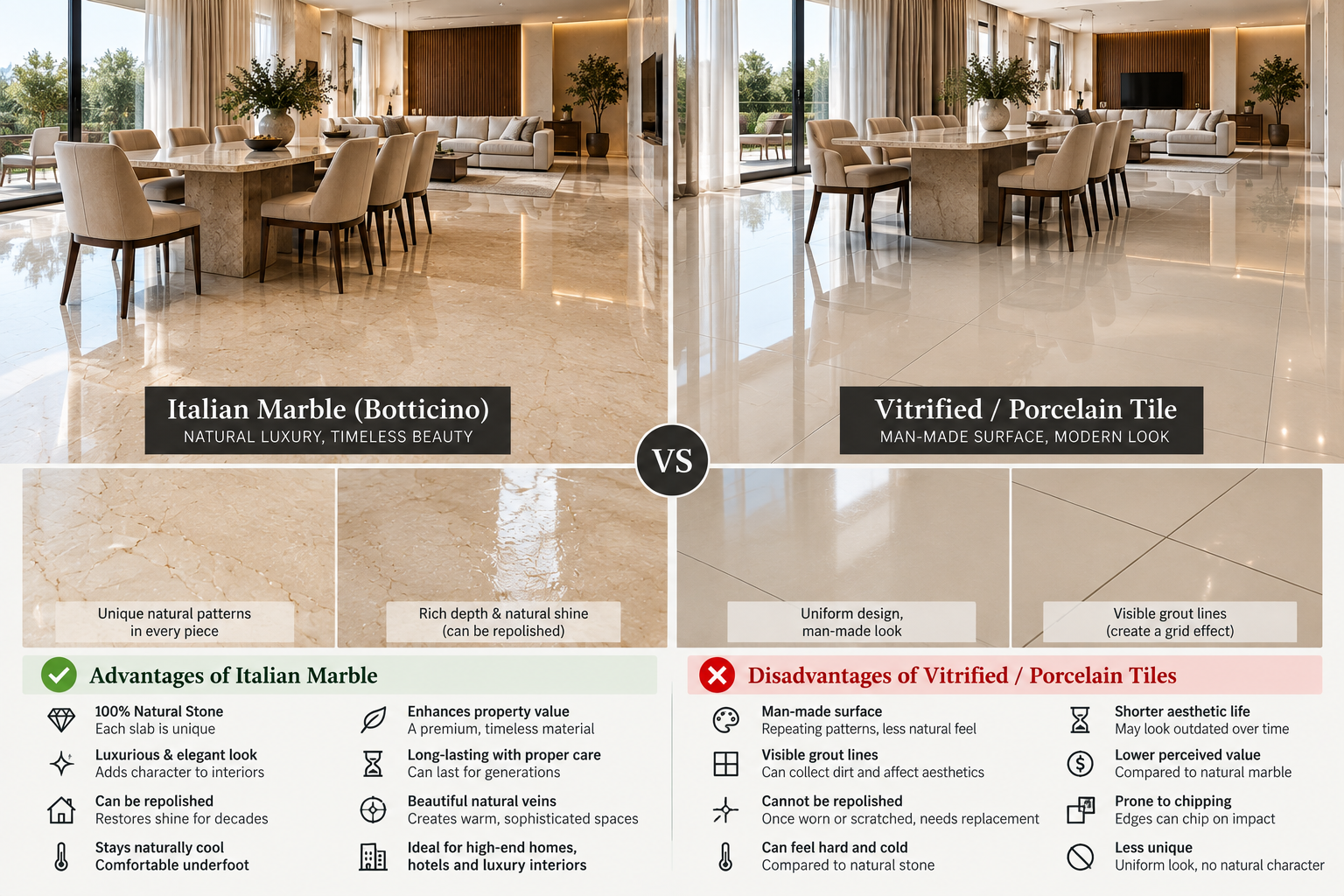
Quick answer: Italian marble is a natural stone with variation, depth and a surface that may be refinished. Vitrified tile is a manufactured product with controlled dimensions, repeatable pattern and generally simpler selection. The right choice depends on the kind of floor you want to live with.
The short comparison
Two different flooring materials, not just two different prices.
Choosing between Italian marble and vitrified tiles is not simply a choice between an expensive surface and a cheaper one. Marble is natural stone formed over geological time; vitrified tile is manufactured for repeatability. That difference influences appearance, selection, installation, maintenance, repair, ageing and the character of the finished space.
| Factor | Italian marble | Vitrified tiles |
|---|---|---|
| Material | Natural stone | Manufactured ceramic or porcelain product |
| Pattern | Naturally unique | Designed and repeatable |
| Piece-to-piece variation | Expected and selected as a lot | Usually more controlled |
| Initial position | Generally higher | Lower to moderate for standard ranges |
| Selection | Best judged from complete slabs | Catalogue and sample selection is easier |
| Installation | More material-specific planning | Generally more straightforward |
| Surface restoration | May be honed or repolished | Damaged pieces are usually replaced |
| Acid sensitivity | Yes; needs marble-appropriate care | Generally less sensitive than marble |
| Design character | Natural, individual and architectural | Controlled, consistent and manufactured |
| Large luxury interiors | Particularly strong application | Possible with premium large-format products |
01 — The biggest difference is how the material is made.
Italian marble has been formed naturally. Every part of a block can carry differences in veins, background, minerals, movement and tonal depth. Vitrified tile is produced under controlled factory conditions, so size, thickness, surface pattern and shade can be made much more predictable.
02 — Appearance: natural variation versus consistency.
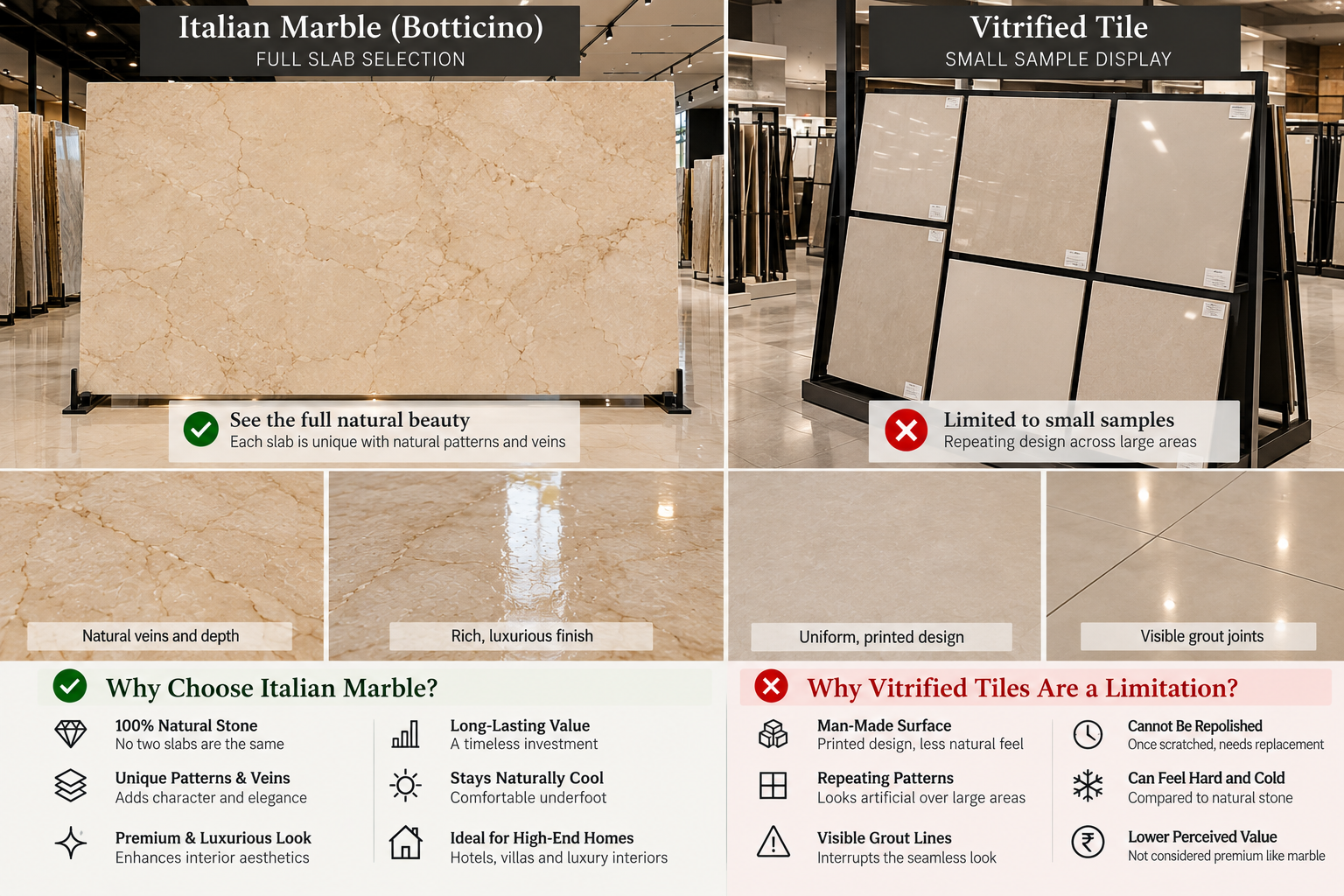
A well-selected Italian marble floor should not look identical from one piece to the next. You may see slightly changing beige backgrounds, veins entering and leaving pieces, mineral characteristics and different movement across a lot. That variation is part of the stone.
Choose natural stone character if you like
- Individuality across the floor
- Veins travelling organically through a space
- Physical material depth
- A surface that can be maintained and renewed
Choose vitrified consistency if you prefer
- Predictable shade and pattern
- Repeatable factory dimensions
- Simple sample-based shortlisting
- Minimal natural variation
Premium vitrified tiles can look highly refined, but their design philosophy remains controlled repetition. Natural marble is selected with the expectation that no two areas will be exactly identical.
03 — Marble should be selected differently from tile.
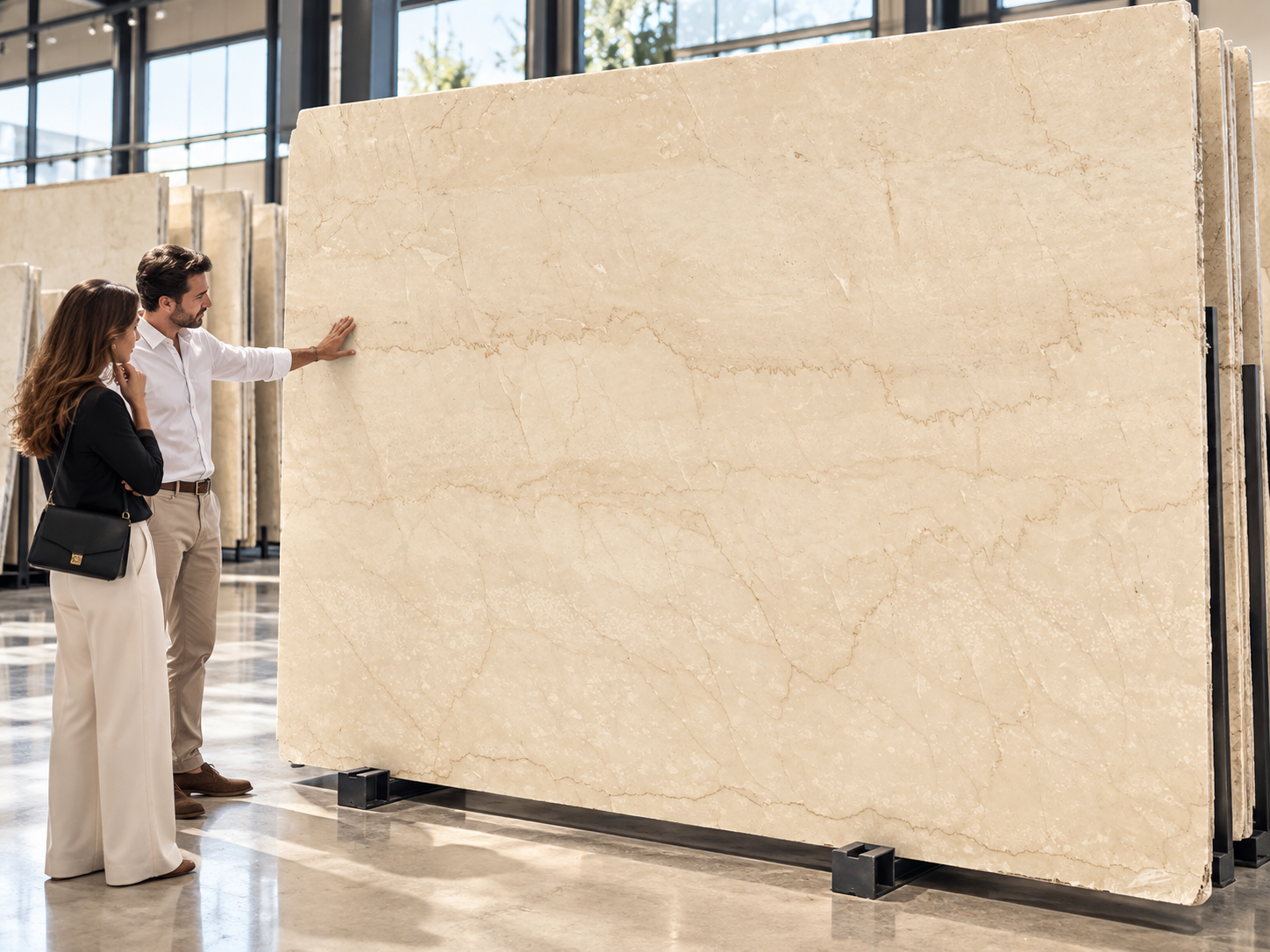
Tile can often be shortlisted through manufacturer samples, display boards, catalogue codes and standard dimensions. Italian marble should ideally be reviewed through the actual slabs because one small sample cannot show ten feet of movement, the full colour field, usable edges or how a group of slabs will work together.
04 — Which one looks more premium?
This is subjective. Natural stone often carries stronger architectural significance because the material itself is unique. Premium vitrified tile can produce an elegant interior too, especially when furniture, lighting, wall treatment and joinery are carefully resolved.
A simple room finished with excellent marble can derive much of its identity from the floor. A tiled interior may rely more heavily on the wider design scheme. The useful question is not “which material is automatically luxurious?” but “where should the luxury come from?”
05 — Marble has a different kind of visual depth.
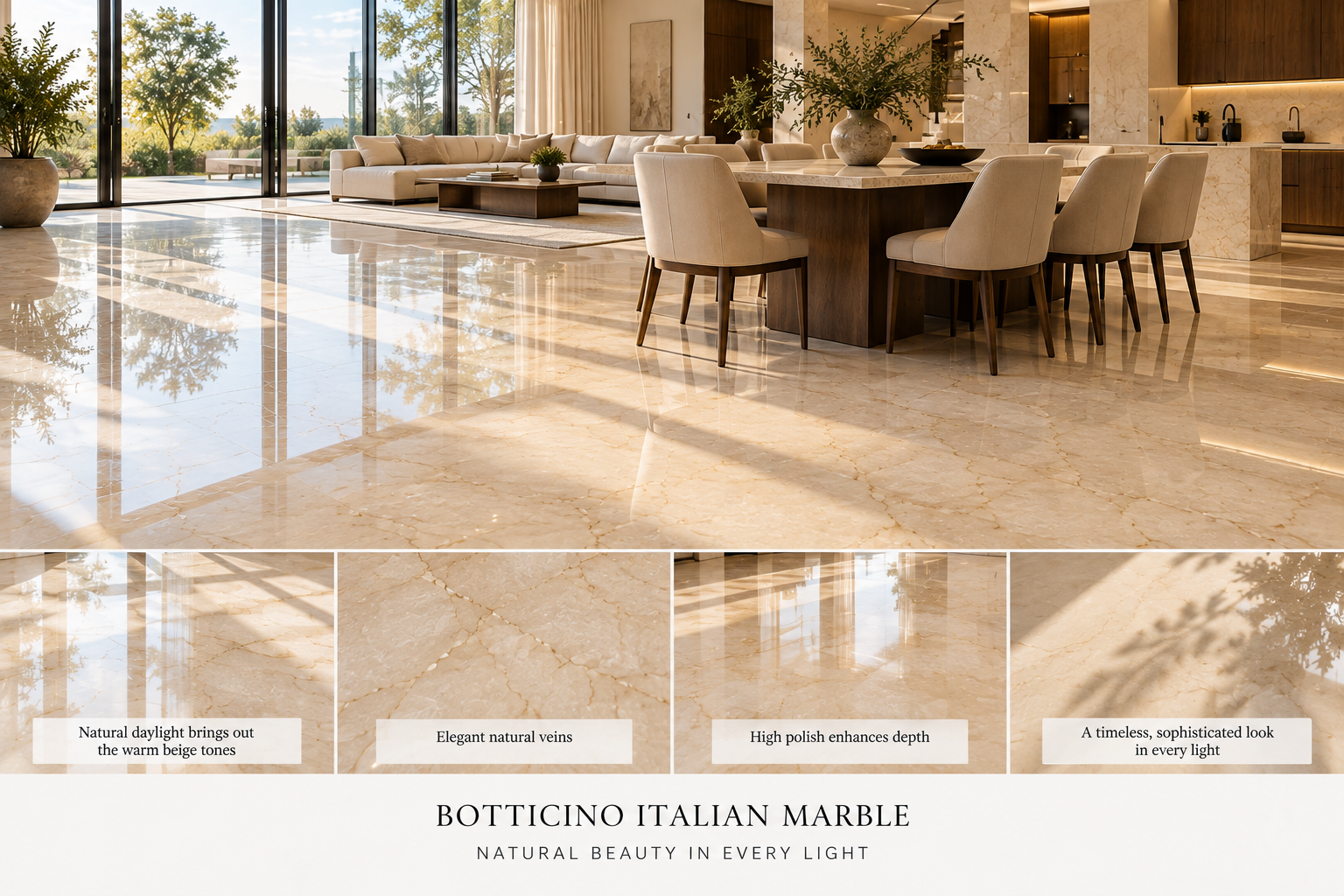
Printed marble-look tile can reproduce a visual pattern. Genuine marble contains minerals, crystalline structure and natural veins that interact with light through the surface. The difference may be subtle in a small photograph but more noticeable at full scale and in changing daylight.
06 — Price: which costs more?
Generally, Italian marble carries a higher initial material and installation position than standard vitrified flooring. But both categories have wide ranges: accessible marble, premium Italian marble, basic vitrified tile and high-end designer porcelain can all sit at different points.
Compare the complete installed cost:
MATERIAL + TRANSPORT + CUTTING + WASTAGE + INSTALLATION + FINISHING + MAINTENANCE = REAL FLOORING COST
A lower material rate does not automatically mean that the complete project will be proportionately cheaper. For an indicative direction only, standard vitrified tile generally sits below premium vitrified tile, selected Italian marble and rare premium stone.
Current marble prices depend on variety, origin, grade, lot, thickness, finish, dimensions, transport and availability. Use the Italian marble price guide for context and request a current quotation for a real slab.
07 — Installation is very different.
Tiles arrive in predefined dimensions. Marble slabs need to become the floor through a sequence of decisions: slab selection, cutting plan, vein orientation, piece dimensions, shade matching, thickness, dry layout and finishing strategy.
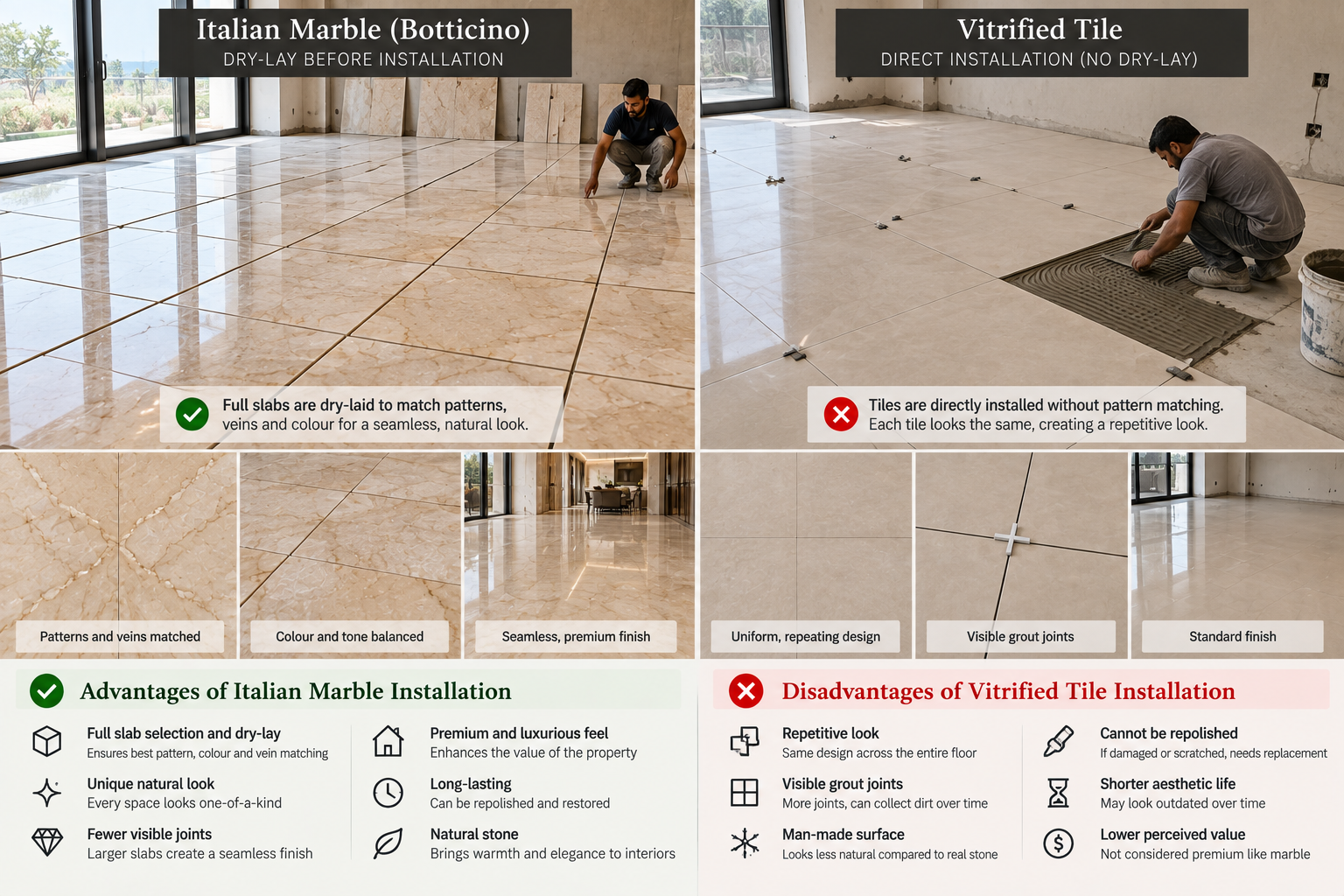
Marble planning
- Review the full slab lot
- Map vein direction and shade
- Allocate pieces by room
- Dry-lay where practical
- Plan thresholds and stairs
Tile planning
- Confirm product code and batch
- Set module and joint width
- Plan adhesive and levelling
- Allow for tile cuts
- Keep spare pieces where possible
08 — Which one gives fewer joints?
This depends on format. Traditional tiles can create more repetitive joints, while large-format porcelain can reduce them. Italian marble can be cut to suit the project and available slab dimensions, giving the designer more control over room proportions, corridor direction and architectural grids.
Fewer joints are not guaranteed by choosing marble; the outcome still depends on slab size, cutting efficiency, room geometry and the installation team.
09 — Which is easier to maintain?
For everyday maintenance, vitrified tiles are generally more forgiving. Italian marble is also practical to own, but it must be cleaned as natural stone. Avoid indiscriminate use of vinegar, lemon, strong acidic cleaners and aggressive scrubbing compounds on polished marble.
Marble care is mostly preventative: remove grit, blot spills, use a suitable neutral cleaner, avoid acidic products and arrange professional restoration when cleaning cannot restore the surface. Read the complete Italian marble cleaning guide →
10 — Damage: repair or replace?
Depending on the cause and depth of damage, marble may be honed, repolished, refinished or locally restored. A damaged vitrified tile is normally replaced. Replacement sounds simple, but a discontinued tile model or changed batch may be difficult to match several years later.
| Situation | Italian marble | Vitrified tile |
|---|---|---|
| General dullness | May be refinished | Factory surface remains as supplied |
| Minor surface scratches | May be correctable depending on depth | Often permanent on the affected tile |
| Broken piece | Replacement required | Replacement required |
| Acid etching | Professional restoration may be possible | Usually less acid-sensitive |
| Future visual match | New natural lot may differ | Product may be discontinued |
| Whole-floor refresh | Repolishing may transform the surface | Replacement is usually required |
11 — Which one ages better?
Marble can develop wear, but wear does not automatically mean failure. Historic stone floors demonstrate that natural material can have a long service life when installed and maintained appropriately. Its finish may also be restored. Vitrified tile can remain highly consistent for years, but its surface character is essentially fixed at manufacture.
The distinction is simple: marble can be maintained and renewed as stone; tile generally retains or loses its manufactured finish.
12 — Which is better for Indian weather?
Both can work well in Indian homes when correctly specified. Stone is often appreciated for its cool underfoot feel, but actual floor temperature depends on sunlight, indoor temperature, insulation, subfloor, climate and air conditioning. Avoid promises that marble will reduce a home’s temperature by a fixed number.
13 — Marble versus tile for a villa.
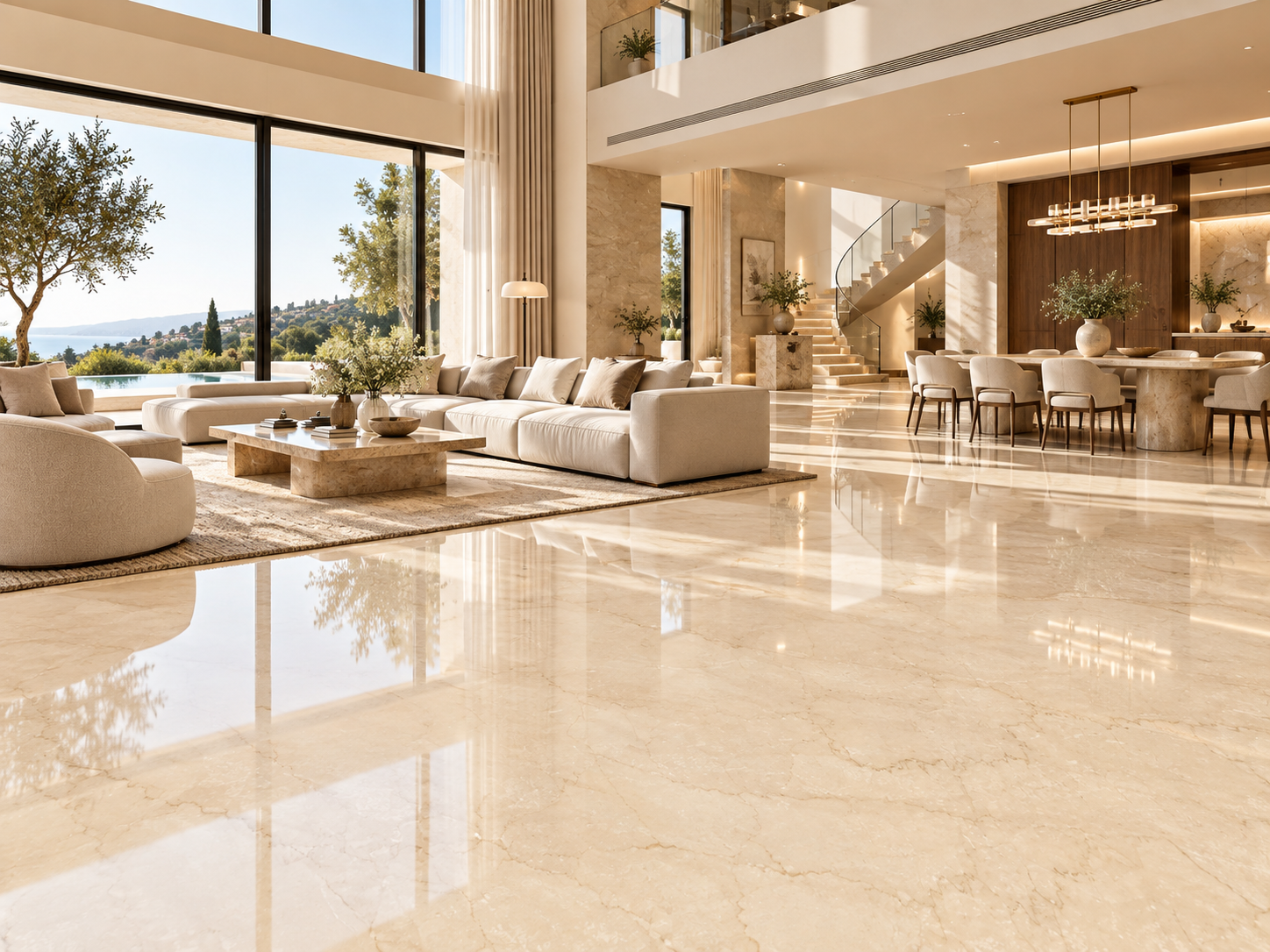
For a premium villa, Italian marble becomes particularly compelling when large connected spaces, stairs, entrance impact, long-term material character and custom floor dimensions matter. Full-slab selection gives the architect more control over the composition of the finished floor.
14 — What about apartments?
Vitrified tile can make excellent practical sense in many apartments when the priorities are predictable budget, quick selection, simple installation, low maintenance and consistent appearance. Marble can still be appropriate in premium apartments, especially in living and dining spaces or selected foyers. Property type alone should not decide the material.
15 — What about staircases?
Marble has a distinctive aesthetic advantage on stairs because treads, risers, landings, fascia and skirting can be fabricated from compatible slabs. Tiles can cover stairs too, but edge detailing, nosing and transition profiles require careful planning.
16 — What about bathrooms?
Tiles often have practical advantages in bathrooms because slip-resistant finishes and low-water-absorption options are widely available. Marble can be used beautifully, but finish, sealing, wet-area detailing and maintenance become more important. Polished flooring in a wet area should be evaluated carefully for slip resistance.
17 — What about kitchen flooring?
Both materials can work. Marble needs awareness of acidic spills, oils, food staining and cleaning methods. Vitrified tile is generally more forgiving for heavy kitchen use. The right answer depends on whether the household prioritises natural character or lower surface sensitivity.
18 — Which one is more consistent?
Vitrified tile. That is one of its genuine strengths. If you want almost identical pieces, tightly controlled dimensions, predictable colour and a repeatable pattern, tile is designed to provide that. Natural marble is not.
19 — Which one is more unique?
Italian marble. Even slabs from the same block can show evolving movement. This gives a floor a character that is difficult to duplicate exactly elsewhere. For many homeowners, that individuality is the reason to choose natural stone.
20 — Sustainability is more complicated than “natural is better”.
Marble requires quarrying, processing and transportation. Vitrified tile requires raw-material extraction, industrial manufacturing, kiln firing and transportation. Environmental performance depends on sourcing, manufacturing, distance, durability, installation and replacement cycle. There is no responsible universal claim that one material is always eco-friendly.
Decision table: which should you choose?
| Your priority | Better starting point |
|---|---|
| Natural individuality | Italian marble |
| Manufactured consistency | Vitrified tile |
| Custom slab-based layouts | Italian marble |
| Lower initial material budget | Vitrified tile |
| Easy routine maintenance | Vitrified tile |
| Surface can be refinished | Italian marble |
| Unique vein movement | Italian marble |
| Predictable sample-to-floor result | Vitrified tile |
| Large premium villa | Italian marble deserves serious consideration |
| High-use utility area | Vitrified tile may be more practical |
Make the choice clearer
The five-question flooring decision test.
Choose the answer that sounds most like your project. The result is a starting point, not a substitute for inspecting the actual material.
Start here: select the priorities that matter most to your project.
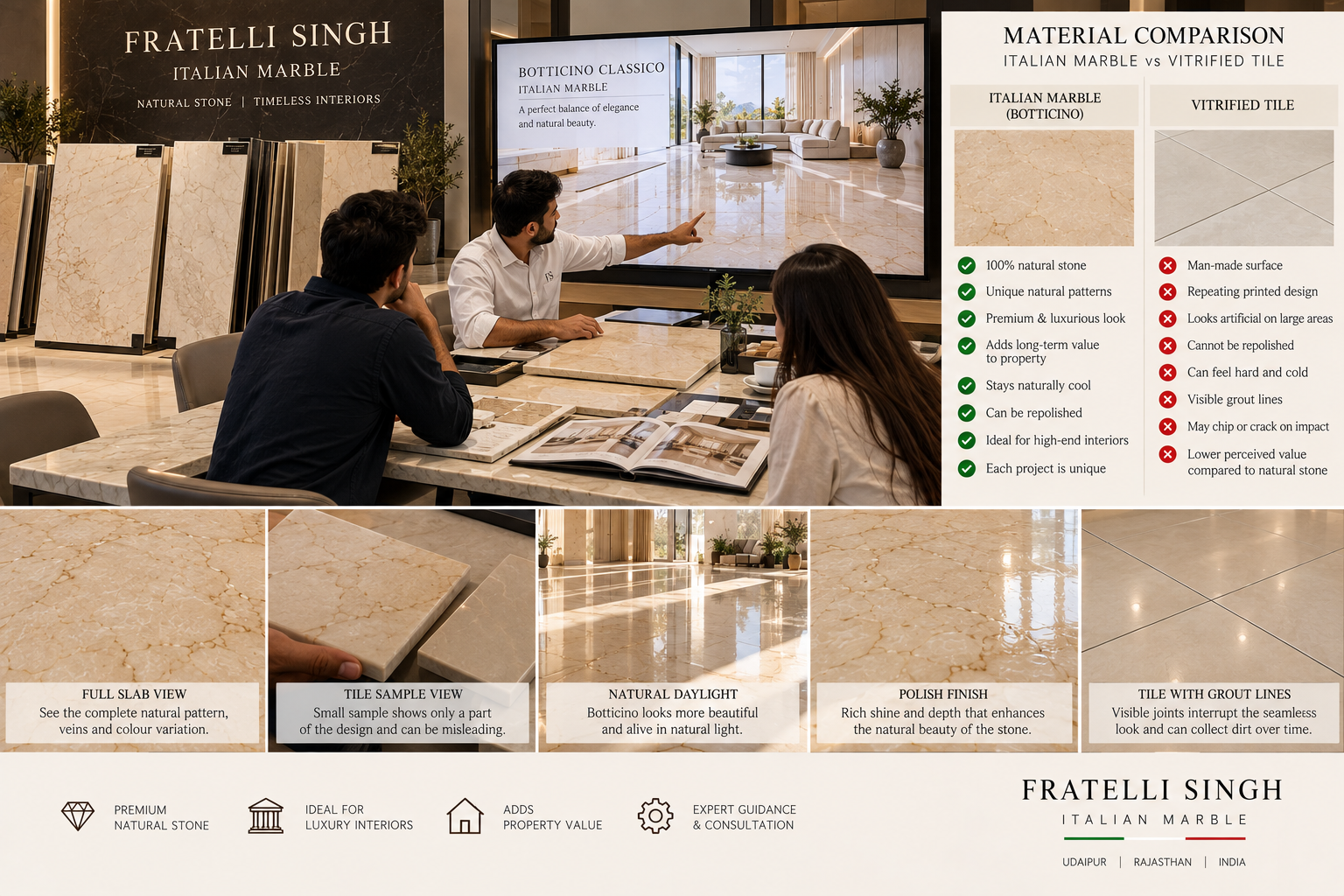
How Fratelli Singh helps compare the real material.
A useful comparison does not end with a brochure image. We encourage architects, designers and homeowners to review the actual slab, intended application, lighting, dimensions, finish, lot compatibility and installation plan before confirming the floor.
For a current selection, share the room type, approximate area, preferred tone, city and whether the project includes stairs or connected spaces. The Fratelli Singh team can help you move from a general marble-versus-tile question to a practical material decision.
Before you finalise
Flooring comparison checklist.
Clear answers
Frequently asked questions.
Is Italian marble better than vitrified tiles?
Neither is automatically better. Italian marble suits natural variation, architectural character and possible refinishing. Vitrified tiles suit manufactured consistency, simpler selection and generally lower initial material cost.
Is Italian marble more expensive than vitrified tiles?
It generally has a higher initial material and installation position than standard vitrified tiles. Compare the complete installed cost rather than only the rate of one square foot.
Which is better for flooring in an Indian home?
Marble is compelling for premium villas and spaces where natural character matters. Vitrified tiles can be practical where predictable budget, consistent appearance and simpler maintenance matter more.
Is Botticino marble good for Indian homes?
Yes. Botticino can work beautifully in living rooms, dining areas, entrances, bedrooms, stairs and other applications when compatible slabs and appropriate finishing are selected.
Which material is easier to maintain?
Vitrified tiles are generally more forgiving. Marble remains practical when cleaned as natural stone and protected from acidic cleaners, abrasives and prolonged spills.
Can Italian marble be repaired or repolished?
Depending on the damage, it may be honed, repolished, refinished or locally restored. A damaged tile is usually replaced.
Does vitrified tile look like real marble?
Premium tile can reproduce marble-inspired patterns convincingly, but genuine marble has natural mineral depth and variation that a printed surface does not reproduce in exactly the same way.
Is marble cooler than vitrified tile?
Stone can feel cool underfoot, but actual temperature depends on the building, sunlight, insulation, subfloor, climate and air conditioning. Avoid fixed cooling claims.
Should marble be selected from a full slab?
For important flooring projects, yes. A small sample cannot show the complete movement, shade, usable dimensions or compatibility of a natural slab lot.
What should I choose for a luxury villa?
Italian marble deserves serious consideration when natural individuality, connected spaces, staircase continuity and full-slab selection matter. Premium vitrified tiles may still be right when consistency and lower initial cost matter more.
Still deciding between marble and tile?
Share your room type, approximate area, budget direction, preferred tone and city. Fratelli Singh can help you compare the right material and current slab availability.
Request assistance ↗