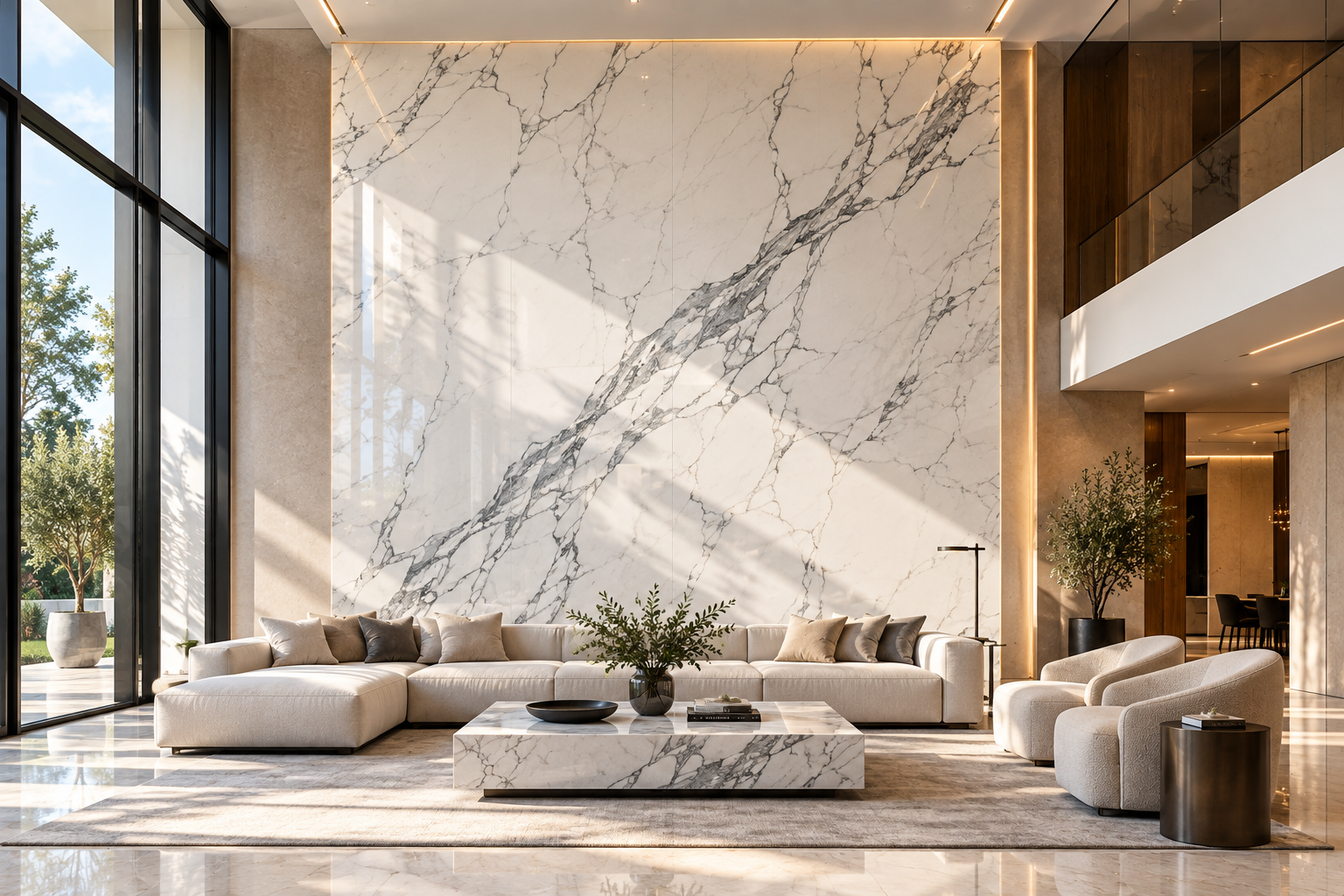
Quick answer: Statuario works best where its natural vein movement can be appreciated without competing with too many other strong finishes. Use dramatic slabs where you want attention, and calmer selections where the material will repeat across a large surface.
Where Statuario works
One strong architectural role is often enough.
Statuario is one of the most recognisable white Italian marbles used in premium interiors. In India, you may also hear the name written or pronounced as Satvario or Satwario. Statuario is the standard international spelling; Satvario and Satwario are common trade spellings.
It is associated with Italy’s Carrara marble district and is generally recognised by a white to soft ivory background with distinctive grey movement. The actual selected slab remains the authority because natural tone, vein density and surface characteristics vary.
| Application | Why it works |
|---|---|
| Feature wall | Shows the scale and movement of the complete slab |
| Bookmatched wall | Creates a deliberate mirrored composition |
| Entrance or foyer | Creates a strong first visual impression |
| Staircase | Carries selected movement vertically through the architecture |
| Bathroom wall | Creates impact in a contained visual zone |
| Vanity or island | Turns one carefully chosen slab into a feature object |
| Flooring | Works when background, lot and vein movement are carefully controlled |
01 — Start with the whole slab.
With Statuario, the veins are not a minor detail. They are often the main reason the slab is selected. Before approving one, stand back and inspect the complete surface rather than judging only the whitest corner.
Look at the composition
- Vein direction and thickness
- Open white areas
- Intersections and secondary movement
- Balance from one edge to another
Look at the project fit
- Finished dimensions
- Visible cut zones
- Adjacent slab compatibility
- Lighting and surrounding finishes
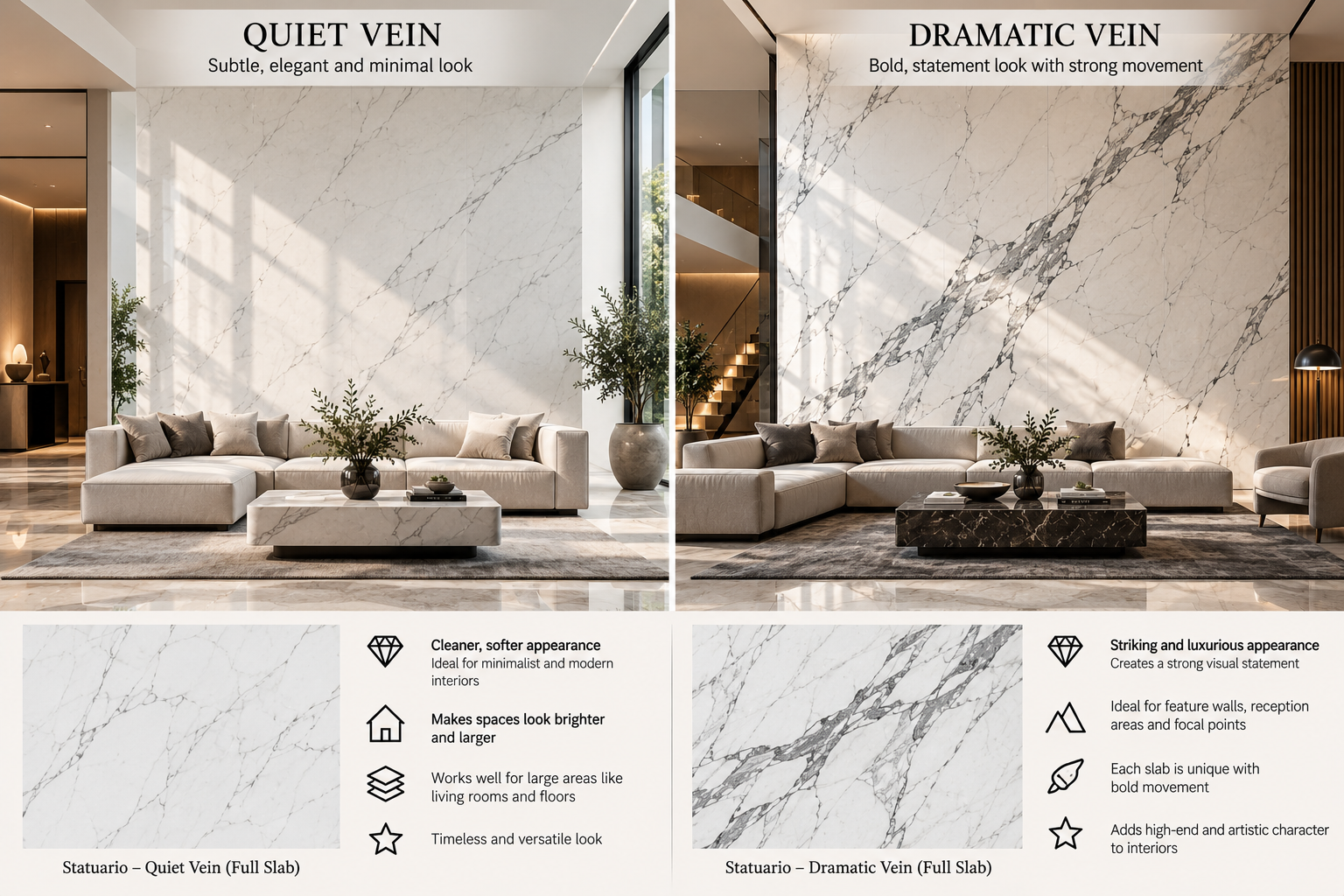
02 — More veining does not automatically mean better.
A highly dramatic slab can look exceptional when viewed individually. Place several heavily veined slabs across a floor or wall, however, and the result may become visually overwhelming. The best Statuario depends on how much of it will be visible and how often the pattern repeats.
| Selection | Visual character | Good starting applications |
|---|---|---|
| Quieter Statuario | Open white background and finer movement | Large floors, multiple walls, calm bedrooms |
| Balanced Statuario | Clear grey movement with open background | Walls, stairs and premium floors |
| Dramatic Statuario | Dense expressive veins and strong direction | Feature walls, tables, bookmatch and focal points |
The useful question is not “how white is it?” but “what should the complete surface say?”
03 — Feature walls are one of its strongest applications.
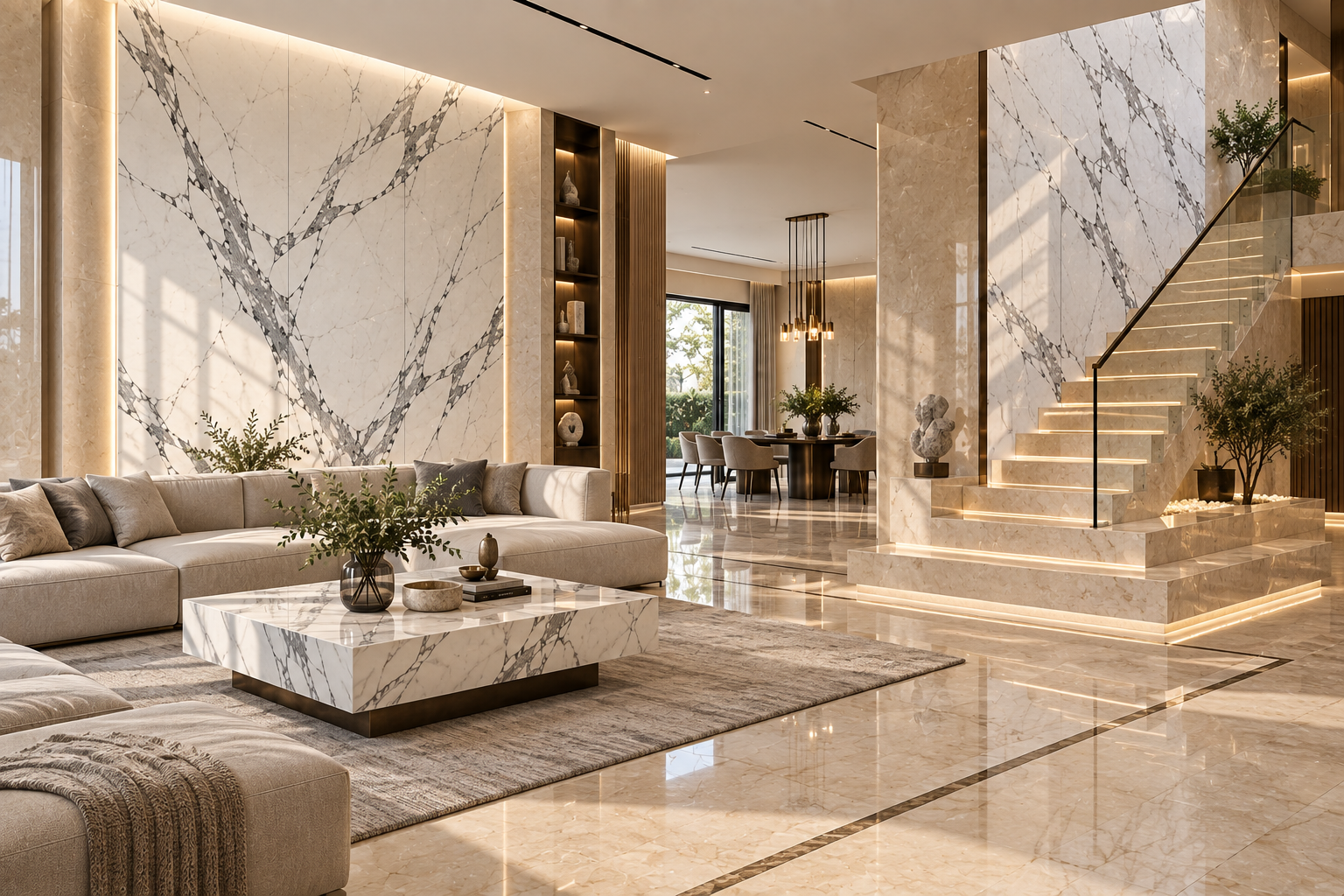
A feature wall allows Statuario to be viewed almost like artwork. It can work in a double-height living room, entrance foyer, reception area, television wall, formal dining area or hotel lobby. The surrounding materials should usually be quieter so the stone has visual room to breathe.
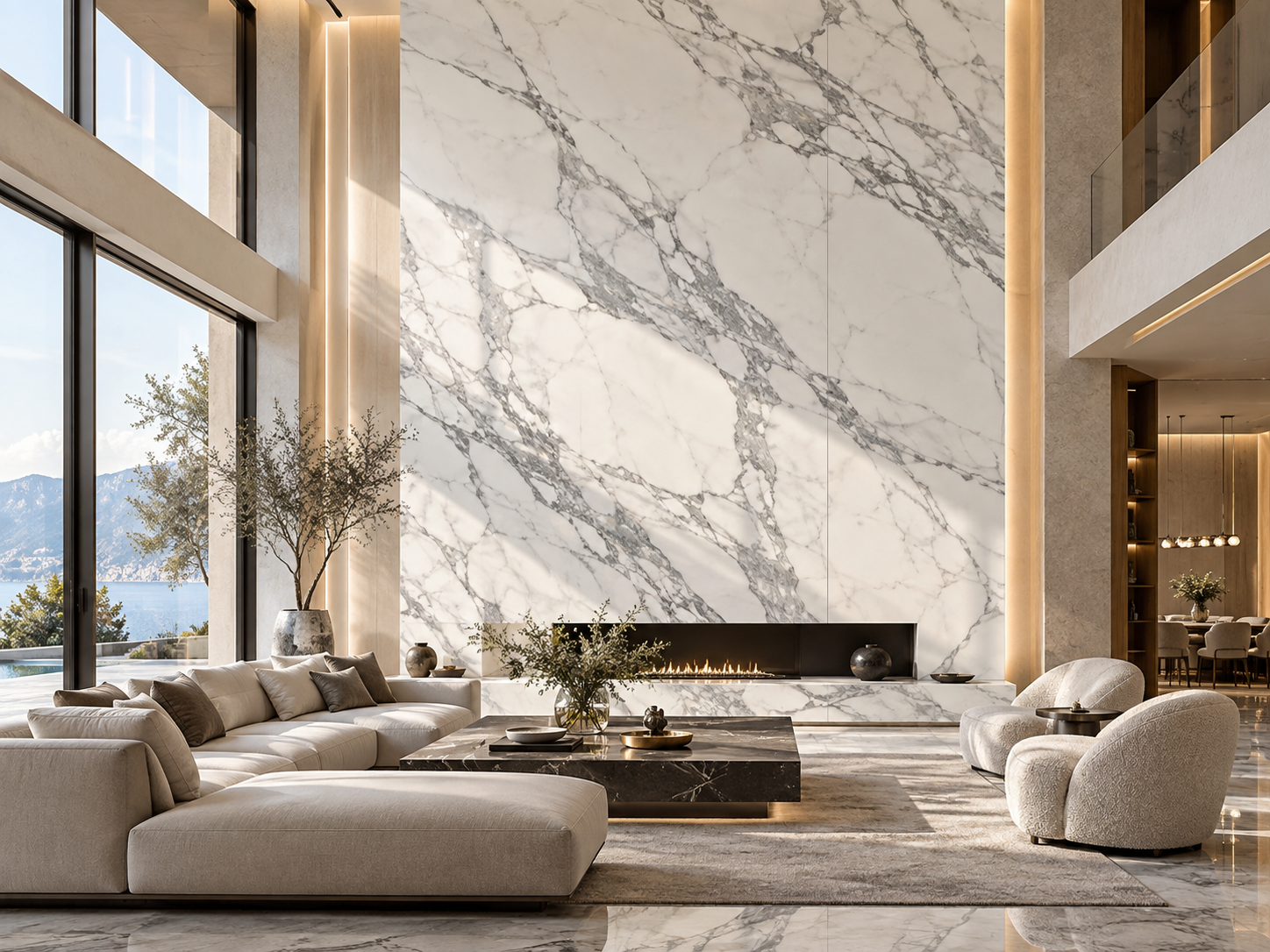
Three large slabs can create a continuous architectural field, but the joints and sequence should remain realistic. Natural stone should not be forced into an impossible repeated pattern simply to imitate a printed surface.
04 — Bookmatching creates a deliberate focal point.
Bookmatching uses sequential slabs so their vein patterns create a mirrored effect when opened beside one another—like the pages of a book. It is particularly effective for feature walls, master bathrooms, entrance panels, dining backdrops and hotel reception walls.
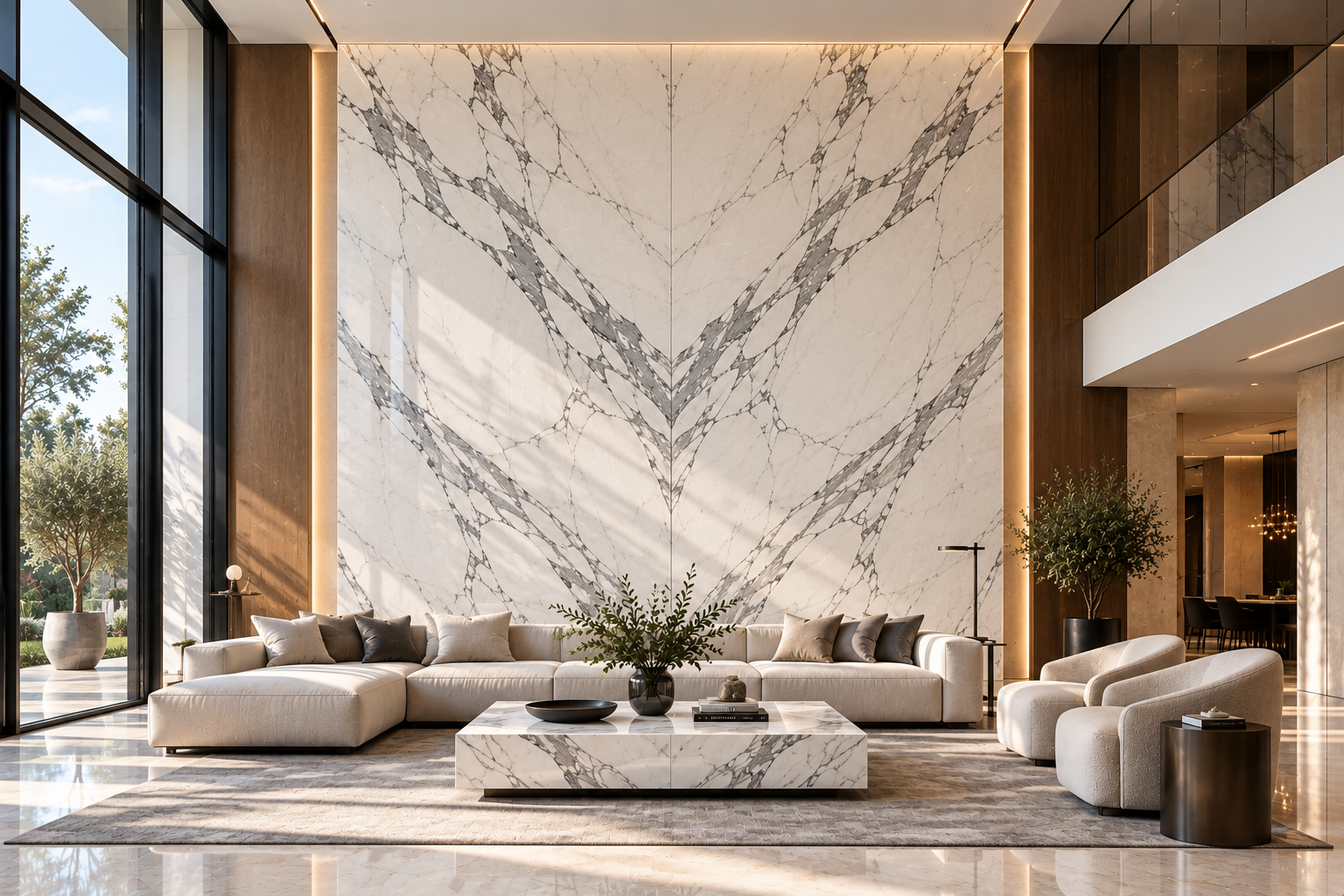
Not every pair is suitable. Review the sequence, direction, usable dimensions and intended cut before approving the bookmatch.
05 — When bookmatching becomes too much.
Bookmatching is already visually powerful. Patterned wallpaper, ornate furniture, heavy decorative lighting, multiple other marbles and strong flooring patterns can make the room feel competitive. A simple rule helps: let one material dominate each visual zone.
If Statuario is the statement
Use quieter flooring, warm timber, plain upholstery and restrained metal accents around it.
If the room is already expressive
Choose a calmer Statuario selection or reserve it for one contained application such as a vanity or table.
06 — Can Statuario be used for flooring?
Yes, but the selection strategy changes. A feature wall may use two or four slabs; a large floor may require dozens. That means background consistency, vein density, quantity, slab dimensions, lot matching, piece size, laying direction and dry layout all become important.
| Flooring priority | Why it matters |
|---|---|
| Compatible lot | Keeps a large floor visually balanced |
| Background tone | Prevents sudden colour changes between zones |
| Vein density | Controls visual intensity when repeated |
| Slab dimensions | Affects cut size, joints and wastage |
| Thickness | Supports level and installation planning |
| Dry layout | Lets the team review the final composition before fixing |
For the complete flooring process, read the Italian marble flooring guide →
07 — Statuario staircases need a cutting plan.
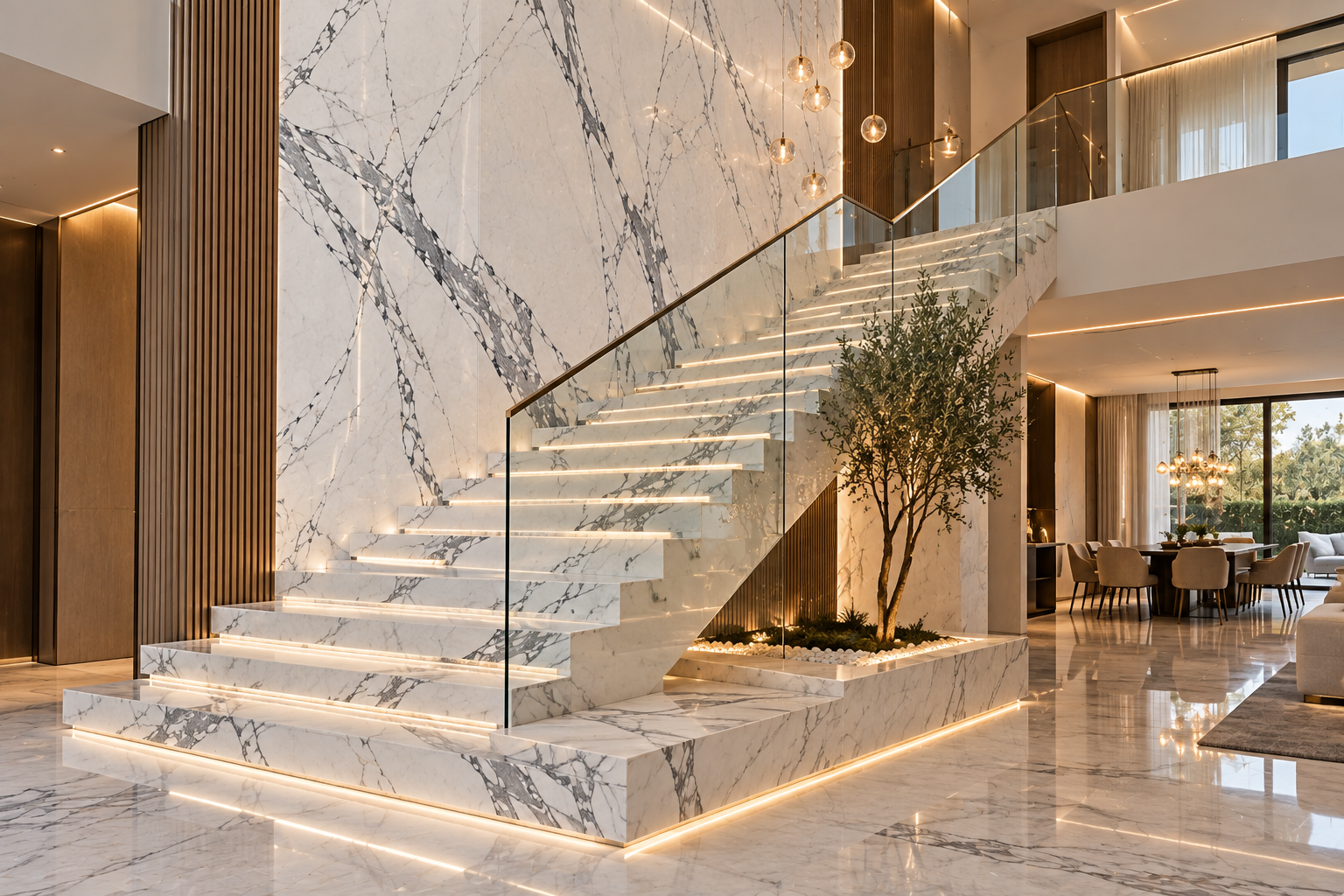
A Statuario staircase can become one of the strongest architectural features in a house, but the pieces should not be cut randomly. Decide where the major vein should run on treads, whether risers should continue the movement or become quieter, how the landing connects visually and which edge profile suits the architecture.
08 — Statuario in bathrooms.
Bathrooms are ideal for statement marble because the visual zone is contained. Statuario can be used on a shower wall, vanity wall, bath backdrop, vanity top or selected floor. Covering every wall, floor, niche and vanity with heavily veined stone can dilute the effect.
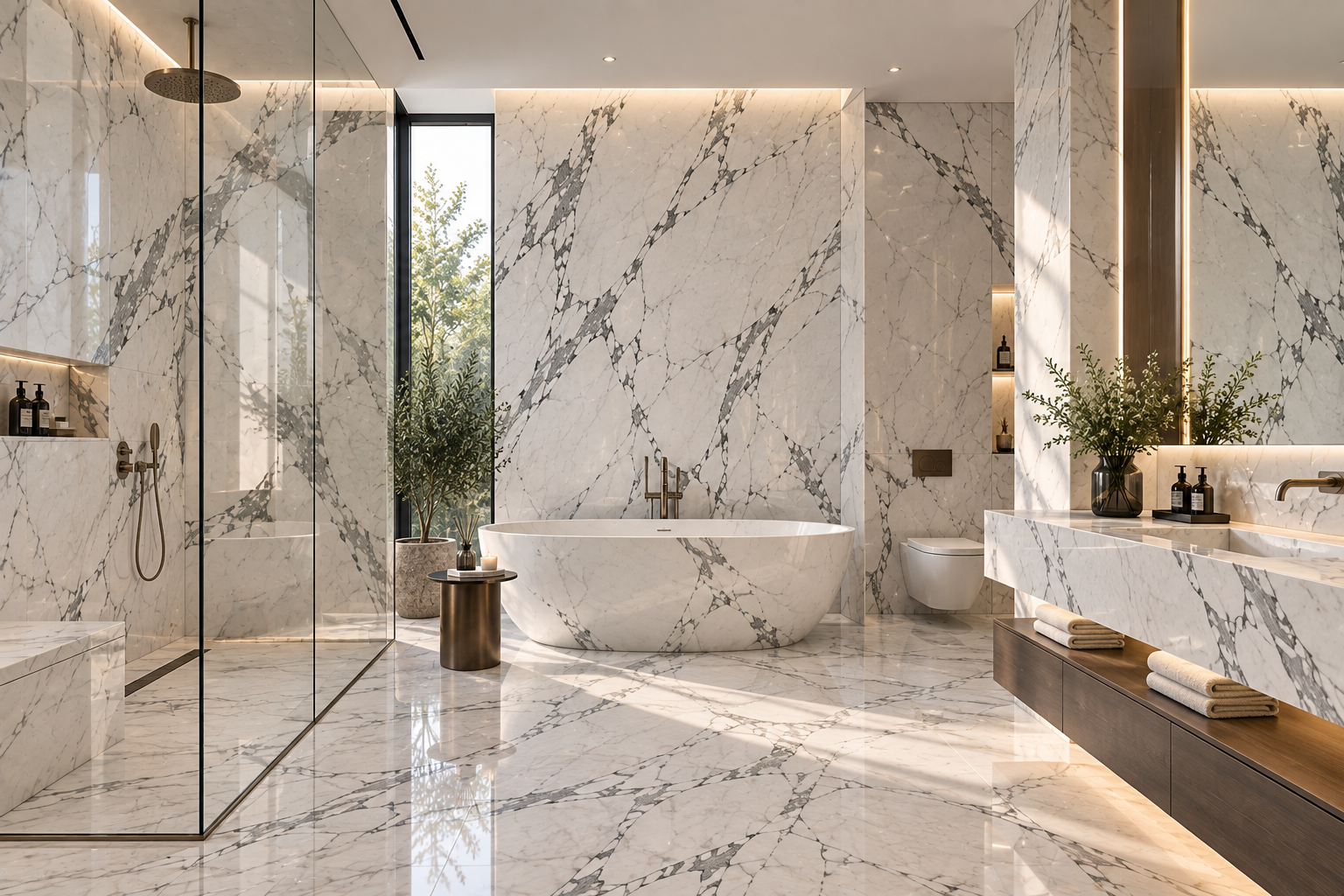
Option 01
Statuario feature shower wall + neutral stone floor + warm timber vanity.
Option 02
Statuario vanity and backsplash + quiet wall finish + subtle floor.
09 — Kitchen islands and dining tables.
Statuario is effective when one large slab becomes a single object: a kitchen island, dining table, console, vanity or bar counter. The exact position of the cut matters. Decide which part of the slab should become the visible surface before fabrication, rather than cutting the first available rectangle.
10 — Lighting can change Statuario more than expected.
White marble responds strongly to its lighting environment. Daylight usually gives the most neutral impression. Warm light can shift the background toward cream or ivory; cool light can strengthen grey or blue undertones; grazing light can make veins and surface characteristics appear stronger.
| Light condition | Possible effect |
|---|---|
| Daylight | Shows a more neutral background and natural movement |
| Warm interior light | Warms white marble toward cream or ivory |
| Cool interior light | Can emphasise grey or blue undertones |
| Grazing light | Strengthens visible veins and surface character |
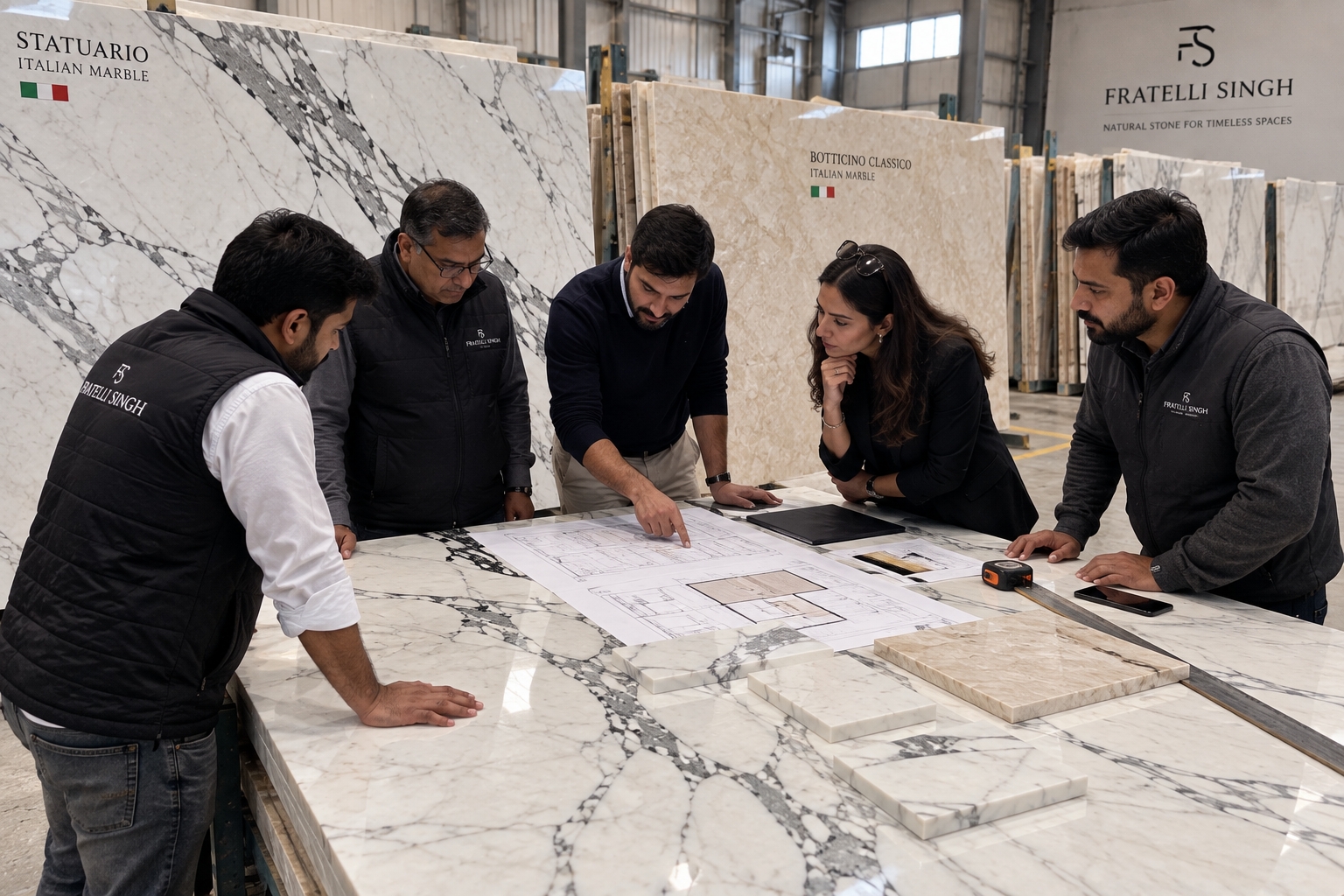
Review a slab under the kind of light it will experience in the finished interior. Warehouse lighting alone is not enough.
11 — Statuario and warm wood.
Statuario’s white and grey movement can feel cooler when used without contrast. Walnut and warm oak introduce softness, natural texture and visual warmth. The combination works in living rooms, bedrooms, dining areas, vanities and reception spaces without making the marble feel clinical.
12 — Statuario and metal.
| Metal | Effect |
|---|---|
| Brushed brass | Warmer and more decorative |
| Bronze | Understated and architectural |
| Black | Strong contemporary contrast |
| Nickel or stainless steel | Cooler and cleaner |
Use metal as an accent rather than competing with the marble. A few consistent details usually feel more intentional than mixing several finishes.
13 — Statuario and Botticino.
This can be a particularly useful Fratelli Singh combination. Botticino can form the warmer, quieter architectural base—flooring, staircase surround or secondary areas—while Statuario becomes the statement wall, vanity, table or reception element.
14 — Statuario versus Botticino.
| Feature | Statuario / Satvario | Botticino |
|---|---|---|
| Base tone | White to light | Warm beige |
| Vein character | Grey and expressive | Beige or brown natural movement |
| Visual intensity | Medium to high | Low to medium |
| Best role | Statement material | Architectural base |
| Feature walls | Excellent | Suitable |
| Large flooring | Needs careful selection | Particularly versatile |
| Interior mood | Bright and expressive | Warm and understated |
Neither is automatically better. They perform different design roles.
15 — Statuario versus Calacatta versus Carrara.
Buyers often group white Italian marbles together, but their visual characteristics can differ. Carrara is widely associated with softer, often greyer movement, while Statuario is generally recognised for a lighter base with stronger grey veins. Calacatta is another distinct white Italian marble family and should not simply be treated as another name for Statuario.
Names help narrow a search; the actual slab should always be viewed before a final comparison.
16 — How to inspect Statuario before buying.
Do not judge only how white the slab is. For expressive stone, inspect:
- Overall composition: does the complete slab feel balanced?
- Vein location: will the major movement remain visible after cutting?
- Background: does the tone suit the room and nearby materials?
- Adjacent slabs: do the slabs work together as a sequence?
- Dimensions: can the intended pieces actually fit?
- Surface finish: is the polish consistent across the lot?
- Natural characteristics: are fissures, veins, repairs or treatments understood?
For a deeper inspection process, read How to check Italian marble quality before buying →
17 — Design before you cut.
For expressive marble, the sequence matters:
- Space. Understand the room, elevation and sightlines.
- Application. Decide whether the stone is for floor, wall, stair, table or bathroom.
- Final dimensions. Fix the visible piece sizes and joints.
- Design intent. Decide where the strongest movement should appear.
- Select slab. Review the full slab and compatible sequence.
- Position template. Mark the cut over the actual material.
- Cut. Fabricate only after the design has been checked.
Avoid buying a slab, cutting randomly and then trying to make the room work around the leftover pattern. One major vein can completely change the character of a finished piece.
18 — Common Statuario mistakes.
- Using it on every surface: the stone loses its impact.
- Selecting only for whiteness: vein composition may matter more.
- Ignoring slab sequence: especially risky for bookmatched walls.
- Choosing from a small sample: full movement cannot be understood from a small piece.
- Cutting before designing: important parts of the slab may be lost.
- Combining too many statement materials: the interior becomes visually competitive.
- Expecting perfect repetition: natural variation is part of the material.
The Fratelli Singh Statuario selection method.
| Question | Why it matters |
|---|---|
| Where is the stone being used? | Floor, wall, stair, table, bathroom or counter each need a different selection direction. |
| How much will be visible? | One slab can carry more intensity than dozens across a floor. |
| How strong should the veins be? | Choose quiet, balanced or dramatic movement for the intended scale. |
| What surrounds it? | Wood, metal, Botticino, fabric, paint and lighting all change the reading. |
| What needs to be cut? | The fabrication plan should influence slab selection from the beginning. |
SPACE + APPLICATION + VEIN INTENSITY + SURROUNDING MATERIALS + CUTTING PLAN = A BETTER STATUARIO DECISION
Before you approve the slab
Statuario selection checklist.
Clear answers
Frequently asked questions.
Is Statuario the same as Satvario?
In the Indian stone trade, Satvario is commonly used as a phonetic or regional spelling for Statuario rather than as a separate formal marble name.
Is Satwario marble the same as Statuario?
Satwario is another spelling sometimes used in India when referring to Statuario-style marble. Statuario is the standard name used throughout this guide.
Where does Statuario marble come from?
Statuario is associated with Italy’s Carrara marble district, an area internationally known for white marble production. Confirm the origin and material identity for the actual selected slab.
What colour is Statuario marble?
It generally has a white to light background with distinctive grey vein movement. Exact colour and veining vary naturally from slab to slab.
Is Statuario suitable for flooring?
Yes, but large floors need careful lot matching, quantity planning, dimensions and control of vein movement.
Is Statuario good for feature walls?
Yes. Feature walls are one of its strongest applications because the full scale of the vein movement remains visible.
Can Statuario marble be bookmatched?
Sequential slabs with suitable patterns and dimensions can create striking bookmatched installations.
Is more veining better in Statuario?
Not necessarily. Dramatic veins suit statement applications, while quieter slabs may be better for floors, multiple walls and repeated surfaces.
Is Statuario suitable for staircases?
Yes. Plan tread lengths, vein direction, risers, edge detailing and slab dimensions before cutting.
Does every Statuario slab look the same?
No. It is natural stone, so background tone, vein movement and natural characteristics vary.
What works well with Statuario marble?
Warm woods, neutral fabrics, restrained metals and quieter surrounding surfaces generally work well.
Can Statuario and Botticino be used together?
Yes. Botticino can form a warm architectural base while Statuario becomes the statement element.
Should I choose Statuario from a sample?
A sample can help with initial colour understanding, but full slabs are much more useful for final selection because the complete vein structure is important.
How should I choose Statuario for a table or island?
Choose the intended finished dimensions first, then position the template over the slab so the strongest veins appear where you want them in the final piece.
Planning a Statuario interior?
Share the application, approximate dimensions, preferred vein intensity and surrounding materials. Fratelli Singh can help you compare full slabs and plan the right cut.
Request assistance ↗