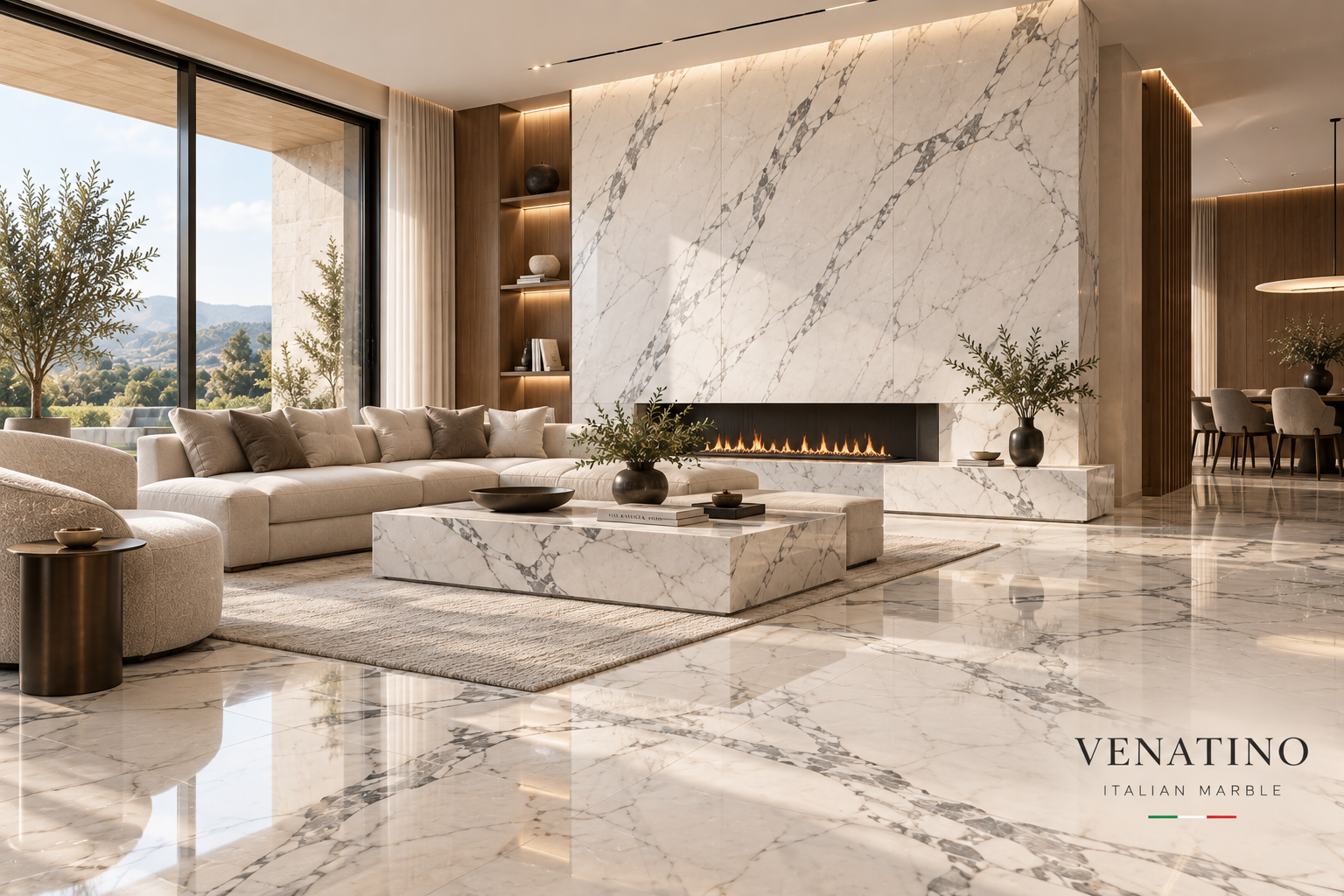
Quick answer: Venatino is a strong choice when an interior needs a light marble palette, fine grey veining and a contemporary character without the visual intensity of a dramatic white statement marble. It is especially useful for large floors, bright bathrooms, restrained feature walls and carefully planned staircases.
A quieter white marble
Refinement through restraint.
Not every white Italian marble needs bold, high-contrast veining. Venatino works best when the marble should support the architecture rather than dominate it. Its appeal is often in a calm white field, controlled grey movement and an ability to sit naturally with pale timber, soft grey, white oak, ivory upholstery, minimal joinery and contemporary lighting.
| Where it works | Why it works |
|---|---|
| Large flooring | Fine movement is easier to repeat without making the floor visually busy. |
| Bathrooms | The lighter palette can make a smaller room feel more open. |
| Feature walls | It creates an architectural backdrop rather than a dramatic statement. |
| Staircases | Fine movement helps treads and risers feel controlled and connected. |
| Minimal interiors | It leaves room for furniture, art, light and joinery to do their work. |
01 — What does Venatino look like?
Venatino generally belongs to the white-to-light marble family with fine grey vein movement. Depending on the lot, the background may read as bright white, soft white, slightly creamy or lightly greyed. Its veins can be fine, linear, cloudy, lightly webbed or gently directional, giving the stone a softer rhythm than heavily veined statement marbles.
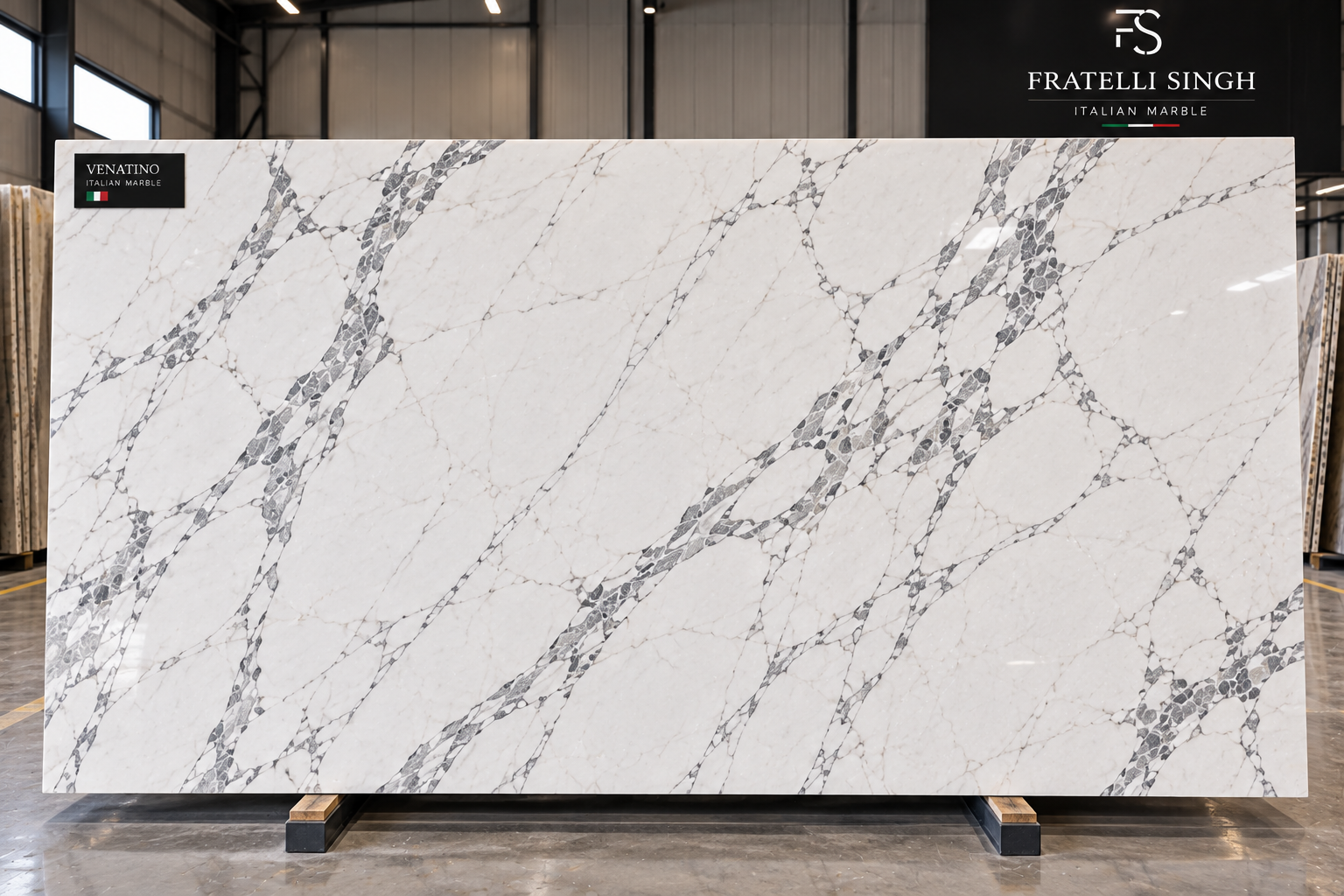
Look for a balanced field
For broad flooring, choose enough open white background to keep a repeated surface quiet and bright.
Use stronger movement intentionally
Slabs with more concentrated grey detail can be excellent for a wall, table, stair landing or another focal application.
02 — Venatino versus Statuario / Satvario.
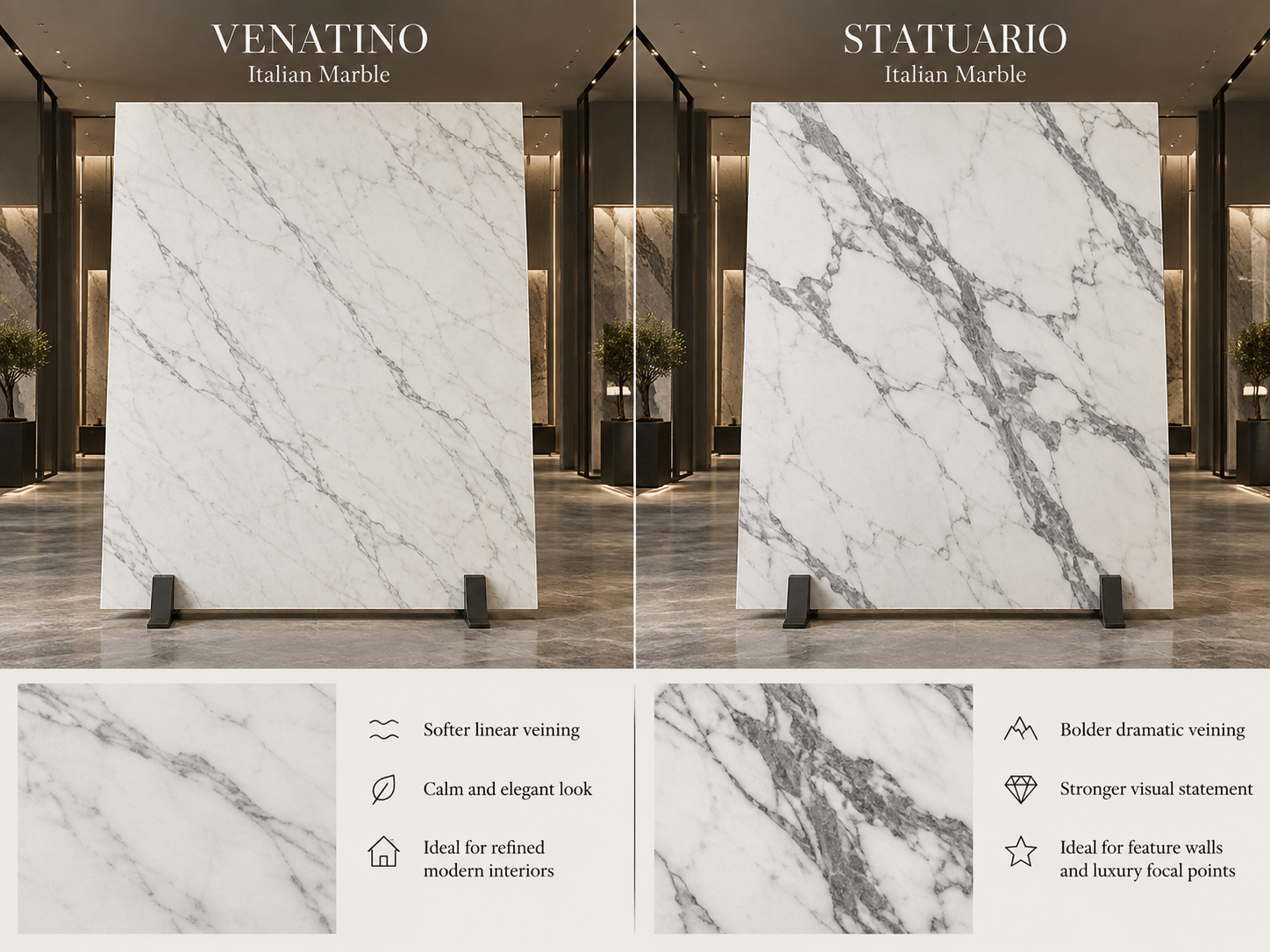
Both can sit in the white Italian marble conversation, but they create different interiors. The simple difference is this: Venatino whispers; Statuario speaks louder.
| Feature | Venatino | Statuario / Satvario |
|---|---|---|
| Background | Soft white / light | White / bright |
| Veining | Fine and restrained | Stronger and more expressive |
| Visual intensity | Low to medium | Medium to high |
| Best role | Calm architectural surface | Statement surface |
| Flooring | Very suitable | Needs more vein control |
| Feature wall | Elegant | Dramatic |
03 — Why Venatino suits modern interiors.
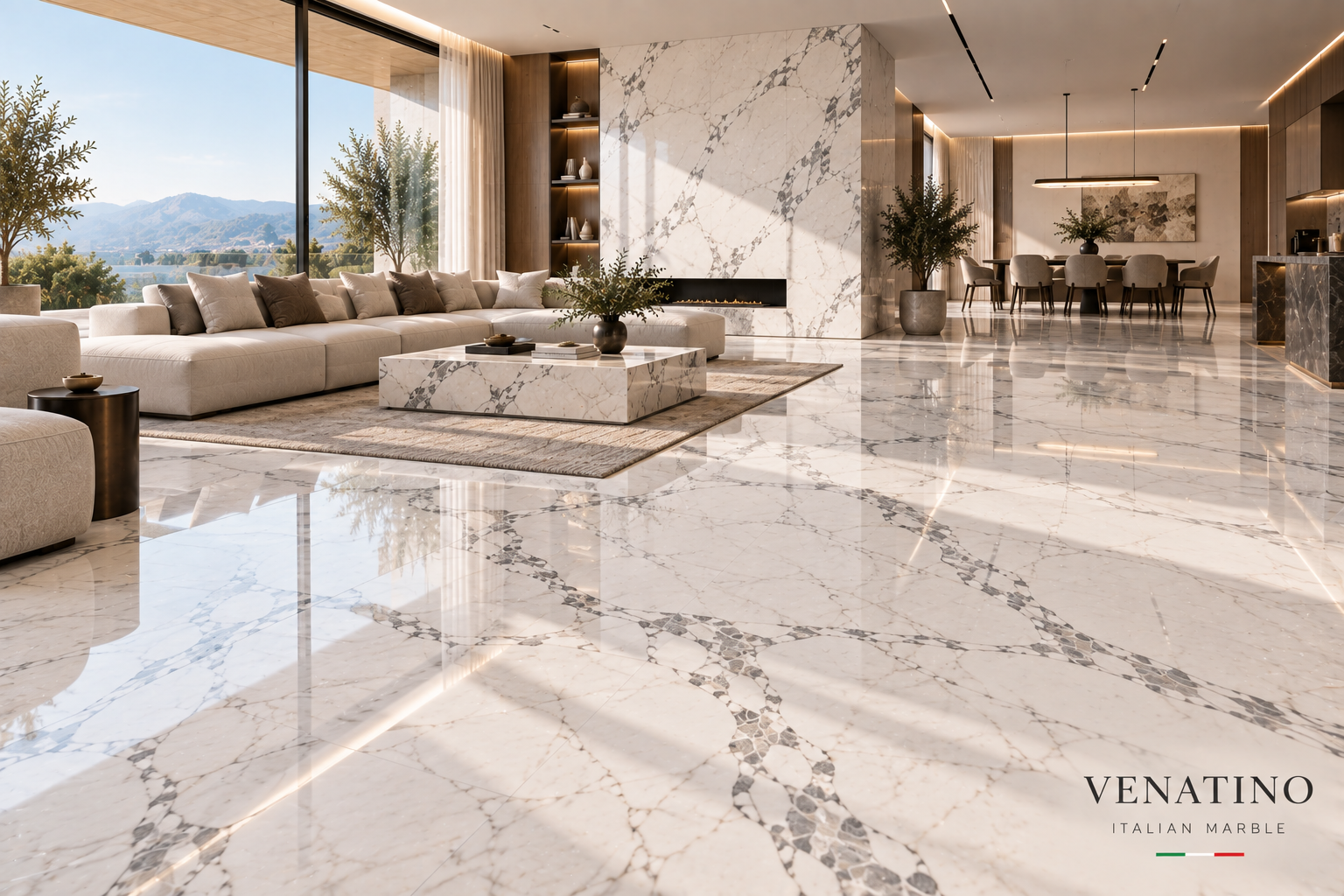
Modern interiors rely on proportion, light, texture, restraint and fewer competing materials. Venatino supports that language because its veining is often subtle enough not to overpower the room. It can make an interior feel bright, calm, clean and refined while still retaining the individuality of natural stone.
04 — Is Venatino good for flooring?
Yes. Venatino can be particularly effective across large floors because finer movement is easier to repeat without making the space feel crowded. The key is to select slabs as a group, not one piece at a time.
LIGHT BACKGROUND → FINE MOVEMENT → COMPATIBLE LOT → LARGE USABLE SLABS → CONTROLLED LAYOUT
Check background consistency, vein density, slab dimensions, thickness, polish and lot compatibility. The objective is not artificial sameness; it is a group of slabs that reads as one intentional material field across the connected areas.
05 — Venatino for bathrooms.
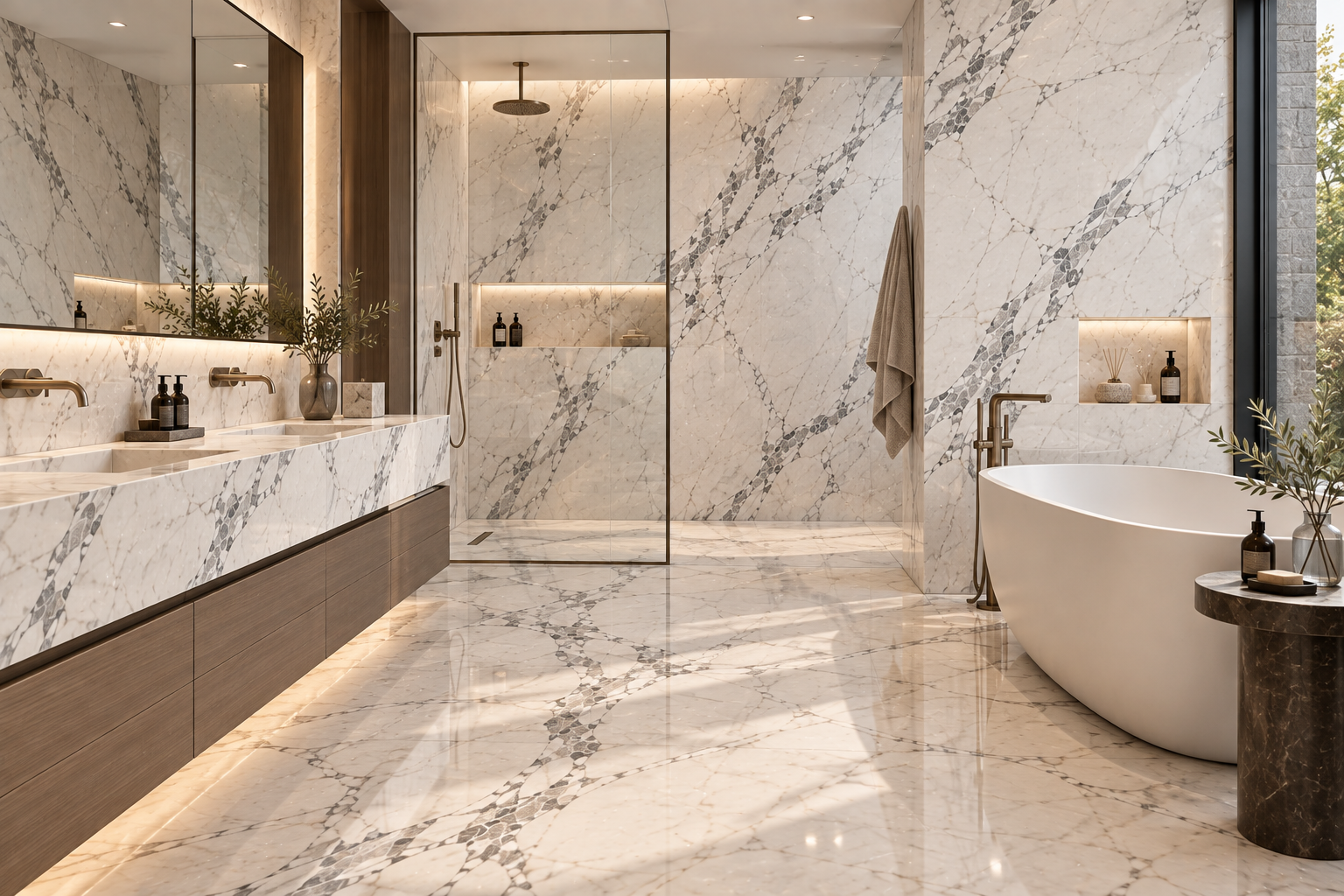
Venatino is particularly well suited to bathrooms because its lighter palette can make smaller spaces feel more open. It works beautifully on shower walls, vanity tops, vanity backdrops, selected floors and bath surrounds. Its fine movement brings natural detail without making the room feel crowded.
06 — Feature walls without visual noise.
A Venatino feature wall creates a quieter effect than Statuario. This makes it a strong choice for bedrooms, reception areas, living rooms, study walls and subtle TV backdrops—especially when the room already has strong furniture, artwork or lighting. Select the wall from the complete slab composition, then decide whether a bookmatch or a continuous directional layout is appropriate.
07 — Venatino with wood and metal.
Venatino works very well with wood. Pale oak produces a soft Scandinavian or contemporary direction; walnut adds contrast and warmth; ash and light timber keep the overall palette bright. The key is to let the fine grey veins remain visible without too many competing textures.
| Metal | Effect with Venatino |
|---|---|
| Brushed nickel | Clean and contemporary |
| Stainless steel | Cooler and minimal |
| Soft bronze | Adds useful warmth |
| Black metal | Creates stronger contrast |
| Brass | More decorative—use selectively |
Because Venatino is visually quiet, it can tolerate a slightly stronger dark metal, charcoal textile, smoked glass or walnut accent without the interior becoming busy.
VENATINO + PALE OR WARM WOOD + ONE DARK ACCENT + TEXTURE = A BALANCED MODERN INTERIOR
08 — Lighting matters.
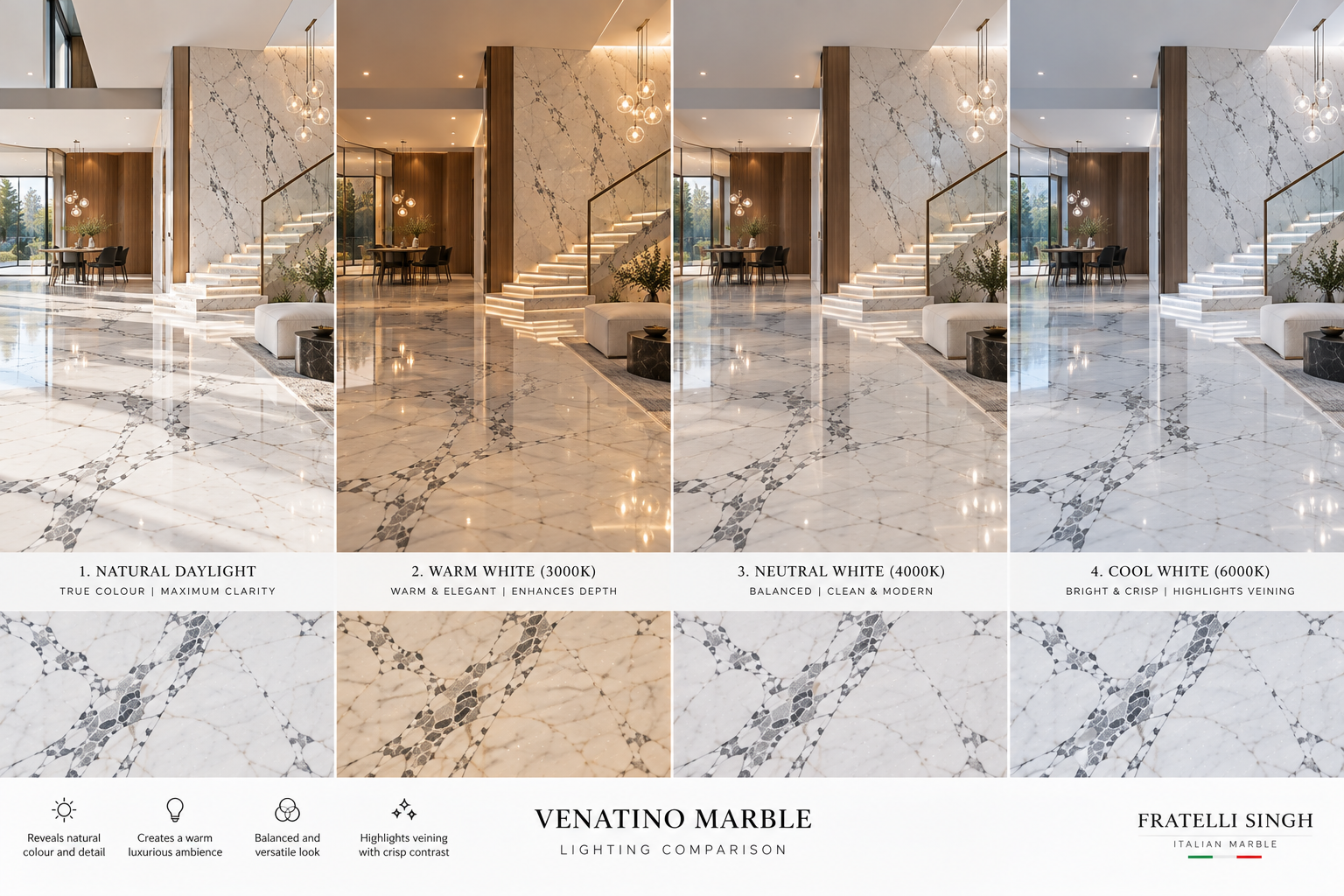
Fine-veined white marble changes noticeably under different lighting. Daylight shows natural grey movement most clearly. Warm light can make the background feel creamier; cool light can strengthen the grey veins; indirect light softens contrast and makes the installation feel more seamless.
09 — Venatino for staircases.
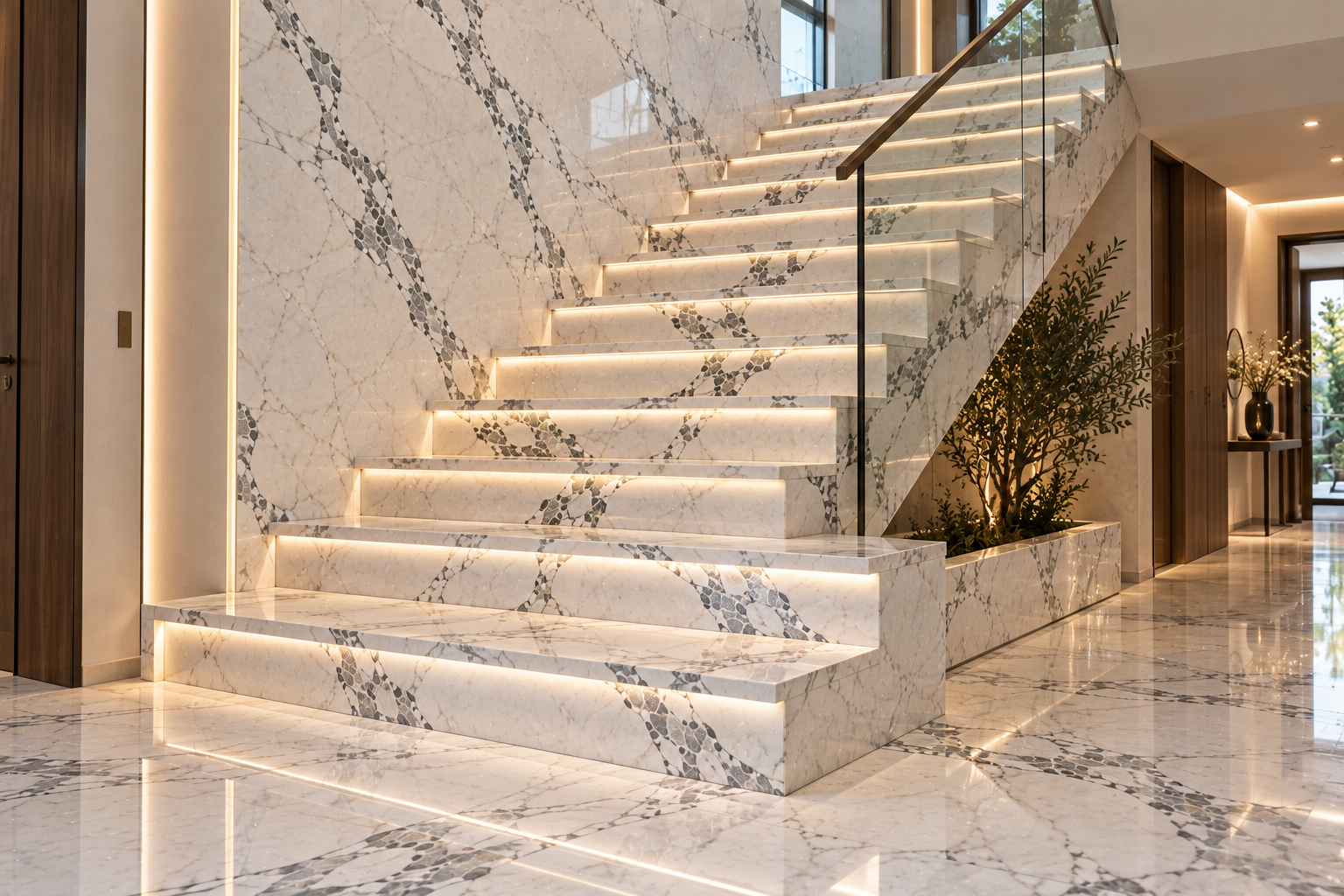
A Venatino staircase can feel especially clean and modern. Plan tread length, riser matching, vein direction, landing continuity and edge profile before fabrication. Fine grey movement can make a staircase look controlled; an unplanned mix of slab direction can make the same staircase feel fragmented.
10 — Venatino versus Vietnam White and Botticino.
White marble varieties are not interchangeable. Vietnam White is often selected for a brighter or more granular white direction, while Venatino carries more linear grey movement and a European white-marble character. Botticino sits at the other end of the mood spectrum: warmer, beige and more classic.
| Feature | Venatino | Vietnam White | Botticino |
|---|---|---|---|
| Base tone | White / soft white | Often brighter white | Warm beige |
| Movement | Fine grey, often linear | Subtler or more granular | Beige-brown movement |
| Interior mood | Refined and calm | Bright and clean | Warm and classic |
| Best for | Modern interiors | Very light palettes | Warm interiors |
11 — Is Venatino too plain?
Not when it is used correctly. A quieter stone gives more freedom to use richer furniture, sculptural lighting, textured wood and focused metal accents without creating visual competition. If the project needs a dramatic statement wall, select a more expressive stone. But if the architecture needs to feel spacious and lasting, quietness can be a strength.
12 — How to select Venatino slabs.
- Choose the application. Define whether the stone will be a floor, wall, stair, bathroom, table or mixed use.
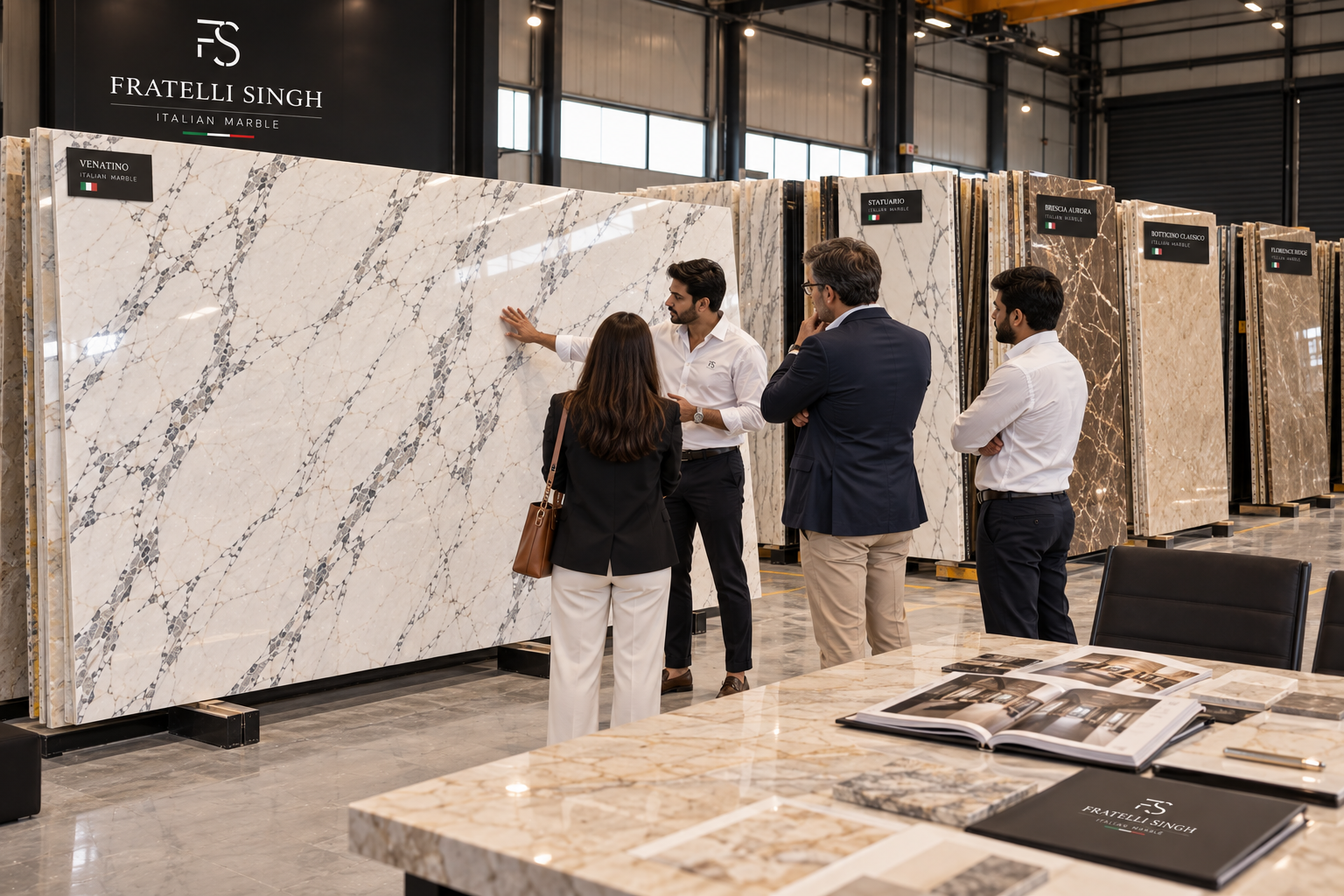
- View complete slabs. Do not make the final decision from a sample.
- Compare backgrounds. Check white-field tone across the intended lot.
- Compare vein density. Decide whether each slab is quiet, balanced or more expressive.
- Check usable dimensions. Confirm slab size, thickness and likely cut pieces.
- Check polish and surface. Inspect the actual finish under suitable light.
- Plan orientation. Map how veins should travel through floors, walls and stairs.
- Finalise the compatible lot. Reserve the material with its intended application in mind.
13 — Common mistakes to avoid.
- Choosing a slab that is too quiet for a statement application: the project may need a stronger marble direction.
- Mixing lots with different white backgrounds: small differences become visible across a large floor.
- Ignoring grey undertones: cool lighting can strengthen them significantly.
- Combining too many pale materials: use a darker or warmer accent so the room does not feel flat.
- Approving from a sample only: a small piece cannot show complete vein direction or usable dimensions.
Before you approve the lot
Venatino selection checklist.
Clear answers
Frequently asked questions.
What is Venatino marble?
Venatino is a light marble known for a white-to-soft-white background and relatively fine grey veining.
Is Venatino an Italian marble?
Venatino is commonly marketed within the Italian marble category. For a specific lot, origin documentation should be checked with the supplier.
Is Venatino good for flooring?
Yes. Its restrained movement suits large flooring areas where a bright and calm surface is preferred, especially when compatible slabs are selected as a group.
Is Venatino good for bathrooms?
Yes. It can work particularly well in bathrooms, vanity areas and shower walls when the material, finish and installation are suitable for the application.
Is Venatino similar to Statuario?
Both are white-marble directions, but Statuario generally carries stronger, more expressive veining while Venatino tends to be calmer and finer.
Does Venatino look good with wood?
Yes. Pale oak, walnut and other warm woods can add useful contrast and warmth to its white and grey palette.
Is Venatino suitable for staircases?
Yes. Fine movement can create a clean staircase when tread, riser and landing slabs are planned together.
Should I choose Venatino from a sample?
Use a sample to understand the general colour family, but make the final selection from full slabs so vein density, direction and lot consistency are visible.
Planning a Venatino interior?
Share the application, approximate area, preferred level of movement, surrounding materials and delivery city. Fratelli Singh can help you compare full slabs and current compatible lots.
Request assistance ↗