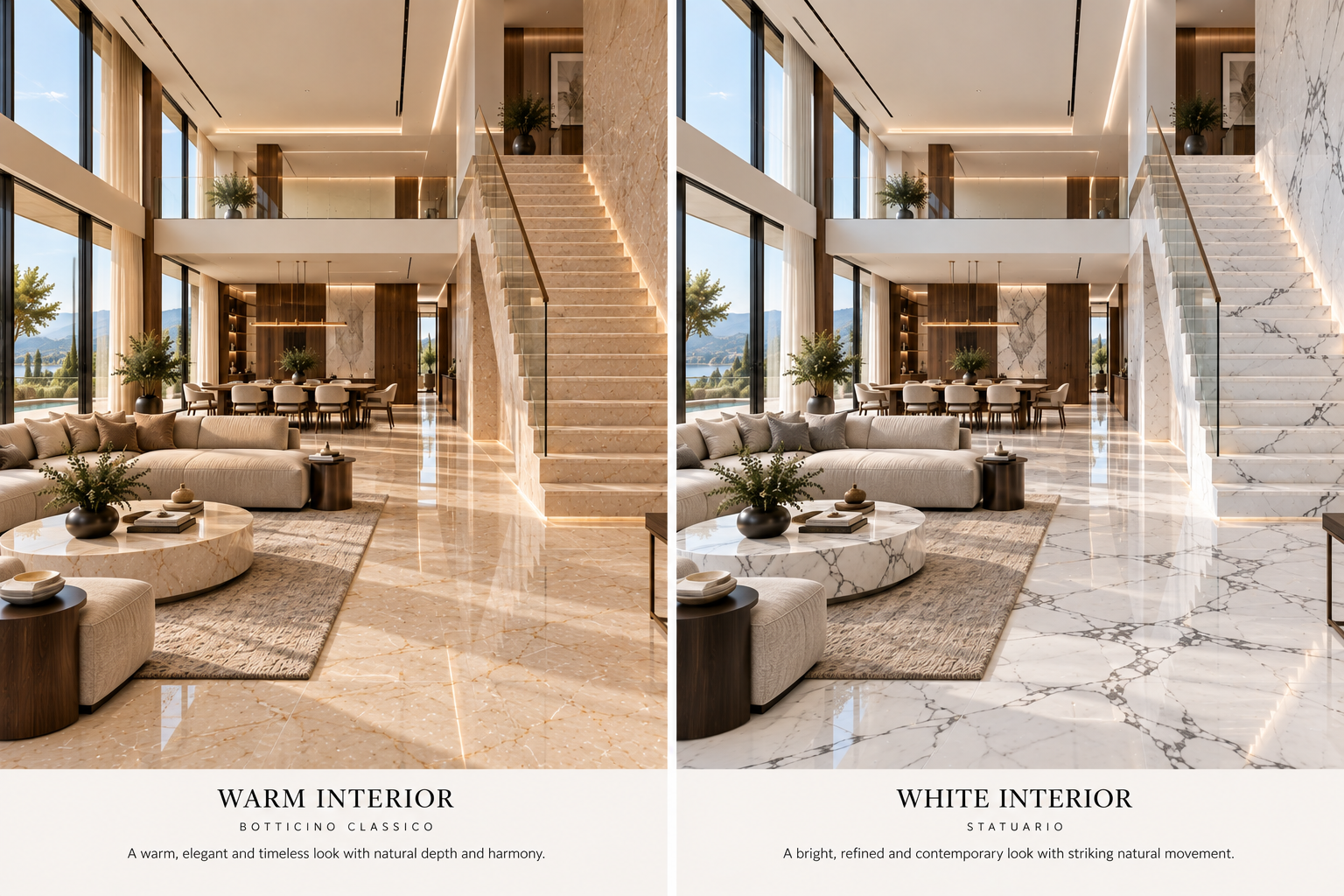
Quick answer: warm marble tends to make an interior feel softer, richer and more grounded; white marble tends to feel brighter, cleaner and more contrasting. Neither direction is automatically more luxurious. The better choice depends on the architecture, daylight, wood tone, furniture, wall colours, room size, vein intensity and the role the stone should play.
When selecting marble, homeowners often reduce the decision to “beige or white?” But these backgrounds change how the rest of the room is perceived. A warm stone may connect naturally to timber and bronze; a white stone may sharpen contrast and make its veins more prominent. The useful question is: which background will best support the rest of the interior?
At a glance
Choose the direction that supports the room.
| If you want… | Consider… |
|---|---|
| Warm, inviting interior | Warm marble |
| Bright, airy interior | White marble |
| Dark walnut furniture | White or balanced warm marble |
| Classical villa | Warm marble often works naturally |
| Minimal contemporary home | White or fine-veined marble often works well |
| Cream and beige palette | Warm marble |
| Strong black accents | White marble |
| Large continuous flooring | Calm warm or restrained white marble |
| Dramatic feature wall | Expressive white marble can be effective |
| Hotel-like warmth | Warm marble |
01 — What is a warm marble?
Warm marble usually carries beige, cream, taupe, soft-brown or golden-grey undertones. Within the Fratelli Singh collection, Botticino, Marmi Crema and Brescia Aurora can each belong to a warm direction, while still having different vein movement and visual intensity.
Warm marble tends to interact naturally with walnut and oak, bronze and brass, cream upholstery, taupe fabrics and warm wall colours. In combination, the stone and surrounding palette usually feel more grounded and inviting.
02 — What is a white marble?
White marble ranges from quiet fine-grained surfaces to highly expressive grey-veined slabs. In the collection, Statuario / Satvario generally represents stronger movement, Venatino a finer and calmer direction, and Vietnam White a brighter field with its own natural character.
White marble interacts strongly with the colours around it. It can work with light oak or dark walnut; bronze, black or nickel; and ivory, grey or beige fabrics. Depending on those choices, the room can feel soft and minimal or create strong contemporary contrast.
03 — Which makes a room feel bigger?
A lighter white marble can make a room feel brighter and more open. This can help in smaller rooms, apartments, narrow passages, bathrooms or spaces with less natural light. But colour alone does not determine spatial perception: piece size, joint pattern, wall colour, ceiling height, furniture density and lighting also matter.
A highly veined white marble can feel busier than a quiet beige marble. So white does not automatically mean calmer, and warm does not automatically mean dark. Consider how the actual movement will repeat across the surface and the distance from which it will be seen.
04 — Which feels warmer?
Warm marble generally creates a softer interior mood. Botticino, for example, can sit naturally beside walnut, cream fabric, warm oak, bronze and beige walls. The materials reinforce each other, making it useful where a room should feel luxurious yet comfortable.
White marble can also feel warm when paired with walnut, warm lighting, textured fabrics and warm-neutral walls. Conversely, warm stone can look crisp and contemporary when the geometry is clean and the detailing restrained. Think of colour as one part of the composition, not a fixed style label.
05 — Which works better with dark wood?
Both can work with walnut, but they create different results. White marble and dark walnut create strong contrast and sharper architecture. Warm marble and walnut create tonal richness, lower contrast and a more enveloping atmosphere. Choose based on whether you want the wood to stand apart from or blend into the palette.
| Combination | Character |
|---|---|
| Statuario + walnut | Dramatic contrast |
| Venatino + walnut | Refined contrast |
| Vietnam White + dark wood | Bright contemporary |
| Botticino + walnut | Warm luxury |
| Brescia Aurora + walnut | Rich and expressive |
06 — Which works better with light oak?
Light oak naturally works with lighter marble, but white is not automatically the winner. Venatino and light oak can feel soft and contemporary; Vietnam White and oak can feel bright and minimal; Botticino and light oak create a warmer Scandinavian or contemporary direction.
A soft beige stone can keep a pale-oak interior from becoming too cool or washed out. Compare the actual undertones together, especially when flooring, cabinetry and walls are all light.
| Combination | Typical direction |
|---|---|
| Venatino + light oak | Soft and contemporary |
| Vietnam White + light oak | Bright and minimal |
| Botticino + light oak | Warm and Scandinavian-inspired |
07 — Warm and white marble in modern interiors.
Modern interiors do not require white marble. Modern design is more about clean geometry, proportion, restraint and controlled materials. Botticino can look contemporary when joints are clean, pieces proportionate, furniture simple and metal details restrained. Statuario can also work beautifully when used selectively rather than everywhere.
Choose the stone for the mood and role it should play. A warm floor can ground a minimal room; a white feature surface can provide a focal point; or either family can become the main field when its movement and scale support the architecture.
08 — Warm and white marble in classical interiors.
Warm marble can feel especially natural in a classical room alongside timber, mouldings, warm lighting, brass and decorative furniture. Cream and beige undertones often reinforce the traditional material palette without needing the stone itself to be highly dramatic.
White marble can also create a very elegant classical interior. The difference is generally atmosphere: warm marble tends to feel softer and more traditional, while white marble tends to feel brighter and more formal. Architecture, finish and the amount of ornament will shape the result as much as colour.
09 — Warm marble in transitional interiors.
Many premium homes are neither purely modern nor purely classical. They mix contemporary furniture with detailed ceilings, warmer materials and clean stone surfaces. Warm marble can bridge traditional warmth with cleaner contemporary detailing, while white marble can keep the overall palette brighter.
| Interior style | Warm marble | White marble |
|---|---|---|
| Minimal contemporary | Very good | Excellent |
| Warm contemporary | Excellent | Very good |
| Modern luxury | Excellent | Excellent |
| Classical | Excellent | Very good |
| Transitional | Excellent | Excellent |
| Scandinavian-inspired | Very good | Excellent |
| Dark luxury interior | Excellent | Excellent with contrast |
| Resort-style interior | Excellent | Very good |
This is a direction guide, not a strict rule. Slab character, architecture, lighting and the surrounding palette can shift the result.
10 — Warm marble for large flooring.
Warm marble can be particularly effective across large connected floors. It often creates a calm foundation without requiring every surrounding element to compensate for brightness. Botticino, Marmi Crema and balanced Brescia Aurora selections can each support a warm floor in a different way.
Across a large area, review vein intensity and compatibility across the required quantity. A very expressive warm stone may need a simpler furniture and wall palette; a quieter selection can be easier to carry through connected rooms.
11 — White marble for large flooring.
White marble can create spectacular open-plan spaces, but quiet white and dramatic white behave differently. Venatino- or Vietnam White-style selections may work well as broad architectural surfaces. Statuario / Satvario brings stronger movement and needs more deliberate vein planning across a large area.
Treat a dramatic white floor almost like a patterned surface: consider how the veining repeats, where joints land and what the room’s rugs and furniture will cover. Do not assume that “white” will always read as a neutral background.
12 — Warm marble for feature walls.
Warm marble walls create a softer statement and can work particularly well in dining rooms, bedrooms, hotel lobbies, reception areas and warm living spaces. Brescia Aurora can be effective when stronger movement is wanted without shifting into a white-grey palette.
Give the stone a clear role. A quieter warm wall can add texture to a room with rich timber; a more expressive selection may become the focal point, so surrounding finishes should support rather than compete with it.
13 — White marble for feature walls.
This is where white marble can become especially powerful. Statuario / Satvario can create dramatic veins, bookmatched compositions, double-height focal walls and bright contrast against timber. For statement applications, it often has more visual impact than a quieter beige stone.
Review the complete slab and panel layout before cutting. Strong movement can be striking when it is composed intentionally, but can feel overwhelming if repeated across too many surfaces without visual relief.
14 — Warm marble vs white marble in bathrooms.
Both directions can work exceptionally well. A warm bathroom might pair Botticino or Brescia Aurora with a walnut vanity, bronze fittings and soft light for a relaxed spa-like atmosphere. A white bathroom might use Venatino, Vietnam White or Statuario with an oak vanity, black, nickel or bronze fittings and neutral lighting for a bright, clean architectural mood.
Botticino or Brescia Aurora, walnut, bronze and soft light.
Venatino, Vietnam White or Statuario, oak and neutral light.
Choose surface, fittings and lighting for the actual room and use as well as the look. Even within one colour family, the slab’s movement and finish can change the mood.
15 — What happens under warm lighting?
Warm artificial light can enhance cream and beige undertones in warm marble. It can also make some white stones appear warmer or slightly creamier. The effect varies by stone, finish, light source and surrounding colours.
This is why a marble should not be judged only under bright warehouse lights or a single showroom spotlight. Compare the actual material under lighting that resembles the finished space, and look at it alongside the project’s walls, wood and fabrics.
16 — What happens under cool lighting?
Cooler lighting can reduce the warmth in beige stone and emphasise grey veins in white marble. Combined with cool grey walls and stainless steel, a white interior may feel significantly colder than expected—or even clinical.
If the room will use cool light, check that the stone’s undertones and surrounding finishes still feel balanced. If warm light is planned, make sure the marble does not become too yellow or overly creamy for the intended palette.
17 — Warm marble is not automatically “old-fashioned.”
This is a common misconception. Warm marble can look highly contemporary when used with large-format pieces, clean joints, oak or walnut, simple furniture and architectural lighting. Beige marble itself is not dated; older styling cues and detailing may be what make a room feel dated.
For a modern look, use proportion and restraint to control the composition. Pair expressive warm movement with calmer materials, or let a quieter stone make a large surface feel continuous.
18 — White marble is not automatically “modern.”
White marble can look overly ornate when combined with excessive gold, complicated borders, highly decorative furniture and heavy wall details. The colour alone does not make a room contemporary.
Modernity comes from the complete composition—geometry, proportion, furniture, fittings, lighting and how the marble is used. White stone can be classical or formal; warm stone can be minimal and current.
19 — Veining matters as much as colour.
Quiet warm marble is not the same as expressive warm marble, and quiet white marble is not the same as expressive white marble. Botticino and Brescia Aurora can sit within a warm family yet bring very different levels of movement. Vietnam White and Statuario can both be white stones but behave very differently across a large floor or wall.
Judge the actual slab, not only its colour category or variety name. Vein intensity affects whether the marble should be the background or the focal point.
20 — Use four scales to compare marble.
Instead of comparing only “beige versus white,” place each option on four useful scales. This makes the design conversation more specific and helps explain why two stones of similar colour can feel very different.
| Factor | One end | Other end | What to consider |
|---|---|---|---|
| Warmth | Cool | Warm | How it relates to wood and wall undertones |
| Brightness | Deep | Bright | How much light the surface reflects into the room |
| Vein intensity | Quiet | Dramatic | Whether the stone is background or focal material |
| Contrast | Soft | Strong | How clearly stone separates from adjacent finishes |
21 — Use a marble personality map.
Warmth and vein intensity are separate qualities. This simple map places the collection on two directions—cooler to warmer and calm to dramatic. It is a starting point for comparing samples, not a substitute for reviewing the actual slabs.
VenatinoBotticino
Marmi Crema
Use the map to explain a direction—cooler and quiet, warmer and expressive, or somewhere between—then compare background, vein movement and finish at full slab scale.
22 — Should an entire villa stay warm or white?
Not necessarily. A strong villa palette can use both families when each has a defined role. Botticino can create a warm foundation in the main flooring; Statuario / Satvario can be reserved for a focal wall; Venatino can provide a quieter bathroom surface; and Brescia Aurora can bring character to a powder room.
+
WHITE STATEMENT · STATUARIO FEATURE WALL
+
LIGHT SECONDARY · VENATINO BATHROOM
This creates hierarchy rather than random variety. Review undertones and movement across the home so the transitions feel planned, and give each stone a clear job.
23 — Which is easier to live with?
This depends on the specific stone, finish and use. Visually, a warm palette may blend some everyday tonal variation more naturally because it already contains several warm shades. Marks can be more noticeable on very bright surfaces. That does not mean one colour family is universally easier to maintain.
Consider stone characteristics, finish, application, sealing where appropriate, usage and cleaning routine. Confirm care requirements for the actual material; colour alone is not a maintenance specification.
24 — Which looks more expensive?
Neither colour family has an automatic advantage. What usually makes marble look expensive is slab selection, scale, vein composition, usable piece size, appropriate joints, good finishing, careful lighting and restrained surroundings.
A beautifully selected Botticino floor can look more sophisticated than an expensive white marble used badly. Compare the complete slab and its proposed installed view, not just a sample label or price.
25 — Decide in five questions.
- Do you want the room to feel warm or bright?
- Is the interior using dark wood or light wood?
- Should the marble be the background or the focal point?
- How much natural daylight does the room receive?
- Do you prefer quiet or expressive movement?
Once these answers are clear, the marble category is easier to narrow. Then refine by vein intensity: Botticino, Marmi Crema, Venatino and Vietnam White can support quieter surfaces; Brescia Aurora and Statuario / Satvario can bring more expressive movement, subject to the actual slab.
26 — Take the interior materials to the marble.
Do not judge a slab alone. Bring or compare the wood, fabric, metal and paint samples, plus a project render if available. Review them against the full slab. A marble that looked perfect by itself may not be the best stone once the actual palette is introduced.
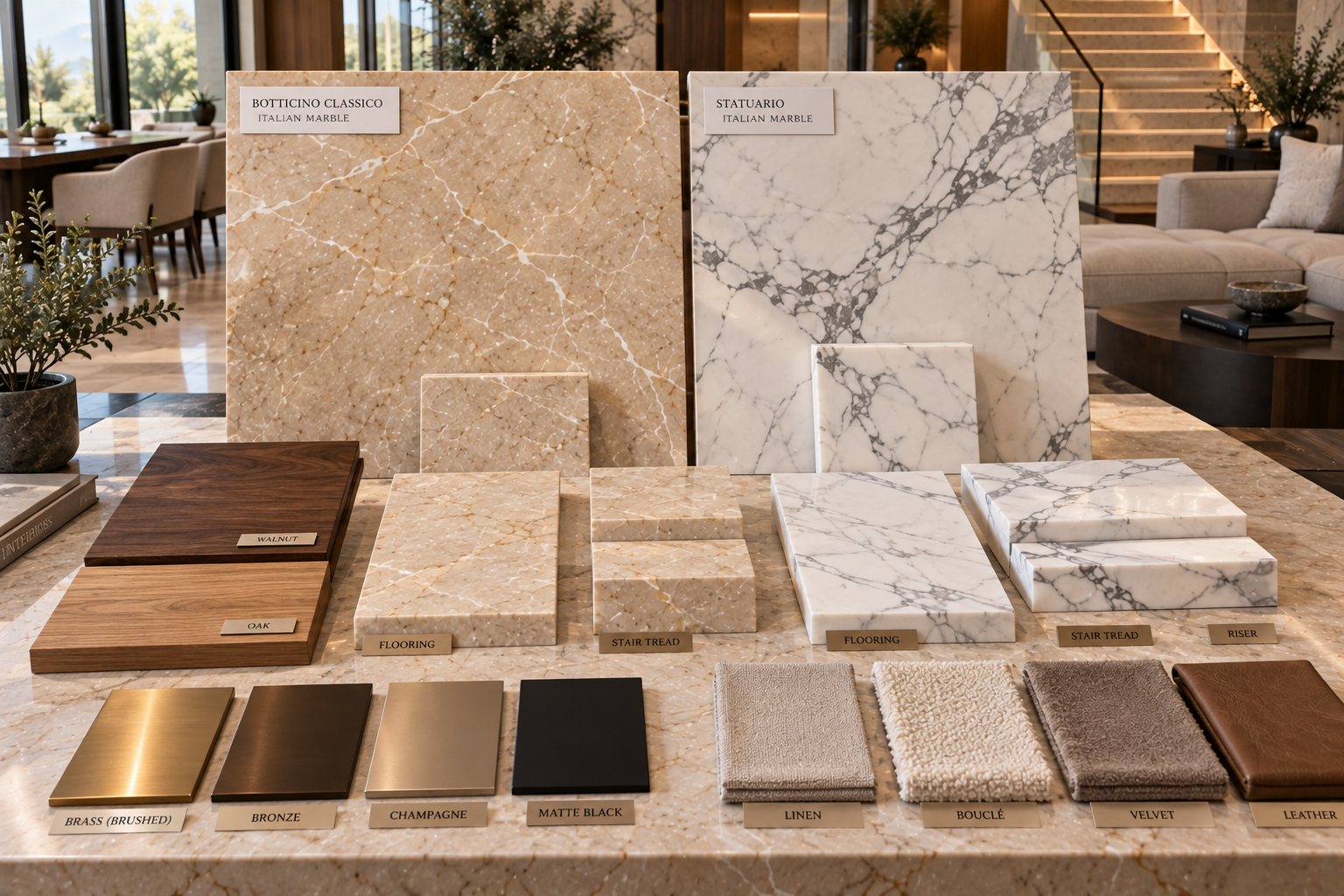
Fratelli Singh selection approach
Rather than starting with “Do you want white marble or beige marble?”, a useful selection conversation asks:
- What mood should the room have?
- Which wood is being used?
- Is the marble the background or focal point?
- How large is the surface?
- What lighting will the room use?
- How strong should the veins be?
- Which other stones appear elsewhere in the home?
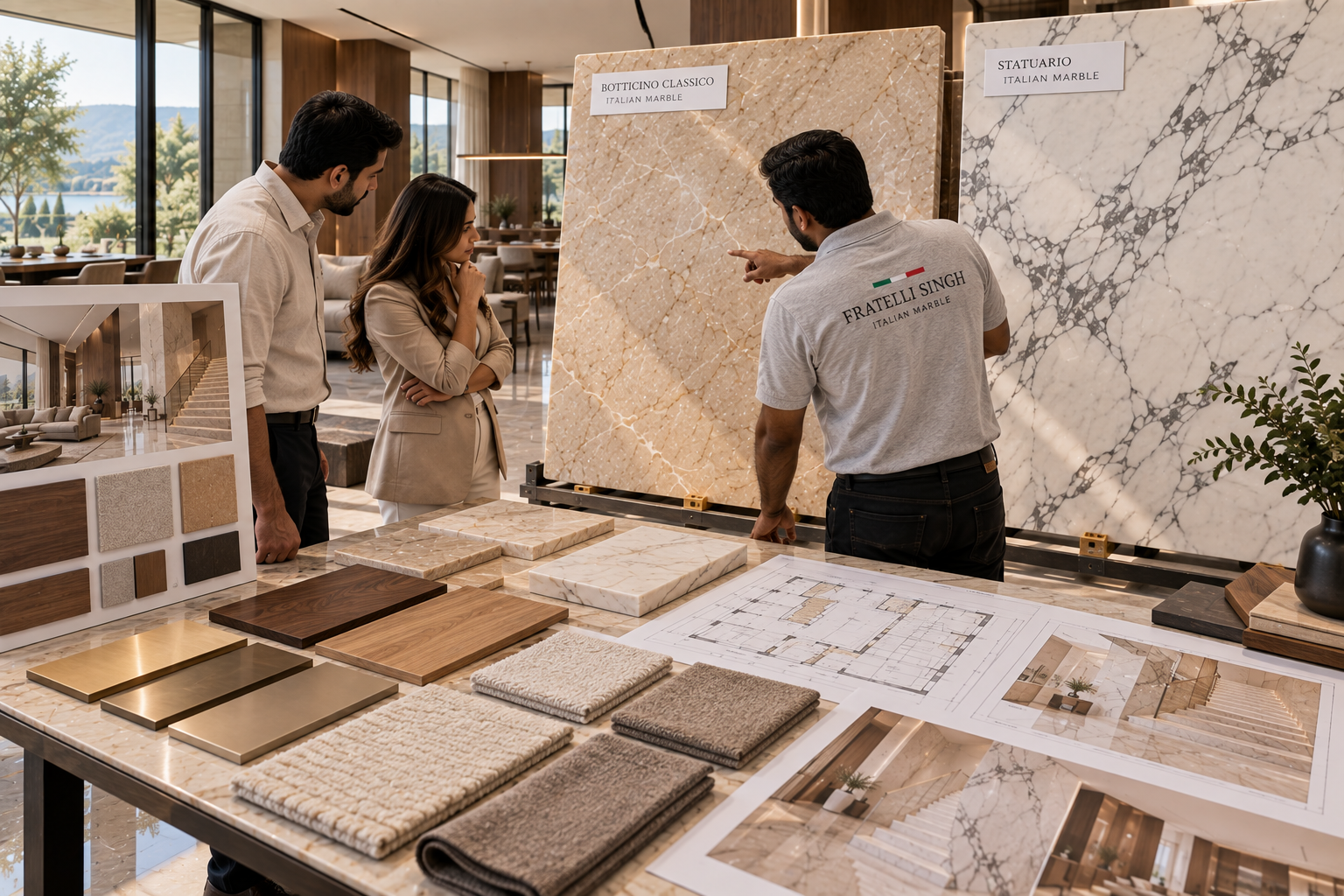
Full-slab comparison helps evaluate the complete visual character before deciding from a warm-or-white label alone.
Warm vs white marble scorecard.
| Question | Warm direction | White direction |
|---|---|---|
| Want a cosy atmosphere? | ✓ | |
| Want maximum brightness? | ✓ | |
| Heavy walnut interior? | ✓ | ✓ |
| Minimal pale-oak interior? | ✓ | ✓ |
| Strong feature wall? | ✓ | ✓ |
| Prefer soft visual contrast? | ✓ | |
| Prefer stronger contrast? | ✓ | |
| Large warm villa floor? | ✓ | |
| Bright compact room? | ✓ |
Some choices can work in either direction. This is a palette guide, not a pass/fail test.
Clear answers
Frequently asked questions.
Is warm marble better than white marble?
Neither is universally better. Warm marble creates a softer, more grounded atmosphere, while white marble generally creates a brighter and more contrasting interior.
Which marble is better for modern interiors?
Both can work. White marble is commonly associated with contemporary spaces, but warm marble can look equally modern when combined with clean detailing and restrained materials.
Which marble is better for classical interiors?
Warm beige and cream marble often work naturally with classical interiors, although white marble can create a more formal and brighter classical look.
Does white marble make a room look bigger?
A lighter surface can make a room feel brighter and more open, but vein intensity, furniture, lighting and layout also affect perceived space.
Does beige marble make a room look dark?
Not necessarily. Light beige marble such as Botticino can still create a bright interior while introducing greater warmth than white marble.
Which marble works best with walnut?
Both warm and white marble can work with walnut. Botticino creates a warmer relationship, while Statuario or Venatino creates stronger contrast.
Which marble works best with light oak?
Venatino, Vietnam White, Botticino and other restrained selections can all work well depending on whether the desired interior should feel cooler or warmer.
Is white marble harder to maintain?
Maintenance depends more on the actual stone, finish, use and care than colour alone, although marks may be more visually noticeable on very bright surfaces.
Can white and warm marble be used in the same house?
Yes. A warm marble can provide the foundation while a white marble is used selectively for feature walls, bathrooms or statement areas.
Can Botticino and Statuario be used together?
Yes. Botticino can provide a warm architectural base while Statuario / Satvario provides a brighter and more expressive focal element.
Is warm marble outdated?
No. Warm marble can look highly contemporary when combined with modern proportions, clean joints, restrained detailing and current materials.
Is white marble always more luxurious?
No. The quality of selection, slab composition, layout, fabrication and overall interior design have much greater influence on the finished result than colour alone.
Choosing a marble direction?
Bring your room plan, preferred wood and fabric samples, wall colours and lighting references. Comparing them against full slabs can clarify whether warm, white or a considered mix best suits your interior.
Request assistance ↗