
The short answer: The best marble for a staircase is not necessarily the most expensive or dramatic slab. It is stone that can be cut, matched and detailed correctly for the complete stair—treads, risers, landing, edges and transitions.
A staircase is a fabricated architectural element, not simply another marble surface. Before choosing colour, consider tread dimensions, usable slab length, thickness, structural condition, vein direction, lot consistency, finish, edge profile, lighting and cutting efficiency. These decisions should be coordinated before fabrication starts.
Confirm these before colour
What matters when choosing marble for stairs?
| Priority | Why it matters |
|---|---|
| Tread length | Determines whether steps can be cut in one piece. |
| Slab dimensions | Control layout options and usable yield. |
| Thickness | Influences fabrication and edge detailing. |
| Structural condition | Important around long or narrow fabricated pieces. |
| Vein direction | Shapes visual continuity across the stair. |
| Lot matching | Helps keep treads and landings harmonious. |
| Finish | Changes appearance and practical performance. |
| Edge profile | Strongly affects the final design. |
| Landing planning | Connects the staircase visually to the next floor. |
| Quantity | Prevents late changes to a different lot. |
Understand these requirements first. The marble name comes after the staircase drawing and complete material plan.
01 — Start with the staircase drawing.
Do not begin with the slab; begin with the staircase. Before selecting marble, confirm the tread width and depth, number of risers, landing dimensions, side fascia, skirting, nosing detail and turning points. A stair with long, wide treads has very different slab requirements from a compact staircase.
Also mark the edge or nosing, side fascia, skirting, wall junctions and railing fixing points. This simple drawing is more useful at the start than a decorative stair photograph because it identifies what the stone must actually do.
02 — Tread length can decide the marble.
A long tread often looks cleaner as one uninterrupted piece. Suppose the stair needs 5 ft 6 in treads but a candidate slab has only 4 ft 10 in of clear usable length. That may force an extra joint, a changed layout, higher wastage or selection of another slab.
| Slab requirement or condition | Possible effect |
|---|---|
| Long clear slab area | More opportunity for single-piece treads. |
| Short usable dimensions | May require joints or another layout. |
| Damaged edge | Reduces the clear length available for a tread. |
| Strong vein crossing a planned cut | May influence placement and visual balance. |
| Larger slab | Offers more flexibility, subject to condition and usable area. |
Compare each required tread with the actual usable slab area before purchase. Two slabs of the same marble can have very different practical value for stairs.
03 — Thickness is more than a number.
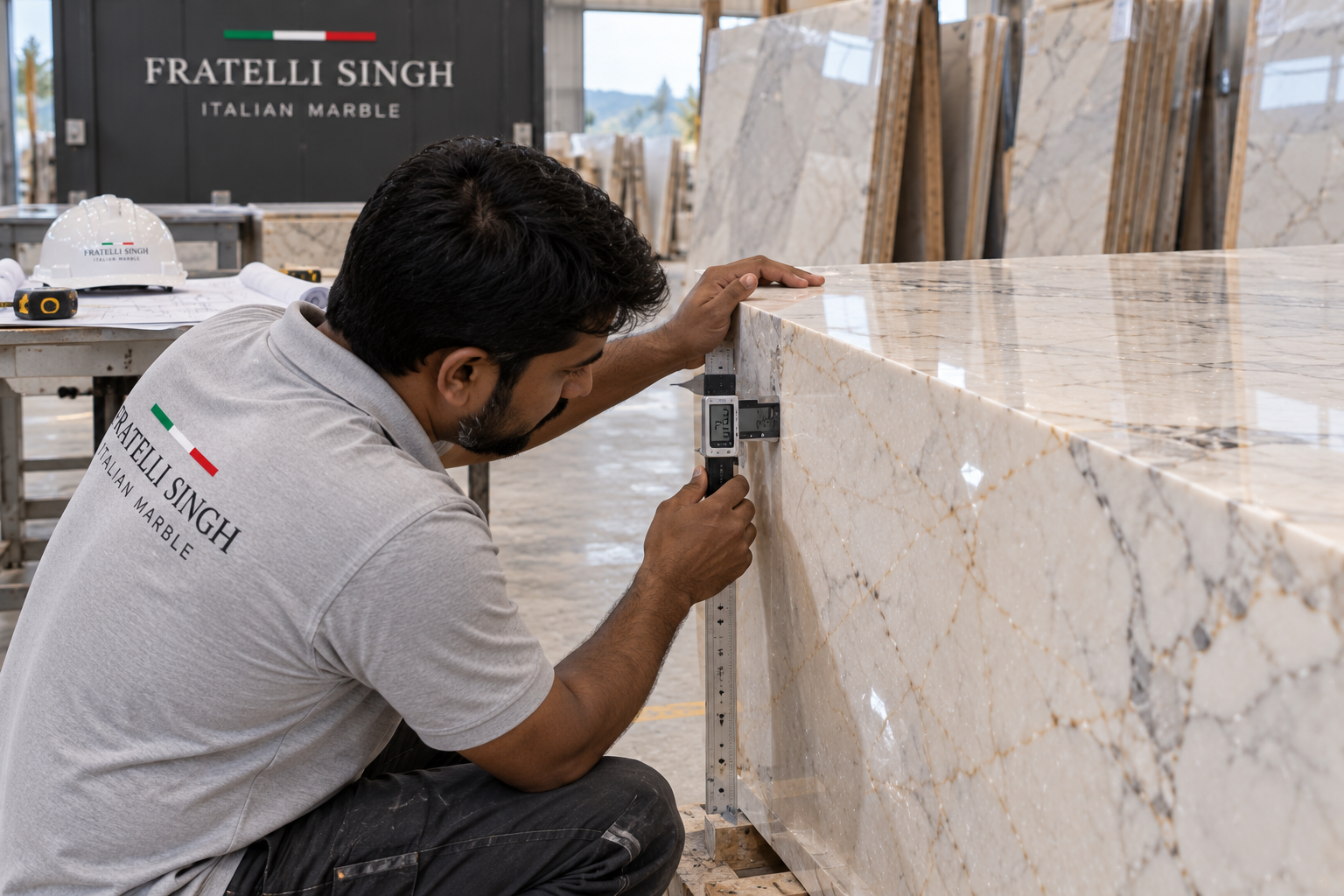
Thickness affects edge appearance, structural behaviour, finished floor levels, riser alignment, fabrication and installation. Do not rely only on nominal thickness: measure the actual slab at multiple points. Small inconsistencies become more noticeable when a similar profile repeats across fifteen or twenty steps.
Review thickness together with the stone’s structural condition, the stair substrate and the planned edge detail. Confirm project-specific requirements with the architect, engineer and stone fabricator rather than assuming one universal thickness.
04 — Vein direction changes the staircase.
A staircase is naturally directional: the eye follows it upward. Veins can reinforce that movement or fight against it. Decide how the natural pattern should relate to the treads and review the complete run rather than approving isolated pieces.
Random placement is not automatically wrong, but unplanned high-contrast cuts can look disorganised with directional stone. The right approach depends on the marble and the design intent.
05 — Design the tread and riser together.
A common mistake is selecting beautiful treads and then using whatever remains for the risers. That can make the stair feel fragmented. Decide the tread-to-riser relationship before cutting.
- Same-movement strategy: tread and riser have related vein character.
- Quiet-riser strategy: the tread carries the visual movement while the riser remains calmer.
- Continuous-effect strategy: selected cuts are planned to create a visual relationship across tread and riser.
These are composition choices, not requirements that every piece match exactly. Confirm the design against the full slabs and actual stair drawing.
06 — Should the staircase match the main floor?
Often it should, but matching has more than one level. The right choice depends on how open the stair is to view and whether you want continuity or a deliberate focal point.
| Approach | How it works | Often suits |
|---|---|---|
| Exact match | Same marble and compatible lot for floor and stair | Minimal interiors, seamless villa design and open stair areas |
| Same marble family | Calmer floor selection with slightly more expressive stair slabs | A connected scheme with subtle variation |
| Deliberate contrast | For example, Botticino floor with a Statuario staircase | A stair intentionally designed as a feature |
What should be avoided is an accidental mismatch that reads like a material shortage or late substitution. If the stair and floor will be seen together, compare them side by side before reserving the slabs.
07 — Botticino for staircases.
Botticino is a good direction when the staircase should feel warm, elegant and timeless. Its beige palette can connect the steps to warm flooring, walnut or oak cabinetry and cream wall finishes.
For stairs, assess the actual usable length for treads and whether the selected slabs have compatible movement across the whole run. A calm-looking variety name cannot guarantee that each individual slab will be equally quiet.
08 — Statuario / Satvario for staircases.
Statuario can create a strong architectural statement. Its more expressive veins make the placement of each cut especially important: a poorly positioned vein can cause one tread to dominate the entire staircase.
- Preview tread positions on the full slabs.
- Choose and document the vein direction.
- Review the landing as part of the same composition.
- Avoid random high-contrast cuts when they compete with the overall design.
09 — Brescia Aurora for staircases.
Brescia Aurora can create a warmer, richer stair with more movement than Botticino. It can pair well with dark timber, bronze details and warm wall finishes. Because tonal movement may be stronger, compare the slabs together before fabrication.
| Desired staircase feel | Marble direction |
|---|---|
| Calm and timeless | Botticino |
| Bright and refined | Venatino |
| Clean and minimal | Vietnam White |
| Dramatic statement | Statuario / Satvario |
| Warm and expressive | Brescia Aurora |
| Soft cream | Marmi Crema |
This is a design-direction guide, not a universal ranking of quality. Full slab condition, dimensions and application suitability still decide the final choice.
10 — Edge profiles matter more than most buyers expect.
The same marble can look traditional or contemporary depending on its exposed edge. Do not leave the profile decision until after cutting; include it in the original fabrication plan.
Confirm the exact edge shape and dimensions with the fabricator and project team. The edge affects appearance and detailing; it should not be treated as a decorative afterthought.
11 — A thicker-looking stair is not always a thicker slab.
Some designs call for a visually substantial stair edge. Depending on the project, that appearance may sometimes be created through fabrication and edge detailing rather than using an unusually thick solid slab.
The appropriate solution depends on the marble, structural design, fabrication method, stair substrate and edge profile. Coordinate the detail with the architect, engineer and stone fabricator before the material is cut; appearance alone does not determine the structural specification.
12 — Polished or lower-gloss finish?
Finish changes the stone’s appearance and how it behaves in use. Polished marble generally has stronger reflection and can make colour and veins look richer. A honed or lower-gloss finish has a softer appearance and may offer more surface texture. However, “honed” does not automatically mean slip-proof.
| Stair condition | What to evaluate |
|---|---|
| Formal, dry interior | Polish may suit the intended look; still assess actual use. |
| High foot traffic | Consider wear, maintenance and finish consistency. |
| Near an exterior entry | Evaluate grip and exposure to water or dirt. |
| Wet-prone staircase | Slip performance becomes especially important. |
| Minimal modern design | A softer, lower-gloss finish may fit the palette. |
| Classic luxury design | Polish may suit the style; practical performance still needs review. |
Evaluate slip performance for the actual application and conditions. Confirm the finish and appropriate safety requirements with the project team; do not infer performance from appearance alone.
13 — Landing slabs are often forgotten.
The staircase does not end at the final tread. A landing needs to feel connected to the run and to the adjoining floor. Include it in the slab and layout review rather than treating it as a later, separate purchase.
- Can the vein direction continue or turn intentionally?
- Will the landing use the same marble or a deliberately related selection?
- How does it transition to the next flooring material?
- Is the landing large enough to benefit from a single composed slab?
A poorly matched landing can make an otherwise considered staircase look unfinished.
14 — Side fascia and skirting matter.
Staircase references often show only the treads and risers, but a real project also needs decisions about the side fascia, stringer area, wall skirting, junctions and railing fixing points. These edges and transitions strongly influence whether the stair looks precise or improvised.
Show these details on the drawing and include their material needs in the slab allocation. Confirm how the stone meets the wall and railing before fabrication so that visible offcuts or unplanned gaps do not become the finishing strategy.
15 — Lighting can exaggerate imperfections.
Step lights often graze across marble from a low angle. That can reveal uneven polish, surface variation, joints, edge alignment and small level differences. Consider lighting and stone detailing together; the installed illumination can make a minor inconsistency much more visible.
Review the intended light positions against the edge and joint plan before installation.
16 — How much extra marble should be planned?
Staircases often need more selective cutting than ordinary flooring. Each tread may require a minimum uninterrupted length, clean edges and a considered vein position, which can reduce cutting efficiency. The required quantity depends on tread and riser sizes, slab dimensions, number of steps, landing area and the chosen layout.
Do not automatically apply the same allowance used for a floor. Calculate from a stair-specific cutting plan, including secondary pieces and a decision about compatible reserve material. For more detail, see How Much Italian Marble Do You Actually Need?
17 — Plan the cutting before the saw starts.
This is one of the most important staircase rules. Planning first protects both the intended composition and material yield.
- Stair drawing. Confirm dimensions and turning points.
- Final tread and riser sizes. Include landing and edge details.
- Full slab review. Check dimensions, condition and movement.
- Mark major veins. Decide how they should read in the installed direction.
- Position treads and risers. Review the complete run, not isolated cuts.
- Plan the landing. Coordinate transitions and composition.
- Check usable area. Confirm the quantity against the actual layout.
- Cut. Begin fabrication only after the plan is reviewed.
Avoid the reverse sequence—buying marble, cutting strips and trying to sort them later.
18 — Use a slab cutting map.
A simple printed or digital cutting map helps the owner, designer and fabricator discuss the same layout. It should be adjusted to the real slab dimensions, natural veins, condition and finished measurements.
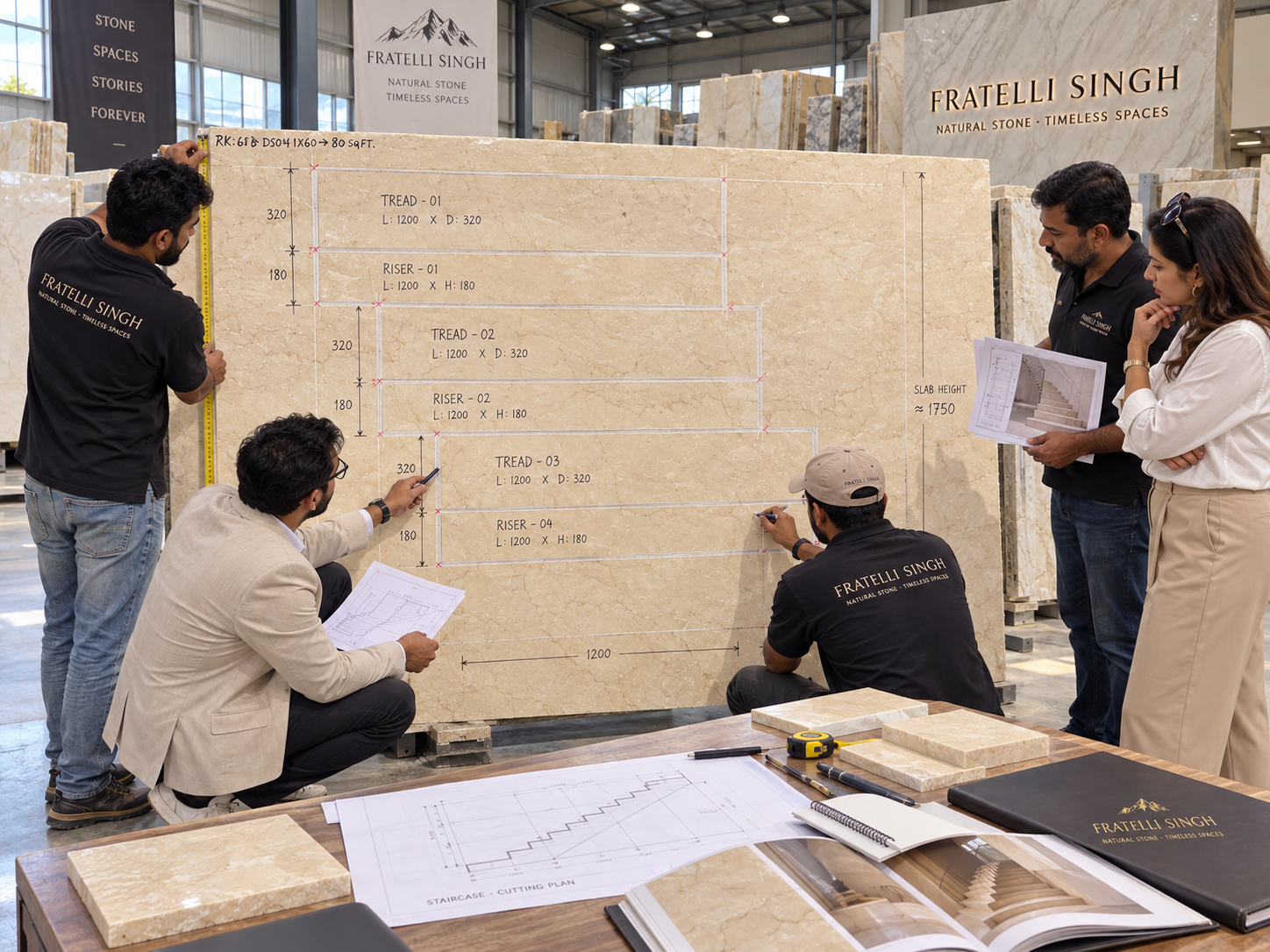
The map is an aid to coordination, not a substitute for professional measurement or fabrication review.
19 — What makes a staircase look expensive?
Usually it is not excessive ornament. A premium-looking marble staircase tends to have long uninterrupted treads, consistent edge detailing, controlled veins, related risers, clean landings and junctions, considered lighting and a restrained railing design.
An expensive stone can still look ordinary when these decisions are inconsistent. The material, fabrication and architecture need to feel resolved as one composition.
20 — Common staircase marble mistakes.
- Choosing by colour alone: slab dimensions and condition matter first.
- Selecting slabs too short for the treads: can create unwanted joints or excess waste.
- Leaving vein direction to chance: especially noticeable with expressive stone.
- Treating risers as leftovers: makes the staircase visually fragmented.
- Forgetting the landing: interrupts continuity.
- Deciding edge profiles after cutting: limits fabrication options.
- Using high gloss without considering use: overlooks practical performance.
- Not reserving enough compatible material: later slabs may not match the original selection.
Before fabrication
Staircase selection scorecard.
Score the actual slab’s suitability, not just the marble name. If any important requirement remains unclear, resolve it against the stair drawing before approval.
A project-led sequence
The Fratelli Singh staircase selection method.
- Understand the drawing. Record tread, riser and landing dimensions.
- Choose a visual direction. Decide whether the stair should feel warm, light, quiet or dramatic.
- Review full slabs. Check usable dimensions, condition and movement.
- Match the complete staircase. Plan treads, risers and landing together—not one tread at a time.
- Plan the cuts. Position major veins and confirm material yield.
- Confirm finish and edge. Resolve these details before fabrication.
- Reserve the required lot. Avoid unintended mixing with later slabs.
This is more dependable than choosing only from a small sample. The drawing, actual slabs and fabrication plan need to work together.
Clear answers
Frequently asked questions.
Which marble is best for a staircase?
There is no single best variety. The ideal marble should have suitable slab dimensions, structural condition, thickness, vein pattern and enough compatible material for treads, risers and landings.
Is Botticino good for staircases?
Yes. Botticino is a strong option where a warm, timeless staircase is desired, particularly when the main flooring is also beige or cream.
Is Statuario suitable for stairs?
Yes. Statuario can create a dramatic staircase, but vein positioning and cutting should be carefully planned because of its stronger visual movement.
What thickness should marble stairs be?
The appropriate thickness depends on the staircase construction, stone, span, substrate and fabrication details. Confirm actual requirements with the project architect, engineer and stone fabricator rather than applying one universal figure.
Should tread and riser marble match?
They do not need to be visually identical, but should normally feel intentionally related unless the design calls for deliberate contrast.
Should the staircase match the flooring?
Often yes, particularly in open villas. The same marble or related selections can create continuity, although a contrasting staircase can also work when intentionally designed.
Which finish is best for marble stairs?
The finish depends on design and use. Polished stone offers greater reflection, while lower-gloss finishes may provide more texture. Slip performance should be evaluated for the actual application.
Can marble stairs be made from one slab?
An entire staircase usually requires multiple slabs, but several treads may be cut from the same slab depending on dimensions and design.
How should veins run on marble stairs?
There is no single mandatory direction. What matters is that the chosen direction is intentional and reasonably consistent with the staircase design.
Should staircase marble be selected before fabrication?
Yes. Ideally, complete slabs should be reviewed and a cutting strategy prepared before fabrication starts.
Why are long slabs important for staircases?
Long usable slabs make it easier to cut uninterrupted treads and reduce unwanted joints.
How much extra marble should be ordered for stairs?
The allowance depends on slab dimensions, tread sizes, riser requirements, landings and vein selection. A staircase-specific cutting plan is more reliable than applying a generic wastage percentage.
Planning a marble staircase?
Bring the stair drawing, tread and riser dimensions, landing details and preferred design direction. Comparing them with full slabs helps make the selection practical as well as beautiful.
Request assistance ↗