The short answer
Choose the arrival before you choose the slab.
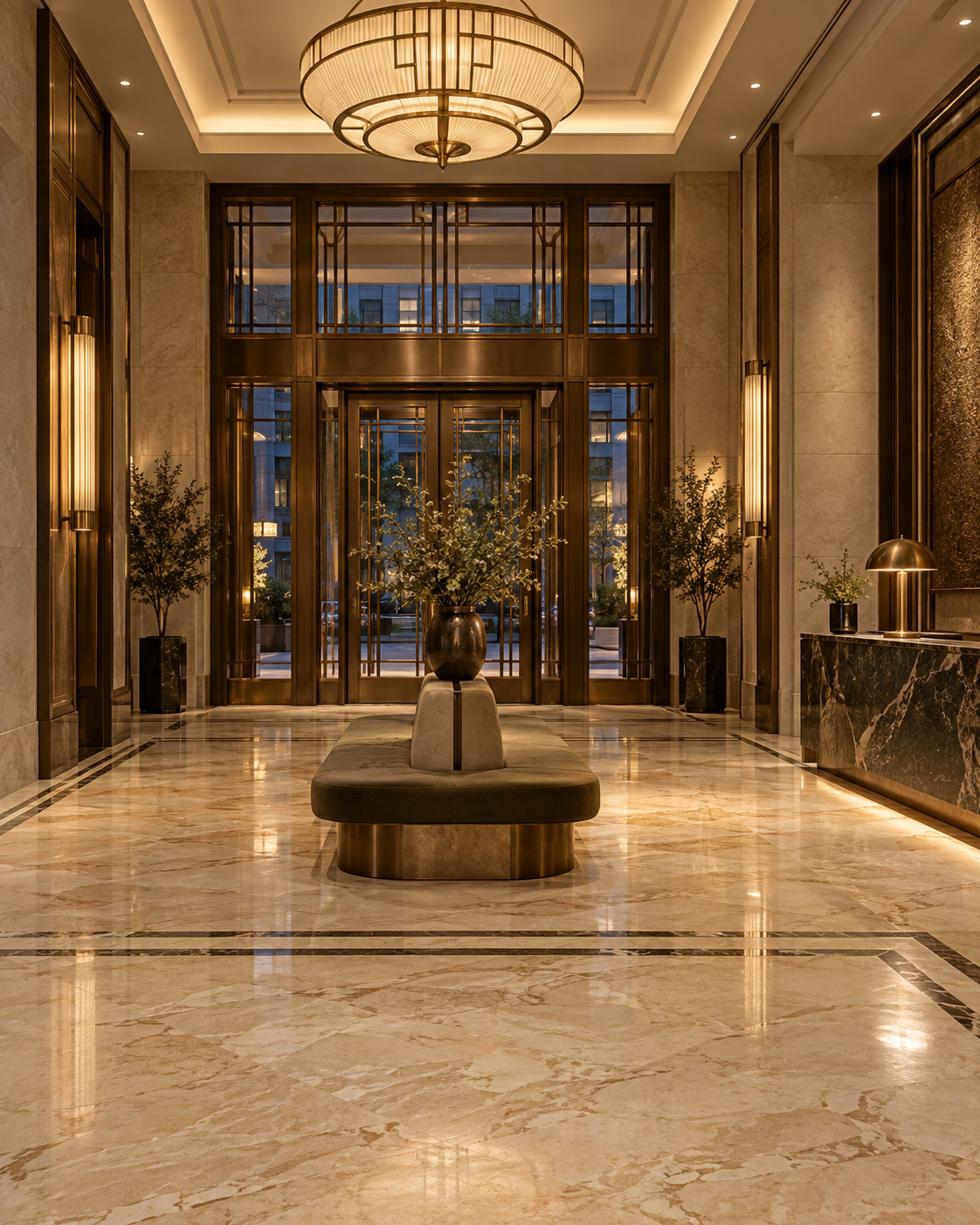
An entrance is where architecture, marble, lighting and the interior palette are experienced together for the first time. It can feel quiet, dramatic, warm, contemporary, classical or formal. The aim is not automatically to make it the most dramatic room; it is to create expectation with one clear material idea and enough restraint around it.
| Entrance intention | Marble direction | Design role |
|---|---|---|
| Quiet and refined | Botticino / Venatino | Soft introduction |
| Bright and minimal | Vietnam White / Venatino | Light foundation |
| Dramatic | Statuario / expressive stone | Selective focal surface |
| Warm and rich | Brescia Aurora / Botticino | Layered welcome |
| Modern-classic | Botticino with selective white marble | Balanced contrast |
| Formal and grand | Statement stone with symmetry | Ceremonial arrival |
Quick planning priorities
| Factor | Why it matters |
|---|---|
| First sightline | Sets the immediate impression and focal point. |
| Floor continuity | Connects the entrance to the adjoining rooms. |
| Marble scale | Pattern size needs to suit the lobby dimensions. |
| Vein direction | Can guide movement through the entrance. |
| Slab dimensions | Affect joints, cut planning and wall panels. |
| Natural lighting | Changes how the background tone reads during the day. |
| Artificial lighting | Can warm the stone or emphasise its veins. |
| Staircase connection | The stairs are often visible from the foyer. |
| Wall / floor hierarchy | Prevents multiple marble surfaces from competing. |
| Care and maintenance | Entrance areas receive concentrated foot traffic. |
| Material transitions | Doors, rugs, timber and metal meet at the threshold. |
| Viewing distance | Determines whether the vein pattern can be appreciated. |
Explore the full 29-point entrance guide
- Decide the entrance mood
- Read the first sightline
- Choose the hero surface
- Botticino flooring
- Statuario statement walls
- Brescia Aurora
- Venatino
- Floor continuity
- When a separate foyer marble works
- Vein direction
- Doors and marble
- Foyer scale
- Large pieces
- Symmetry
- Bookmatching
- Lighting
- Rugs and runners
- Console tables
- Mirrors
- Staircase visibility
- A coordinated entrance scheme
- Hotel lobby requirements
- Floor and reception hierarchy
- Common mistakes
- The five-second test
- Decision tree
- Room-type recommendations
- Selection scorecard
- Fratelli Singh selection approach
01 · Set the intention
Decide what the entrance should do.
Before selecting a marble, name the role of the space. A quiet introduction gently carries the home’s palette into the first view. An architectural statement lets a single surface become the focal point. A warm welcome uses beige stone, timber and soft light. A formal arrival relies on symmetry, scale and considered detailing. Each goal points to a different slab, layout and lighting strategy.
| Desired personality | Marble direction | Keep in balance |
|---|---|---|
| Quiet and refined | Botticino or Venatino | Texture, lighting, simple lines |
| Bright and minimal | Vietnam White or Venatino | Warmth from timber or textiles |
| Dramatic | Statuario or expressive stone | Calmer floor and furnishings |
| Warm and rich | Brescia Aurora or Botticino | Restrained surrounding pattern |
| Modern-classic | Botticino with selective white marble | Consistent detailing |
| Formal and grand | Balanced statement stone and symmetry | Clear central axis |
02 · Look from the threshold
Start with the first sightline.
Stand where a visitor enters and note what appears first. It may be the floor, a staircase, a double-height wall, a console, artwork, a courtyard, a corridor or a reception desk. That axis should shape where the marble is placed and how its movement is oriented. The stone should support the route inward rather than pull attention sideways without a reason.
03 · Create hierarchy
Choose the hero: floor, wall or staircase.
A dramatic floor, expressive wall, statement staircase and decorative ceiling may each be beautiful individually. Together, they can compete. Choose one dominant marble moment first, then let the other surfaces support it.
Everything else supports it.
This single decision prevents many foyer-design problems and gives each selected slab a clear architectural role.
04 · Warm foundation
Use Botticino for a welcoming entrance floor.
Botticino is a natural direction when the entrance should feel warm, timeless and connected to the rest of a villa. Its beige character sits comfortably with walnut, oak, bronze, cream plaster and neutral upholstery. A comparatively quiet floor can also leave room for the staircase, artwork or one vertical feature to become the focal point.
Review the specific slab and finish in the room’s real light. “Warm beige” is not identical from lot to lot, and a foyer’s daylight and evening lamps can shift how the background reads.
05 · Vertical statement
Use Statuario / Satvario where its movement can be read.
Statuario is particularly effective as a vertical entrance feature. A generous wall can show the white field and vein movement at a useful viewing distance without fragmenting it into small cuts. Keep the floor more restrained so the wall remains legible.
A useful combination is a Botticino floor, a Statuario feature wall and a walnut console. That pairing creates warmth, contrast and hierarchy without covering every surface in expressive stone. Review the actual slab sequence and proposed cut plan before committing to a bookmatched or vein-led composition.
06 · Layered warmth
Choose Brescia Aurora for a richer entrance.
Brescia Aurora can create a warm, mature and layered arrival—less stark than a bright white marble. It can pair with walnut, cream plaster and dark bronze. Because the stone already has visual movement, keep neighbouring finishes controlled, especially in a smaller foyer. Compare the full slab against the door, wall colour and planned lighting rather than relying on a small sample.
07 · Quiet contemporary
Choose Venatino when the foyer should feel refined, not theatrical.
Venatino can introduce an elegant light surface without competing with the living area beyond. Pair it with pale oak, soft bronze, textured plaster and simple lighting. Its quieter character is useful where the entrance should feel like a transition into the home rather than an isolated display.
08 · Connect adjacent spaces
Let the entrance floor connect to the next room.
If the foyer opens directly into a living room, dining area, corridor or stair hall, continuing the same foundation marble often makes the architecture feel more coherent. Introduce variation vertically—through a feature wall, console or artwork—rather than changing the floor at the first doorway.
09 · Make transitions intentional
A different foyer marble works when the architecture defines the change.
A second stone can work when the entrance is clearly its own volume: a vestibule, doors, columns, a level change, a threshold or another strong architectural boundary. The transition should look designed, not like two unrelated stone lots happened to meet. Align the change with the threshold and plan the joint or transition strip as part of the composition.
10 · Guide movement
Use vein direction to lead the eye into the home.
Directional marble can help visitors read a long entrance hall. A deliberate orientation may lead toward the living room, staircase or courtyard. There is no universally correct direction: decide what the first view should emphasise, then check the proposed layout against the actual slabs and cut sequence.
START OF MOVEMENT→FOCAL POINT
LIVING / STAIR / COURTYARD
11 · Consider the largest nearby finish
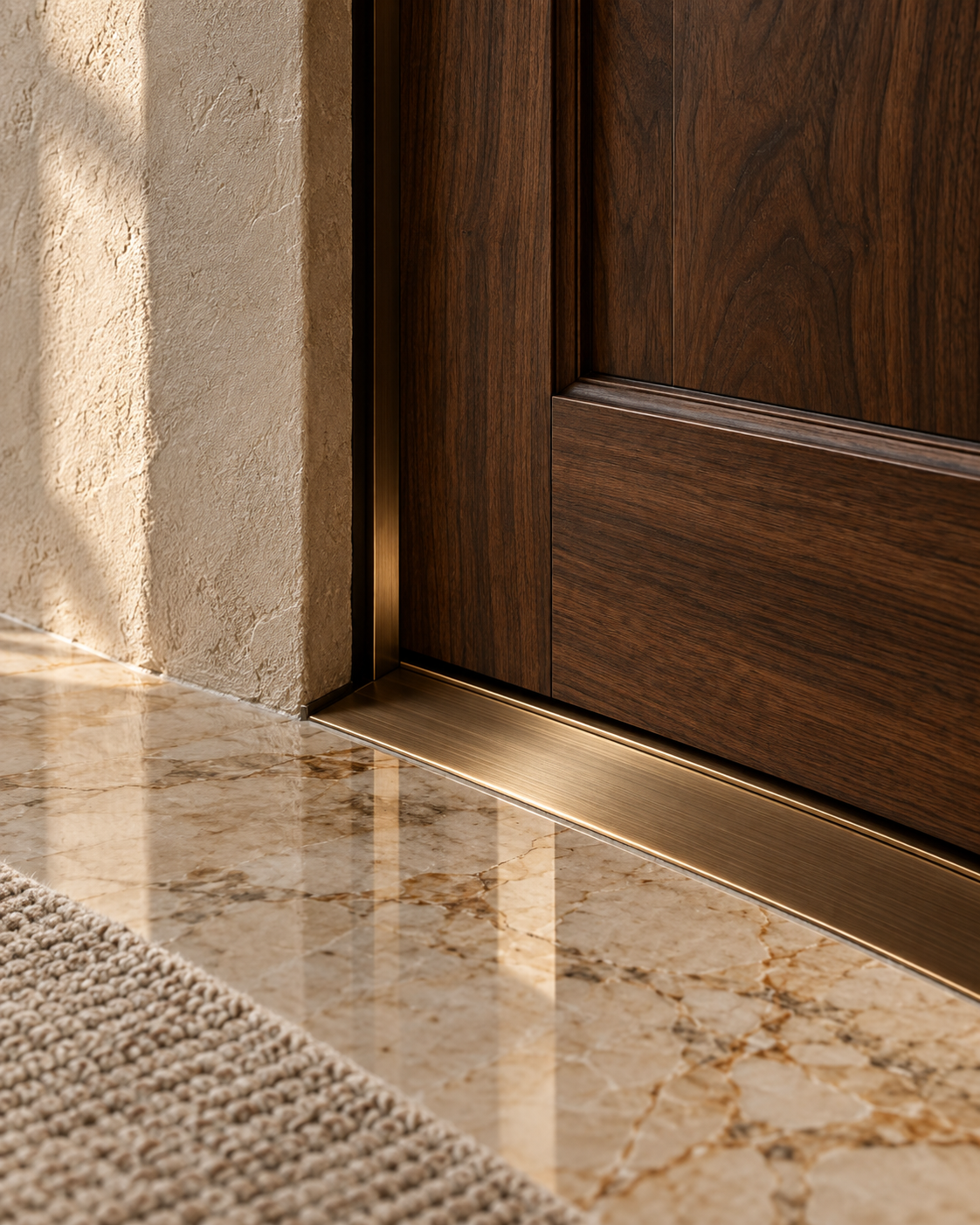
Do not ignore the entrance door.
Doors are substantial material surfaces and often set the first contrast with the floor. A dark walnut door can make light marble feel crisp; pale oak may need a warmer companion to avoid a washed-out palette. Bronze and black metal introduce their own tones. If the door is patterned or highly decorative, a quieter marble usually gives the composition room to breathe.
| Door character | Marble direction | Design note |
|---|---|---|
| Dark walnut | Statuario, Venatino or Botticino | Choose contrast or a warmer tonal transition |
| Pale oak | Botticino or Venatino | Warm stone helps prevent an overly pale room |
| Black metal | White or warm beige marble | Balance the dark frame with the wider palette |
| Bronze | Botticino or restrained white marble | Avoid stacking too many competing warm finishes |
| Highly decorative door | Quieter marble | Let the door retain a clear role |
12 · Match pattern to the room
Scale matters more in a foyer than many people expect.
A 6 × 8 ft residential foyer and a 30 × 50 ft hotel lobby should not be treated alike. The marble pattern must suit the architecture and the distance from which it will be viewed.
13 · Preserve clear geometry
Large pieces can make an entrance feel more important.
Larger pieces can reduce the number of joints, strengthen the visual scale and create cleaner sightlines. Their size still needs to respect room proportions, actual slab dimensions, door width, lift or corridor access and installation conditions. Do not force an oversized format just for effect. Confirm the usable dimensions and proposed layout before ordering or cutting.
14 · Reinforce the architecture
Use symmetry where the entrance already has a strong axis.
Entrances often have stronger architectural symmetry than other rooms. Where the plan supports it, align the central door, console, chandelier, staircase and feature slab. A paired marble-panel composition can reinforce classical villas, hotels and formal apartment lobbies. Treat the marble as part of the architecture—not as a separate decorative layer.
15 · Use the full slab deliberately
Bookmatching can work—but not everywhere.
A bookmatched entrance wall can be spectacular when the wall is large enough, the full composition is visible and the surrounding architecture is quiet. Avoid combining it in the same sightline with a patterned floor, ornate console, decorative wall finish and large artwork. One strong move is usually enough. Review the actual slab pair and dry layout before fabrication.
16 · Review it in real conditions
Lighting is part of the stone selection.
Entrance areas often combine exterior daylight, a warm pendant, wall washers, grazing light and evening ambient lighting. The same slab can feel different from morning to night. Warm light may deepen Botticino, enrich Brescia Aurora and soften Statuario; cooler light may sharpen grey veins and make white fields appear crisper. Grazing light can reveal texture, joints and surface variation.
| Light condition | What to review on the slab |
|---|---|
| Daylight | Underlying tone and natural warmth |
| Warm pendant | Cream and beige shifts |
| Wall washer | Vein emphasis and polished reflection |
| Grazing light | Texture, joints and surface variation |
| Evening ambient | The overall arrival mood after sunset |
Where possible, compare full slabs under balanced light and the planned evening scheme. A small showroom sample viewed only in bright daylight cannot show the whole effect.
17 · Plan for the furnished room
The entrance rug changes the floor composition.
Most entrances eventually contain a rug, runner or mat, often alongside a console. Do not compose the floor as if every square foot will remain visible. The marble that matters most may be the perimeter, the threshold, the central axis or the junction at the staircase. Plan around the actual rug size and furniture positions.
18 · Coordinate furniture finishes
Pair the marble with the console table.
A console usually sits directly against an entrance wall, adding another visible material. Against a dramatic Statuario wall, use a simple walnut console, modest metal detailing and restrained accessories. A Botticino wall can sit comfortably with darker timber and bronze. Avoid a second heavily patterned marble console unless the layered composition is intentional.
19 · Account for reflections
A mirror can make a marble wall feel twice as present.
A mirror reflects the slab and visually increases the amount of veining in the room. In a compact foyer, a large mirror opposite an expressive wall can make the space feel busier than expected. Consider the reflection during stone selection, not after the slabs and mirror are installed.
20 · Design the first view as a whole
Staircase visibility changes the foyer strategy.
If the staircase is visible immediately after entry, treat it as part of the entrance. Decide whether it should use the same marble as the floor, a stronger stone from the same family or a deliberate contrast. The foyer floor, stair, landing and railing should not be selected independently when they all appear in one sightline.
21 · Example composition
Build a warm villa entrance from four coordinated roles.
Finish the composition with walnut. This creates continuity, contrast and hierarchy without introducing four unrelated stones. If the staircase itself is the hero, reduce the feature wall’s movement or simplify the floor instead.
22 · Consider the operation as well as the image
Hotel lobbies need a different entrance strategy.
Hospitality spaces see more foot traffic, rolling luggage, repeated cleaning, longer viewing distances and more artificial lighting than most homes. The selection needs to account for circulation, maintenance and the specified finish as well as appearance. Confirm project-specific technical requirements with the design and installation teams; a beautiful lobby still has to function under its expected use.
A hotel lobby can support more visual scale than a residential foyer, but clear circulation and a controlled material hierarchy remain important.
| Consideration | Residential foyer | Hotel lobby |
|---|---|---|
| Typical use | Household and guest arrival | Frequent arrivals, luggage and concentrated traffic |
| Scale | Read at close range and from the door | Often read from farther away across a larger volume |
| Lighting | Daylight plus a home evening scheme | Often more extensive artificial and decorative lighting |
| Planning priority | Connection to living rooms and stairs | Circulation, cleaning plan and reception hierarchy |
23 · Give each surface a job
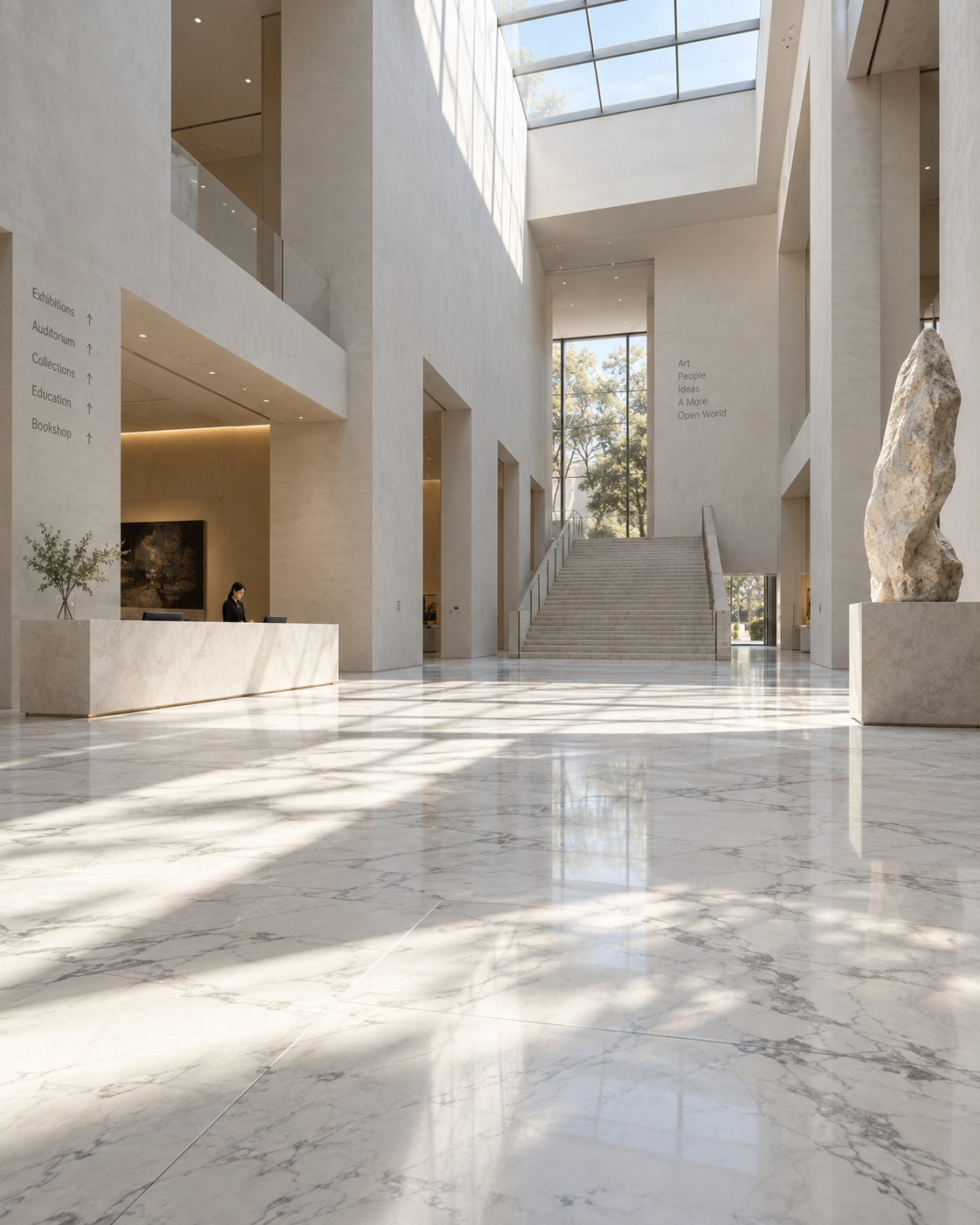
In a hotel lobby, balance the floor against the reception desk.
A useful hospitality hierarchy keeps the floor as a calm visual base, gives the reception desk the focal marble composition and lets the back wall either support or frame the desk. If both the desk and wall are expressive, keep other visible stone surfaces quieter. The aim is a memorable welcome, not a stone showroom.
24 · Protect the hierarchy
Common entrance-marble mistakes.
- A different marble for every surface: too many competing patterns weaken the room’s hierarchy.
- Ignoring the view from the door: the most dramatic slab may not appear in the main approach.
- Random joint placement: unplanned cuts can undermine a central axis or symmetry.
- A busy floor beneath a dramatic staircase: the two focal points compete.
- Forgetting the door material: timber and stone undertones may clash.
- Selecting only in daylight: the entrance can look different under its evening scheme.
- Oversized patterns in a tiny foyer: the full movement may not be legible at close range.
- Tiny pieces in a grand lobby: the floor can feel unnecessarily fragmented.
- Forgetting mirrors: reflections can multiply visual intensity.
25 · Test the arrival
Use the five-second entrance test.
Stand at the threshold and ask what a visitor understands almost immediately. If the answers are unclear, too many ideas may be competing.
26 · Resolve the material change
Follow a simple entrance-marble decision tree.
27 · Apply the strategy to the room
Room-type recommendations.
| Entrance type | Marble direction | Planning emphasis |
|---|---|---|
| Small apartment foyer | Venatino / quiet Botticino | Controlled movement and fewer materials |
| Large villa foyer | Botticino with selective statement stone | First sightline, stair and continuity |
| Double-height entrance | Statuario / Brescia Aurora feature possible | Use the wall scale; keep the floor composed |
| Dark-wood entrance | Light or controlled marble | Balance contrast with timber undertones |
| Pale-oak entrance | Warm beige or fine white marble | Avoid a washed-out overall palette |
| Classical foyer | Botticino / Brescia Aurora | Symmetry and a restrained formal composition |
| Minimal foyer | Venatino / Vietnam White | Quiet joints, clean geometry and soft light |
| Hotel lobby | Calm floor with a stronger focal surface | Circulation, viewing distance and maintenance |
28 · Confirm before finalising
The entrance selection scorecard.
Use this checklist during design review and slab selection. Checking an item here records it only in your browser session; it does not submit or save project information.
29 · Select for the architectural role
The Fratelli Singh entrance-selection approach.
It is not enough to select a slab that looks impressive on its own. Begin with the entrance dimensions, first viewing direction, door finish, staircase position, adjoining flooring, wall height, lighting and intended focal surface. Then compare full slabs for the role they will play in the architecture.
That process leads to the more useful question: What should the visitor notice first—and which marble best supports that moment? It is a better starting point than simply choosing the most dramatic stone available.
Clear answers
Frequently asked questions.
Which marble is best for an entrance foyer?
There is no universal best choice. Botticino works for warm continuity, Venatino for a quiet contemporary entrance, Statuario for a statement surface, and Brescia Aurora for richer warm movement.
Is Botticino good for entrance flooring?
Botticino can create a warm, welcoming entrance and transition naturally into larger living areas. Review the chosen finish and project requirements with the stone and installation team.
Is Statuario suitable for a foyer?
Yes. Statuario or Satvario can be effective as a feature wall, especially when the floor and surrounding materials are restrained.
Should entrance and living-room marble match?
If the spaces are visually connected, continuing the same primary flooring often creates stronger continuity.
Can different marble be used in the foyer?
Yes. A different marble can work when doors, a level change, threshold, vestibule or distinct architectural volume makes the transition intentional.
Should the foyer floor or wall be the main feature?
Either can lead, but choosing one dominant surface usually creates a clearer result than making both highly expressive.
Which marble works best with a dark entrance door?
Statuario, Venatino and Botticino can all work, depending on whether you want contrast or warmth.
Are large slabs good for entrance lobbies?
Large pieces can reduce visual fragmentation if slab dimensions, room proportions, access and installation planning support them.
Should marble veins point toward the interior?
Directional movement can guide the eye toward a staircase, living room or focal point, but there is no mandatory direction.
Does entrance lighting affect marble colour?
Yes. Daylight, warm artificial light and grazing light can change how a stone’s background, veins and polish appear.
Can a bookmatched marble wall be used at the entrance?
Yes, when the wall is large enough to show the composition and the surrounding floor, furniture and lighting remain controlled.
Is marble suitable for hotel entrance lobbies?
Marble can be used in hotel lobbies, with traffic, finish, cleaning, maintenance and application-specific performance considered alongside appearance.
Should the staircase be selected with the foyer marble?
Yes, particularly when visible from the entrance. The floor, stair and landing should feel intentionally related.
How many marble varieties should be visible from an entrance?
There is no fixed number, but a smaller group of coordinated materials generally creates clearer hierarchy than several unrelated stones.
Planning an entrance, foyer or lobby?
Share the floor plan, approximate area, door finish, staircase position, adjoining flooring and lighting scheme. Fratelli Singh can help review the marble’s role and compare full slabs for the space.
Request assistance ↗