
The starting point
The marble does not decide the style by itself.
A common shortcut is “white marble equals modern; beige marble equals classical.” It is far too simple. The same Botticino slab can look contemporary in one project and traditional in another. Statuario can feel minimal, classical or overly decorative depending on its scale, framing and surroundings.
The better question is not “Which marble is modern?” but “How should this marble be selected and detailed for the style of the interior?” Start with the architecture, then coordinate the stone’s role, vein intensity, piece size, joints, edges, furniture, wood, metal and light.
| Design element | Modern interior | Classical interior |
|---|---|---|
| Marble role | Architectural surface | Decorative and architectural |
| Vein intensity | Often controlled | Can be more expressive |
| Joint pattern | Clean and simple | May include borders or patterns |
| Piece size | Often larger | Can vary with the composition |
| Edge detailing | Minimal | More decorative profiles possible |
| Material palette | Restrained | Layered, with clear hierarchy |
| Metal / wood | Black, bronze, nickel; oak or walnut | Brass, bronze; walnut and darker woods |
| Lighting | Architectural and indirect | Decorative and layered |
| Overall goal | Restraint | Richness without overload |
01 · Reduce visual noise
What makes marble look modern?
Modern marble interiors usually rely on clean geometry, fewer competing materials, larger uninterrupted surfaces, simple joints, limited ornament, controlled veining and understated edge profiles. The stone is allowed to feel architectural: a continuous plane that belongs to the room rather than a decorative motif applied over it.
Material restraint does not mean the room has to be empty. It means each visible finish has a clear job, transitions are deliberate, and the strongest surface is given room to read.
= AN ARCHITECTURAL MARBLE INTERIOR
02 · Keep one focal point
Modern does not mean plain.
A contemporary room can use dramatic marble. A Statuario / Satvario feature wall, island, table or double-height panel can be exceptionally effective when the surroundings remain quiet. Simple walnut, plain upholstery, restrained lighting and minimal metal allow the stone’s movement to be the focal point.
The common mistake is not choosing expressive stone; it is combining it with too many other expressive materials. If the marble has strong veins, reduce pattern in nearby wood, rugs, artwork and lighting forms.
03 · Add formality with hierarchy
What makes marble look classical?
Classical interiors can support symmetry, borders, decorative edges, richer wood, warmer metals, layered lighting and formal composition. Those elements give a room rhythm and a sense of ceremony. But classical should not mean overloaded: premium classical spaces still rely on hierarchy, proportion and restraint.
Decide which detail leads—perhaps the floor border, moulded wall, chandelier or stone feature—and let the other elements support it instead of competing for equal attention.
= A FORMAL, BALANCED INTERIOR
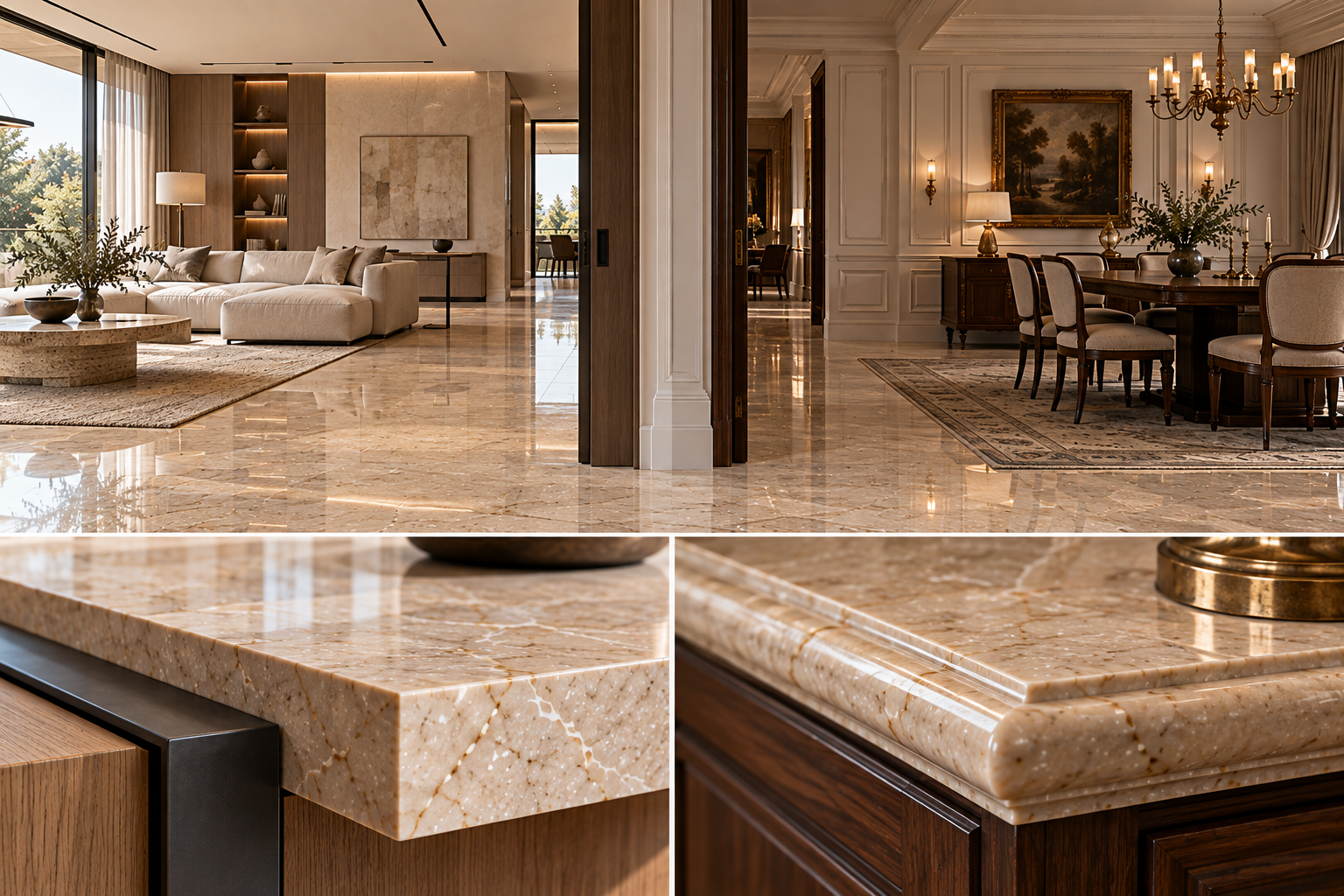
04 · A warm contemporary surface
Botticino can feel at home in a modern interior.
Botticino is often associated with traditional rooms, but that is not a limitation of the stone. Use generous pieces, minimal joints, pale oak or restrained walnut, clean skirting, simple furniture and architectural lighting. The beige field can then feel like a warm, contemporary architectural surface rather than a signal of a particular period.
Pay attention to the layout and the room’s light. A consistent tone across a broad field can be calming; natural variation and a clean grid keep the surface from feeling flat.
05 · One stone, two languages
Botticino can be classical when the composition changes.
Pair the same stone with a considered border, darker wood, brass, mouldings, layered light and formal furniture and its character shifts. The marble has not changed; the design language has. Keep the border scale and wall detailing in proportion to the room, and avoid adding ornament to every available surface.
Simple joints
Pale oak or restrained walnut
Clean skirting
Minimal furniture
Architectural lighting
Walnut and brass
Wall mouldings
Layered lighting
Formal furniture
Controlled ornament
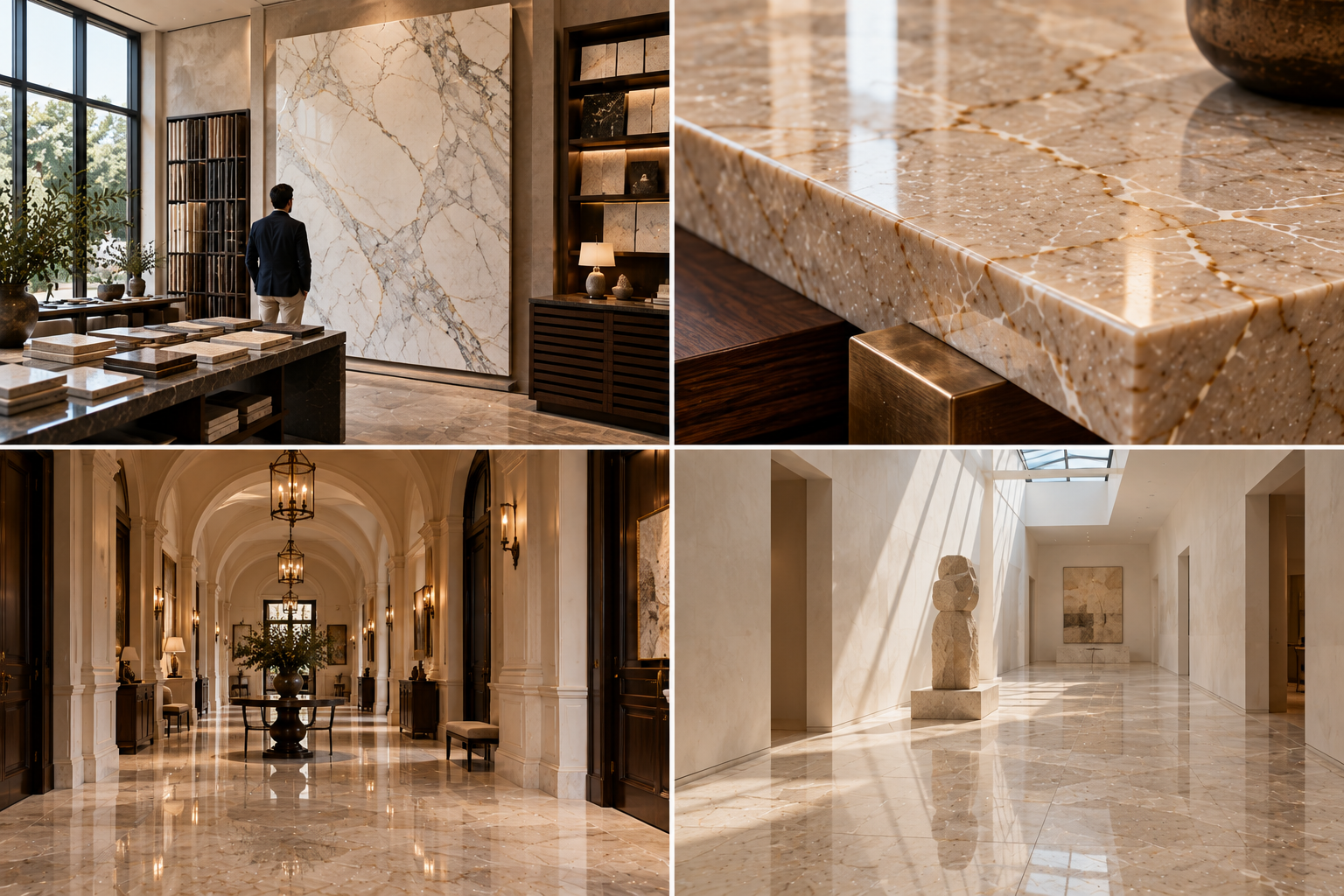
06 · Use expression with restraint
Statuario / Satvario makes a strong modern focal point.
Statuario can work beautifully in contemporary interiors as a feature wall, island, table, bathroom wall or double-height panel. Its white field and visible movement make it naturally attention-grabbing; one well-positioned surface is often more powerful than repeating the same dramatic stone throughout the home.
Plan the slab before fabrication. Consider where the veins will fall across joins, visible ends and cut-outs, and keep surrounding finishes simple enough to let the composition read.
07 · Frame the stone
Statuario can also feel entirely classical.
Use symmetry, detailed wall mouldings, brass, darker wood and framed architecture to give Statuario a more formal setting. The stone itself does not become classical; the way it is framed changes how the room reads. Align the slab composition to the architecture so the framing feels intentional rather than added afterwards.
Because the veining is already expressive, retain a clear hierarchy between stone, moulding, metal and furniture.
08 · Quiet refinement
Venatino supports a cleaner modern design language.
Venatino’s finer movement can suit minimal floors, bathrooms, bedrooms, quiet walls and pale-oak interiors. It offers a light stone field without asking the room to revolve around a dramatic vein. That makes it useful where the architecture, landscape or furniture should remain the primary focus.
Review the whole slab and planned layout even when the stone appears restrained. Vein direction and continuity still affect whether a floor feels calm or visually interrupted.
09 · Warm movement
Brescia Aurora brings richness to classical interiors.
Brescia Aurora’s warmer movement can complement walnut, bronze, cream fabrics and classical detailing. In a formal room, use it with measured symmetry and let the stone’s natural variation contribute depth. It can also work in a modern space when the surrounding materials are simplified and its movement becomes the one warm focal note.
Marble style matrix.
| Marble | Modern | Classical | Strongest quality |
|---|---|---|---|
| Botticino | Excellent | Excellent | Versatility and warmth |
| Statuario / Satvario | Excellent | Excellent | Statement movement |
| Venatino | Excellent | Very good | Calm refinement |
| Vietnam White | Excellent | Good | Brightness |
| Brescia Aurora | Very good | Excellent | Warm movement |
| Marmi Crema | Excellent | Excellent | Soft continuity |
This is a guide to possible design directions, not a quality ranking. The individual slab, room proportions, light and material palette can shift the result.
10 · Think in surface fields
Piece size changes the style impression.
Large pieces often feel more contemporary because there are fewer joints, the surfaces feel calmer and the geometry is simplified. Smaller or more articulated layouts can create a more traditional rhythm. Neither is an absolute rule: room proportion, slab availability, installation access and the architecture still matter.
Use this comparison as a visual tendency, not a formula. A large-format grid can still suit a classical room, and a small-format pattern can feel modern when its geometry is clean.
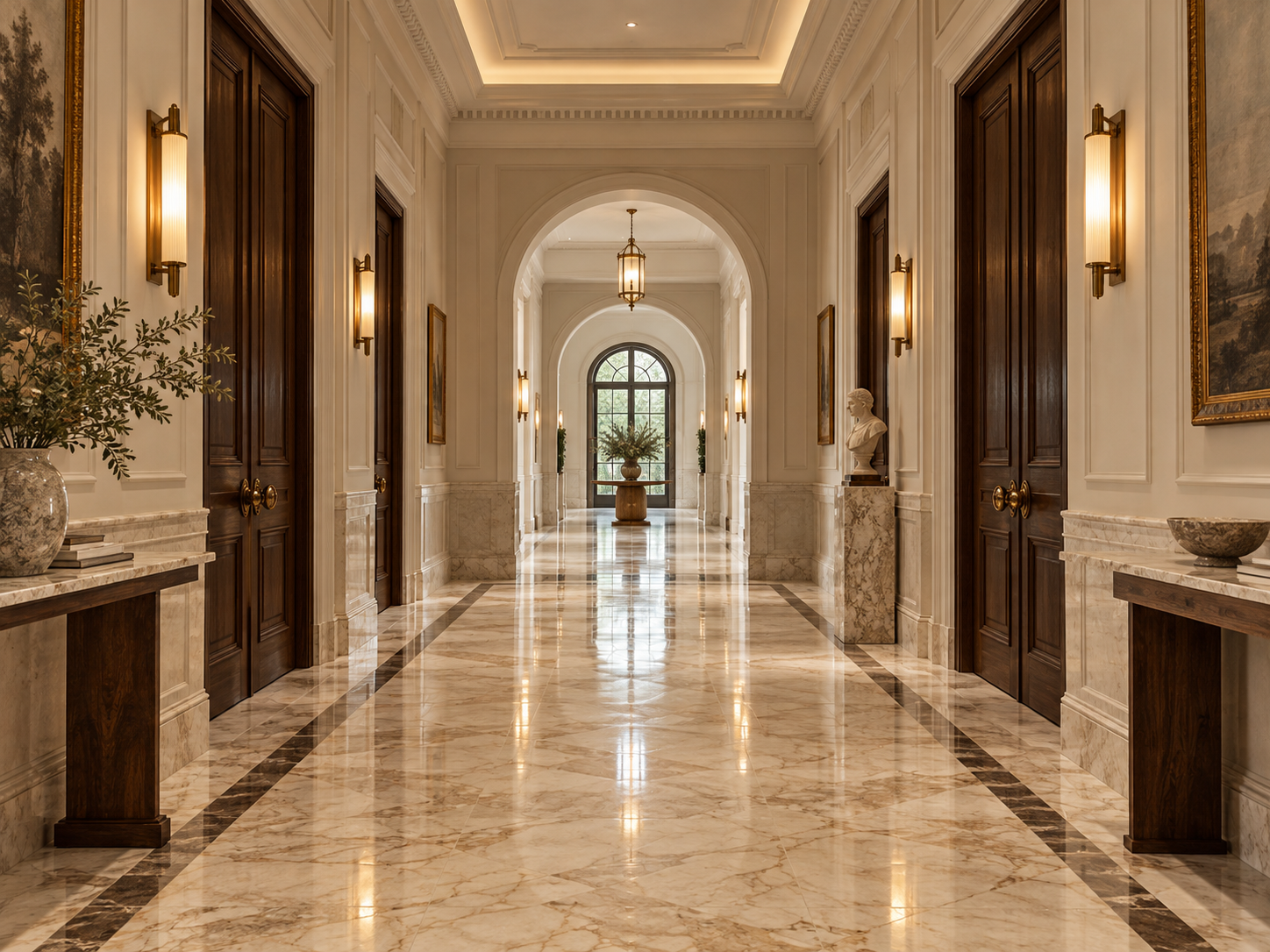
11 · Set the floor’s rhythm
Borders change the interior language.
A marble floor without a border often feels cleaner and more contemporary. A perimeter band, darker inlay, patterned centre or decorative transition can make the floor feel more formal or classical by establishing a frame and a deliberate centre.
Borders are not outdated by definition. Their width, contrast, material and alignment need to suit the architecture and the room scale. One well-proportioned detail can look more refined than several competing patterns.
12 · Fabrication has a design voice
Edge profiles matter as much as the stone.
Modern interiors often work well with square edges, small chamfers and clean mitres. Classical rooms can support rounded edges, more substantial profiles and decorative moulded details. The same slab can therefore shift in character through fabrication alone.
13 · Modern material pairings
Modern marble and wood combinations.
| Marble + wood | Effect | Design note |
|---|---|---|
| Statuario + walnut | High contrast | Let the marble or walnut lead; keep other patterns quiet. |
| Venatino + light oak | Soft contemporary | Fine veins and pale grain create a calm field. |
| Botticino + pale oak | Warm modern | Simple joints and clean detailing prevent a traditional read. |
| Vietnam White + warm oak | Bright but balanced | Warm timber softens the light stone. |
14 · Classical material pairings
Classical marble and wood combinations.
| Marble + wood | Effect | Design note |
|---|---|---|
| Botticino + walnut | Warm and timeless | Use brass and formal detailing with restraint. |
| Brescia Aurora + dark walnut | Rich and layered | Keep fabrics lighter to preserve separation. |
| Statuario + dark wood | Formal contrast | Symmetry and framing make the statement feel intentional. |
15 · Coordinate the accent finish
Metal choice changes the mood.
| Metal | Modern interior | Classical interior |
|---|---|---|
| Black | Excellent | Limited or highly selective |
| Brushed nickel | Excellent | Good |
| Dark bronze | Excellent | Excellent |
| Brass | Good as an accent | Excellent |
| Antique brass | Limited | Excellent |
These are starting points, not rules. Choose metal alongside the marble, timber and fabric so its temperature and reflectivity support the full palette.
16 · Reveal the geometry
Lighting in modern interiors.
Modern schemes often use concealed linear lighting, recessed spots, wall washing and indirect sources. They emphasise surface, geometry and slab continuity, keeping the fixtures themselves visually quiet. Grazing light across highly polished marble can make surface variation, tiny undulations and reflections more visible, so review the selected finish under the intended lighting.
17 · Layer warmth and atmosphere
Lighting in classical interiors.
Classical rooms may combine chandeliers, sconces, decorative fixtures and warmer colour temperatures. This can make beige stone richer, brass warmer and wood deeper. The effect depends on the fixture position and light output: too much amber can make a warm palette look yellow and merge distinctions between materials.
The same marble can feel different in the morning and evening. Review it under both daylight and the planned decorative lighting.
18 · Keep the broad plane composed
Modern floors should usually feel quiet.
Modern architecture may already contain strong geometry, large glass, open spaces and clean furniture. A busy floor can fight with that language, especially when it spans a large connected area. Botticino, Venatino, Vietnam White or controlled Brescia Aurora can provide a quieter foundation.
“Quiet” does not mean featureless. It means the movement, joint pattern and scale work with the architecture rather than competing with it.
19 · Give the floor structure
Classical floors can carry more structure.
Classical flooring can accommodate borders, framing, stronger pattern and richer material changes. A central field and one well-designed perimeter border can reinforce symmetry and give the room a formal order.
More pattern is not automatically more luxurious. Coordinate the border with door axes, furniture placement and the room’s proportions; avoid layering unrelated motifs that compete with wall mouldings and furniture.
20 · Change the framing
Feature walls work in both styles.
In a modern interior, use a large slab, minimal joints, a simple surrounding wall and concealed lighting. In a classical interior, compose the slab symmetrically and frame it with mouldings, brass or established architectural lines. In both cases, the stone should have a defined boundary and a clear role.
The same material can feel quiet or formal depending on how it is framed. Plan the panel layout and vein alignment before fabrication.
21 · Let the stone carry the interest
Modern bathroom direction.
Venatino or Statuario can work with a simple vanity, clear glass, concealed lighting and minimal metal. Venatino keeps the room calmer; Statuario creates a stronger focal point. Keep the vanity and fittings visually simple if the marble wall is expressive.
Choose the finish and detailing for the room’s actual use as well as its appearance, and consider how joints, edges and transitions will appear in the compact space.
22 · Make the marble part of a composition
Classical bathroom direction.
Botticino or Statuario can be paired with a framed mirror, warmer metal, a detailed vanity and layered lighting. Botticino tends toward warm continuity; Statuario supplies formal contrast. The marble becomes part of a richer composition rather than the only decorative element.
Use one or two clear focal details—such as a framed mirror and stone wall—and allow other surfaces to remain quieter.
23 · Treat the stair as architecture
Staircase style matrix.
| Element | Modern direction | Classical direction |
|---|---|---|
| Treads | Long and uninterrupted | Formal proportions |
| Nosing | Minimal, clean edge | More detailed if appropriate |
| Railing | Glass or thin metal | Brass, wrought metal or timber |
| Marble | Quiet field or one statement | Warm tone or formal composition |
| Lighting | Concealed | Decorative and layered |
Whichever direction you choose, check usable slab length, vein direction, tread and riser dimensions, nosing detail and fabrication tolerances. Avoid over-decoration: a staircase has strong geometry before any finish is added.
24 · Minimalism exposes decisions
Modern interiors need more precision.
When an interior has fewer details, small mistakes become more visible. You notice joints, edge alignment, slab transitions, polish and symmetry because there is less ornament to distract the eye. Minimalism hides very little; a “simple” marble interior can therefore demand especially careful measurement, layout and fabrication.
Review the dry layout and transitions before installation, not only the individual slab. Consistent joints and crisp edges are part of the design language.
25 · Richness needs editing
Classical interiors need more control.
Classical rooms contain more potential elements, so the challenge is preventing too many borders, marble colours, gold accents, heavy furniture and wall details from competing simultaneously. Classical luxury still requires restraint and a clear visual order.
Choose the dominant feature first. Then reduce or simplify any secondary detail that repeats the same role.
26 · Let the architecture lead
How to choose between modern and classical direction.
Answer a short sequence of questions before selecting the slab: Are the spaces open and clean-lined or formal and symmetrical? Is the furniture minimal or decorative? Does pale oak or rich walnut suit the room? Should the metal be black or bronze, or brass? Will marble act as a background or a statement?
Once those answers are clear, the stone selection becomes easier—and the same marble can be detailed to suit a modern, classical or transitional interior.
27 · Challenge the colour shortcut
Modern does not mean white.
A warm Botticino floor with large pieces, light oak, clean walls and black accents can look extremely contemporary. The style comes from scale, joints, geometry, contrast and detailing—not from choosing a white stone by default.
Warmth can make modern architecture more welcoming and distinct. The important thing is to keep the palette edited and the stone layout aligned with the room.
28 · Let composition define the style
Classical does not mean beige.
Statuario can look highly classical when used with symmetry, dark wood, brass and decorative architectural framing. A white stone is not locked into a modern language any more than Botticino is locked into a traditional one.
Style is created by composition: framing, proportion, material relationships, furniture and lighting. Choose the slab for its role in the project, not for a label.
29 · Combine with intention
Transitional interiors are often the most interesting.
Many current luxury homes combine modern furniture, classical proportions, warm materials and minimal marble detailing. Rather than forcing the room into one strict category, give each layer a clear role and let the balance between them feel natural.
30 · Diagnose before adding
Common mistakes—and a final style scorecard.
- Choosing by style labels alone: no marble belongs exclusively to one style.
- Using white everywhere to make a room “modern”: the result can feel cold or generic.
- Adding borders everywhere to make a room “classical”: the floor can become visually heavy.
- Mixing too many stone varieties: it weakens the hierarchy in both modern and classical rooms.
- Ignoring edge details: fabrication has a strong effect on style.
- Choosing furniture after the marble without coordination: the materials may clash.
- Using the same lighting for every stone: tone and surface appearance change with the light.
| Question | Modern direction | Classical direction |
|---|---|---|
| Prefer cleaner surfaces? | Strong fit | Possible |
| Prefer richer layering? | Use selectively | Strong fit |
| Large uninterrupted pieces? | Strong fit | Can work |
| Decorative borders? | Use sparingly | Can suit the architecture |
| Minimal edge profiles? | Strong fit | Possible |
| Warm brass details? | Accent use | Strong fit |
| Black / bronze accents? | Strong fit | Can work |
| Dramatic slab as one focal point? | Strong fit | Strong fit |
| Multiple decorative materials? | Limited | Possible with hierarchy |
| Strong symmetry? | Possible | Strong fit |
Fratelli Singh selection approach
Select the slab for the project’s interior language.
Instead of categorising a slab as simply “modern” or “classical,” evaluate the architecture, application, finished piece size, vein strength, joint pattern, edge detail, wood, metal and lighting. The same marble can be selected and detailed very differently depending on the intended interior language.
The important question is not “Is this a modern marble?” It is: “How should this particular slab be used to make the project feel modern, classical or somewhere between the two?”
Clear answers
Frequently asked questions.
Does white marble always look modern and beige marble classical?
No. Colour alone does not determine style. Piece size, joints, edges, furniture, lighting, wood and the surrounding architecture change how the same marble reads.
Can Botticino look modern?
Yes. Large pieces, minimal joints, clean skirting, pale oak or restrained walnut, simple furniture and architectural lighting can make Botticino feel contemporary.
Can Statuario work in classical interiors?
Yes. Symmetry, darker wood, brass, mouldings and framed architecture can give Statuario a formal classical role.
Which marble is best for modern interiors?
Botticino, Statuario, Venatino, Vietnam White, Brescia Aurora and Marmi Crema can all work. Choose by the room’s palette, the slab’s movement and whether the stone is a background or statement.
Do modern interiors require large marble slabs?
Not always. Larger pieces can create a calmer, more continuous field, but format should suit the room, slab dimensions, installation access and intended layout.
Are marble floor borders outdated?
No. Borders can suit a project when their scale, contrast and detailing relate to the architecture. A single considered border is often more refined than several competing patterns.
What metal finishes suit modern and classical marble interiors?
Black, brushed nickel and dark bronze often support modern schemes. Brass and antique brass can enrich classical palettes, while bronze can work in both.
Can modern and classical interior styles be mixed?
Yes. Transitional interiors often combine clean furniture with classical proportions, warm materials and restrained marble detailing.
How should I choose the exact marble slab?
Review the full slab with the architecture, intended cuts, wood and metal samples, lighting and desired vein intensity before approval.
Developing an interior palette?
Compare the full slab with your architecture, furniture, wood and metal samples. Fratelli Singh can help you review tone, movement and detailing for the intended style.
Request assistance ↗